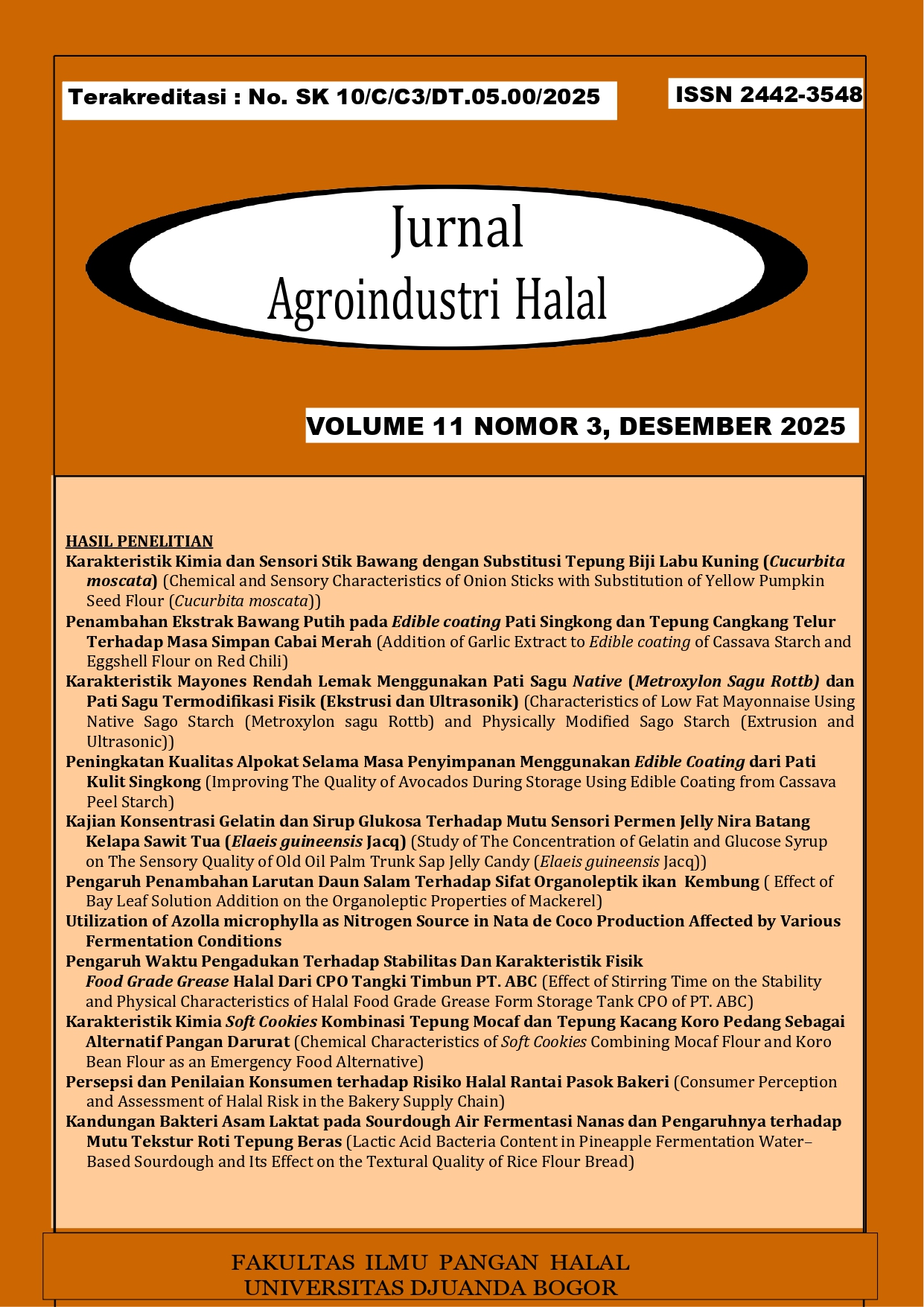
Karakteristik Mayones Rendah Lemak Menggunakan Pati Sagu Native (Metroxylon Sagu Rottb) dan Pati Sagu Termodifikasi Fisik (Ekstrusi dan Ultrasonik)
DOI:
https://doi.org/10.30997/jah.v11i3.20976Keywords:
Pati sagu, pati termodifikasi, karakteristik mayones, rendah lemakAbstract
Tujuan dari penelitian ini adalah upaya diversifikasi produk mayones dengan menurunkan kadar lemak menggunakan pati sagu sehingga didapatkan mayones rendah lemak. Pati termodifikasi secara fisik ini dapat digunakan dalam berbagai produk makanan sebagai pengganti lemak. Analisis fisikokimia, mikrobiologi, PSA (Particle Size Analyzer) dan hedonik. dilakukan untuk mengetahui pengaruh perlakuan jenis pati sagu terhadap karakteristik mayones rendah lemak. Penelitian ini menggunakan metode Rancangan Acak Lengkap (RAL) satu faktor. Faktor perlakuannya adalah MPN, MPE, dan MPU. Hasil analisis fisikokimia mayones rendah lemak pada karakteristik kestabilan emulsi, viskositas, uji warna L a* b* menunjukkan hasil yang berpengaruh. Namun, tidak berpengaruh pada nilai pH. Hasil analisis mikrobiologi mayones rendah lemak pada uji Salmonella sp. menunjukkan hasil yaitu negatif koloni/25 gram, sesuai dengan standar yang SNI No.01- 4473-1998 yaitu tidak adanya kandungan mikroorganisme Salmonella sp. Hasil analisis PSA didapatkan nilai Z-Average yang berpengaruh, sedangkan nilai PdI tidak berpengaruh. Hasil uji mutu hedonik mayones rendah lemak pada karakteristik warna, aroma, rasa, tekstur, kekentalan, dan penerimaan umum menunjukkan hasil yang tidak berpengaruh. Studi ini menunjukkan potensi yang baik dari pati sagu untuk digunakan sebagai pengganti lemak dalam mayones dengan produk terpilih yaitu MPU.
References
Abedi-Firoozjah, R., Azadinejad, H., Hosseini, A., Afrah, A., & Abdolmaleki, K. (2025). Potential of fat replacers to develop low/reduced-fat mayonnaise and salad dressing systems: An updated review. Current Nutrition & Food Science, 21(2), 156–178. https://doi.org/10.2174/0115734013306923240607074032
Ahmad, F. B., Williams, P. A., Doublier, J.-L., Durand, S., & Buleon, A. (2020). Physicochemical characterization of sago starch. Carbohydrate Polymers, 229, 115421. https://doi.org/10.1016/j.carbpol.2019.115421
Ashwar, B. A., Gani, A., Shah, A., Wani, I. A., & Masoodi, F. A. (2021). Ultrasound treatment of starch: A review on physicochemical and functional modifications. Carbohydrate Polymers, 259, 117740. https://doi.org/10.1016/j.carbpol.2021.117740
Badan Pengawas Obat dan Makanan Republik Indonesia. (2020). Persyaratan keamanan pangan olahan.
Badan Standardisasi Nasional. (1998). SNI 01-4473-1998: Mayones.
Codex Alimentarius Commission. (2022). General standard for contaminants and toxins in food and feed (CXS 193-1995). FAO/WHO.
Dickinson, E. (2020). Strategies to control and enhance the stability of emulsions in food systems. Food Hydrocolloids, 102, 105414. https://doi.org/10.1016/j.foodhyd.2019.105414
El-Bostany, A., Nahla, A. M., Gaafar, & Salem, A. A. (2011). Development of light mayonnaise formula using carbohydrate-based fat replacement. Australian Journal of Basic and Applied Sciences, 5(9), 673–682.
European Food Safety Authority. (2010). Scientific opinion on dietary reference values for fats. EFSA Journal, 8(3), 1461. https://doi.org/10.2903/j.efsa.2010.1461
Fadillah, U., Dirpan, A., & Syarifuddin, A. (2024). Fat replacers in food system: A focus on ingredients, fabrication methods, and applications in food products. Future Foods, 10, 100490. https://doi.org/10.1016/j.fufo.2024.100490
Food and Drug Administration. (2015). Food labeling: Nutrient content claims, definition for “fat free” (21 CFR § 101.62).
Frost, R. L., Xi, Y., & Martens, W. (2016). Starch-based emulsions: Structure, interactions and applications. Carbohydrate Polymers, 147, 83–94. https://doi.org/10.1016/j.carbpol.2016.03.094
Ghazaei, S., Mizani, M., Piravi-Vanak, Z., & Alimi, M. (2015). Particle size and cholesterol content of a mayonnaise formulated by OSA-modified potato starch. Food Science and Technology (Campinas), 35(1), 152–157. https://doi.org/10.1590/1678-457X.6485
Hunt, K., Espinosa, Y. G., & Morales, R. (2021). Influence of emulsion droplet size on optical properties and consumer perception of reduced-fat mayonnaise. Food Hydrocolloids, 118, 106775. https://doi.org/10.1016/j.foodhyd.2021.106775
Laca, A., Sáenz, M. C., Paredes, B., & Díaz, M. (2010). Rheological properties, stability and sensory evaluation of low-fat mayonnaise prepared with protein-based fat replacers. Journal of Food Engineering, 98(3), 379–385. https://doi.org/10.1016/j.jfoodeng.2010.01.008
Lawless, H. T., & Heymann, H. (2010). Sensory evaluation of food: Principles and practices (2nd ed.). Springer. https://doi.org/10.1007/978-1-4419-6488-5
Liu, H., Xie, F., Yu, L., Chen, L., & Li, L. (2019). Thermal processing of starch-based polymers. Progress in Polymer Science, 93, 1–32. https://doi.org/10.1016/j.progpolymsci.2019.03.001
Liu, K., Zhang, Q., & Wang, H. (2021). Effect of extrusion on physicochemical properties of starches and its applications in food systems. Food Hydrocolloids, 111, 106203. https://doi.org/10.1016/j.foodhyd.2020.106203
Ma, Z., & Boye, J. I. (2018). Advances in the design and production of reduced-fat and low-fat food products. Food Research International, 111, 41–52. https://doi.org/10.1016/j.foodres.2018.05.021
Martínez, M. M., Calviño, A., Rosell, C. M., & Gómez, M. (2018). Effect of different extrusion treatments on the physicochemical properties of starches. Food Hydrocolloids, 75, 261–270. https://doi.org/10.1016/j.foodhyd.2017.09.003
Meilgaard, M., Civille, G. V., & Carr, B. T. (2007). Sensory evaluation techniques (4th ed.). CRC Press. https://doi.org/10.1201/9781420009615
Mun, S., Kim, Y. L., Kang, C. G., Park, K. H., Shim, J. Y., & Kim, Y. R. (2009). Development of reduced-fat mayonnaise using 4αGTase-modified rice starch and xanthan gum. International Journal of Biological Macromolecules, 44(5), 400–407. https://doi.org/10.1016/j.ijbiomac.2009.02.009
Ojo, M. O., Ariahu, C. C., & Chinma, C. E. (2020). Effect of ultrasonication on the properties of starch-based food systems: A review. Food Hydrocolloids, 108, 106061. https://doi.org/10.1016/j.foodhyd.2020.106061
Pedro, A. S., Rodrigues, L. R., & Pereira, R. N. (2020). Inulin as fat replacer in mayonnaise: Impact on rheology and sensory properties. LWT – Food Science and Technology, 131, 109746. https://doi.org/10.1016/j.lwt.2020.109746
Rahbari, M., Ghorbani, M., & Fadavi, G. (2022). Fat-free mayonnaise production using protein-polysaccharide complexes: A review. Food Reviews International, 38(4), 739–760. https://doi.org/10.1080/87559129.2021.1897036
Rawle, A. (2010). Basic principles of particle size analysis (Technical paper). Malvern Instruments.
Resurreccion, A. V. A. (2018). Sensory aspects of food quality and safety. Elsevier. https://doi.org/10.1016/C2016-0-04428-4
Rizki, M. (2017). Daya serap air dan profil gelatinisasi tepung jagung termodifikasi metode ekstruder ulir tunggal [Skripsi, Institut Pertanian Bogor].
Sajilata, M. G., & Singhal, R. S. (2005). Specialty starches for snack foods. Carbohydrate Polymers, 59(2), 131–151. https://doi.org/10.1016/j.carbpol.2004.08.012
Sapper, M., & Wilke, M. (2022). Role of polysaccharides in improving food quality and safety. Food Hydrocolloids, 129, 107632. https://doi.org/10.1016/j.foodhyd.2022.107632
Sharma, A., Jaiswal, A. K., & Jaiswal, S. (2020). Antimicrobial properties of polysaccharides: Food and biomedical perspective. Trends in Food Science & Technology, 99, 21–33. https://doi.org/10.1016/j.tifs.2020.02.017
Singhal, R. S., Kennedy, J. F., Gopalakrishnan, S. M., Kaczmarek, A., Knill, C. J., & Akmar, P. F. (2008). Industrial production, processing, and utilization of sago palm-derived products. Carbohydrate Polymers, 72(1), 1–20. https://doi.org/10.1016/j.carbpol.2007.07.043
Stone, H., & Sidel, J. L. (2004). Sensory evaluation practices (3rd ed.). Academic Press. https://doi.org/10.1016/B978-012672690-9/50000-7
Subroto, E., Pratama, F., & Putri, D. (2021). Konsumsi lemak jenuh, obesitas, dan risiko penyakit degeneratif. Indonesian Journal of Human Nutrition, 8(2), 101–112. https://doi.org/10.21776/ub.ijhn.2021.008.02.7
Tang, C. H., Zhang, Y., & Li, H. (2018). Influence of starch modification on emulsion stability and particle size distribution. Food Research International, 108, 258–266. https://doi.org/10.1016/j.foodres.2018.03.050
Tekin, A., Karasu, S., & Karaman, S. (2020). Reduced-fat mayonnaise production using dietary fibers: Rheological, microstructural and sensory properties. Journal of Food Measurement and Characterization, 14(5), 2589–2601. https://doi.org/10.1007/s11694-020-00498-6
Tethool, E. F., Raharjo, S., Pranoto, Y., & Supriyadi, S. (2025). Investigation of pregelatinized sago starch–decanoic acid complex by ultrasonication and its potential to stabilize oil-in-water emulsion. Trends in Sciences, 22(3), 9241. https://doi.org/10.48048/tis.2025.9241
Winuprasith, T., & Suphantharika, M. (2016). Properties and stability of oil-in-water emulsions stabilized by pregelatinized sago starch and its hydrolyzates. Journal of Food Engineering, 175, 94–102. https://doi.org/10.1016/j.jfoodeng.2015.12.002
Downloads
Published
How to Cite
Issue
Section
License
Copyright (c) 2025 Amelia Nurlaelasari Sari, Agus Budiyanto, E. Y. Purwani, Lia Amalia, Aminullah

This work is licensed under a Creative Commons Attribution-ShareAlike 4.0 International License.
Authors who publish with Jurnal Agroindustri Halal agree to the following terms:
- Authors retain copyright and grant the journal right of first publication with the work simultaneously licensed under a Creative Commons Attribution 4.0 International License that allows others to share the work with an acknowledgement of the work's authorship and initial publication in Jurnal Agroindustri Halal.
- Authors are able to enter into separate, additional contractual arrangements for the non-exclusive distribution of the journal's published version of the work (e.g., post it to an institutional repository or publish it in a book), with an acknowledgement of its initial publication in Jurnal Agroindustri Halal.
- Authors are permitted and encouraged to post their work online (e.g., in institutional repositories or on their website) prior to and during the submission process, as it can lead to productive exchanges, as well as earlier and greater citation of published work