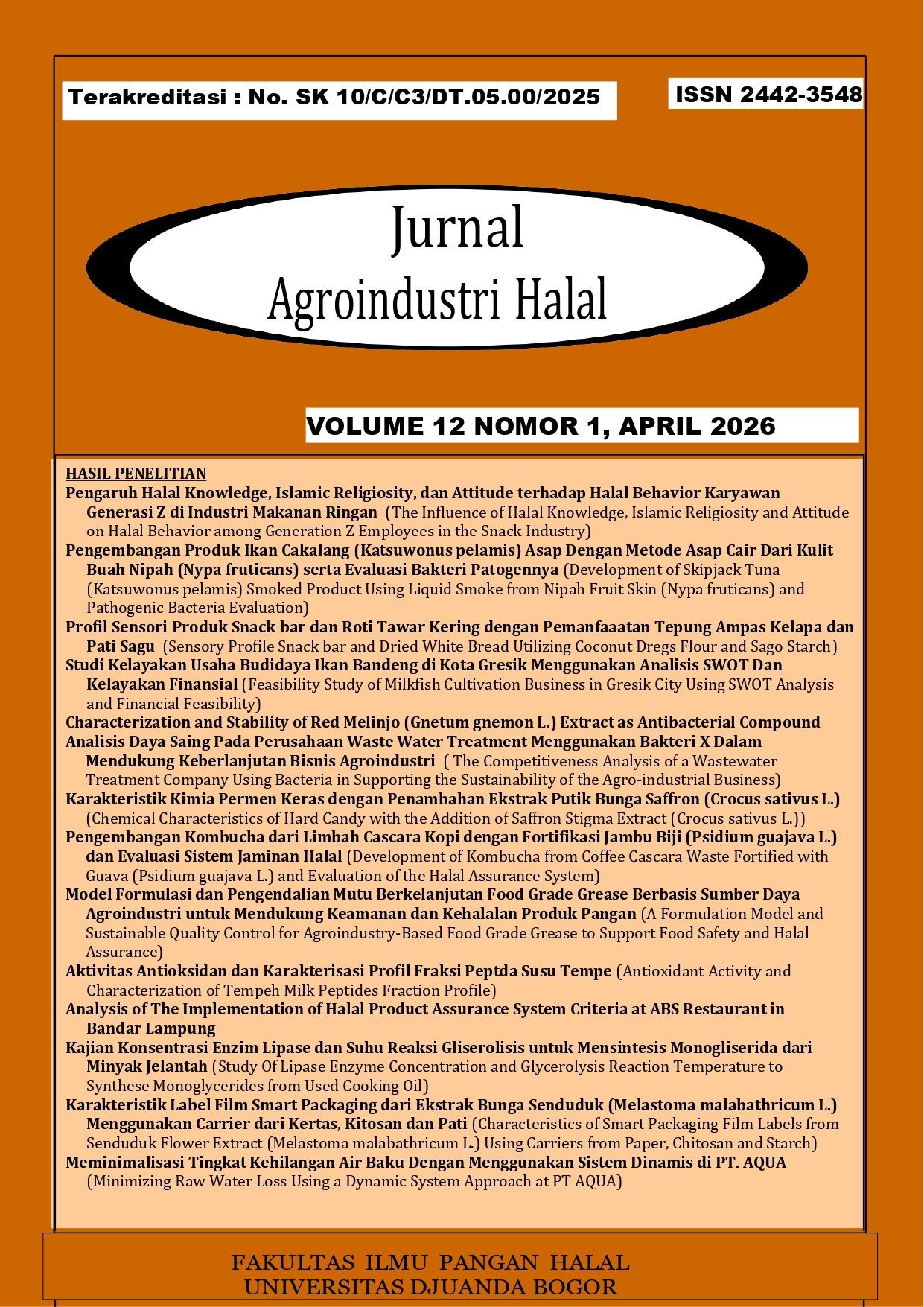
Meminimalisasi Tingkat Kehilangan Air Baku Dengan Menggunakan Sistem Dinamis di PT. AQUA
DOI:
https://doi.org/10.30997/jah.v12i1.10449Keywords:
sistem dinamis, air minum dalam kemasan, non-revenue water, efisiensi produksi, skenario simulasiAbstract
AMDK is processed raw water that is safely packaged for human consumption, including mineral and demineralized water. However, there are still several issues in the provision of AMDK, with the main problem being water loss, also known as Non-Revenue Water (NRW). This study aims to identify the contributing factors to AMDK loss at PT. AQUA and to analyze and explain the dynamic system model involved. The method applied in this research is a dynamic system approach, used to design, depict, and simulate a system that changes over time. The interactions among variables in this structure are then translated into mathematical models and simulated using Powersim software to trace their developments over time. The findings of this study indicate that there are variables causing water loss, and these variables fall into three subsystems. Alternative scenarios, namely the moderate, optimistic, and pessimistic scenarios, are developed over a period of ten years to reduce water loss. By examining the results of these three scenarios, the company can implement these alternatives to minimize water rejection, thus reducing water loss and enhancing operational efficiency.
References
Agung, G. D. (2020). Pemodelan Sistem Dinamis Produksi Tempe “Sumber Mas” Di Kabupaten Jember. 64. Https://Sipora.Polije.Ac.Id/Id/Eprint/2914
Aini, S. (2019). Peran Pemerintah Desa Dalam Penyediaan Air Bersih Pada Masyarakat Pesisir Lombok Timur. Sosio Edukasi Jurnal Studi Masyarakat Dan Pendidikan, 3(1), 22–27. Https://Doi.Org/10.29408/Sosedu.V3i1.3511
Aminudin, M., Mahbubi, A. & Puspita Sari, R. A. (2014). Simulasi Model Sistem Dinamis Rantai Pasok Kentang Dalam Upaya Ketahanan Pangan Nasional. Agribusiness Journal, 8(1), 1–14. Https://Doi.Org/10.15408/Aj.V8i1.5125
Beratha, I. M. I., Eryani, I. G. A. P. & Sinarta, I. N. (2020). Evaluasi Kehilangan Air Pada Sistem Distribusi Perumda Air Minum Tirta Mangutama Wilayah Pelayanan Kuta Dengan Metode Steptest. 62(1), 538–549.
Deas, R. & Rusdi, R. (2021). Pt Air Mineral Amanah Insanillahia Kecamatan Limakaum Kabupaten Tanah Datar Tahun 1998-2020. Jurnal Kronologi, 3(4), 317–335. Https://Doi.Org/10.24036/Jk.V3i4.342
E. Wirijadinata, J. & Afriany, D. (2017). Analisis Peningkatan Kualitas Pelayanan Izin Usaha Perdagangan Dengan Menggunakan Causal Loop Diagram (Cld). Jurnal Ilmu Administrasi: Media Pengembangan Ilmu Dan Praktek Administrasi, 14(2), 151–166. Https://Doi.Org/10.31113/Jia.V14i2.110
Elmadhania, A. (2017). Optimalisasi Beban Kerja Petugas Keamanan Berdasarkan Standar Tingkat Keamanan (Studi Kasus: Satuan Keamanan Dan Keselamatan Its) [Institut Teknologi Sepuluh Nopember]. In Bmc Public Health (Vol. 5, Issue 1).
Hidayat, T. (2011). Pemodelan Dinamik Analisis Investasi Untuk Meminimisasi Tingkat Kehilangan Air ( Studi Kasus Di Pdam Kota Tegal ). Seminar Nasional Sains Dan Teknologi Ke-2 Tahun 2011 Fakultas Teknik Universitas Wahid Hasyim Semarang, 82–87.
Salim, M. A. (2019). Analisis Kebutuhan Dan Ketersediaan Air Bersih ( Studi Kasus Kecamatan Bekasi Utara ). [Skripsi, Universitas Islam Negeri Syarif Hidayatullah].
Sari, Y. & Situmorang, N. (2020). Pengaruh Jarak Kandang Ternak Terhadap Total Coliform Pada Air Sumur Gali Di Desa Klambir. Biolink (Jurnal Biologi Lingkungan Industri Kesehatan), 6(2), 186–195. Https://Doi.Org/10.31289/Biolink.V6i2.2470
Downloads
Published
How to Cite
Issue
Section
License
Copyright (c) 2026 Delfitriani Delfitriani, Fadia Wardatul Jannah, Ahmad Syarbaini

This work is licensed under a Creative Commons Attribution-ShareAlike 4.0 International License.
Authors who publish with Jurnal Agroindustri Halal agree to the following terms:
- Authors retain copyright and grant the journal right of first publication with the work simultaneously licensed under a Creative Commons Attribution 4.0 International License that allows others to share the work with an acknowledgement of the work's authorship and initial publication in Jurnal Agroindustri Halal.
- Authors are able to enter into separate, additional contractual arrangements for the non-exclusive distribution of the journal's published version of the work (e.g., post it to an institutional repository or publish it in a book), with an acknowledgement of its initial publication in Jurnal Agroindustri Halal.
- Authors are permitted and encouraged to post their work online (e.g., in institutional repositories or on their website) prior to and during the submission process, as it can lead to productive exchanges, as well as earlier and greater citation of published work