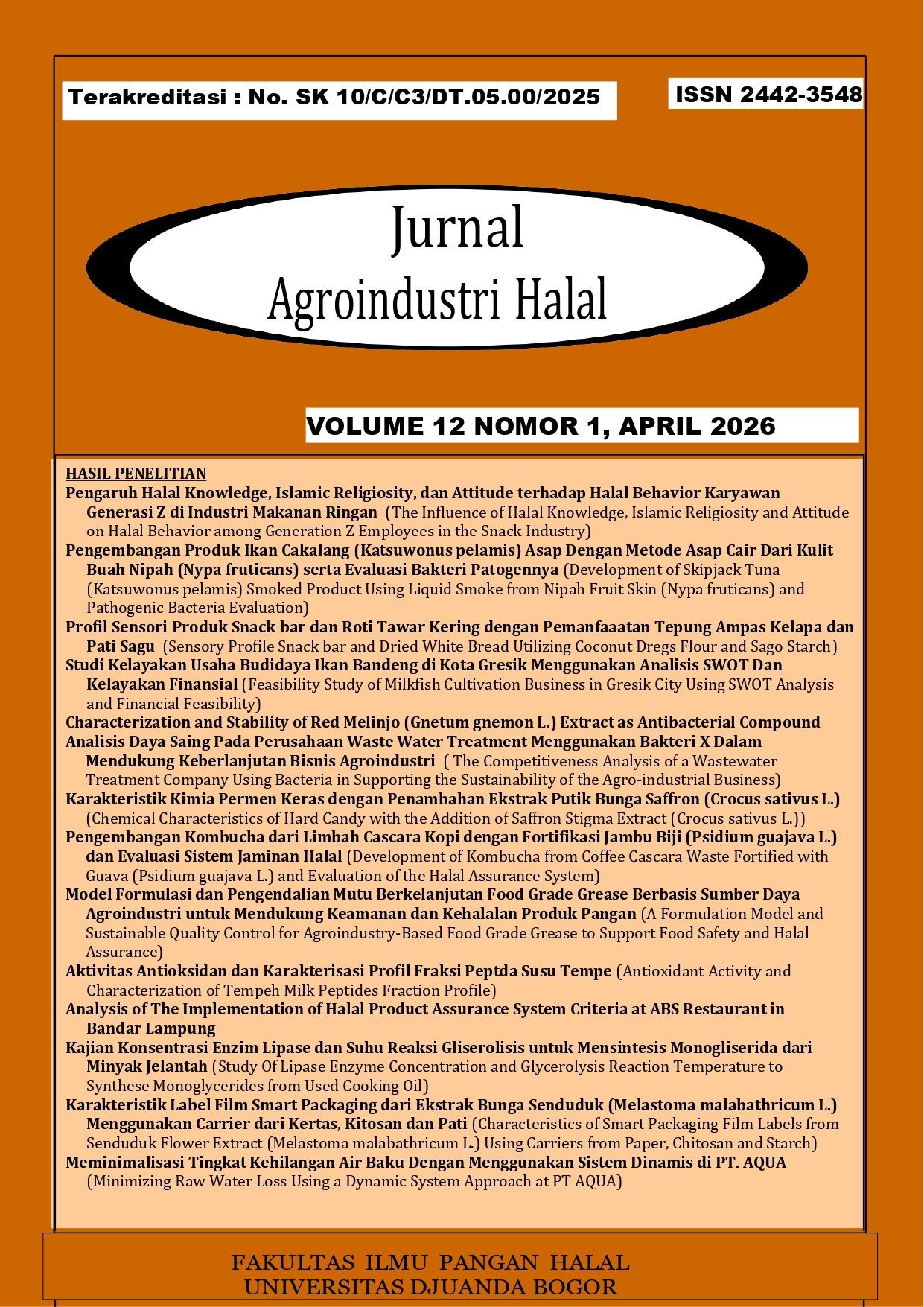
Aktivitas Antioksidan dan Karakterisasi Profil Fraksi Peptida Susu Tempe
DOI:
https://doi.org/10.30997/jah.v12i1.24360Keywords:
antioksidan, fraksi ultrafiltrasi, peptida bioaktif, tempeAbstract
Tempe dapat dimanfaatkan dalam pembuatan produk minuman olahraga untuk pemulihan kondisi tubuh pasca olahraga. Namun, penelitian mengenai minuman olahraga tersebut masih belum diketahui secara lebih lanjut mengenai fraksi yang memiliki aktivitas antioksidan terbaik. Fraksinaksi dilakukan untuk memisahkan peptida berdasarkan berat molekul, memurnikan, dan mengkonsentrasikan. Maka dari itu penelitian ini memiliki tujuan yaitu memisahkan peptida menjadi fraksi-fraksi, menguji konsentrasi protein dan berat molekul dari fraksi-fraksi yang diperoleh, membandingkan nilai aktivitas antioksidan dengan metode DPPH dan ABTS dari fraksi peptida, dan menentukan nilai IC50 dari fraksi peptida yang memiliki aktivitas antioksidan terbaik. Proses fraksinasi dilakukan terhadap sampel dengan aktivitas antioksidan terbaik yaitu hidrolisis selama 3 jam dengan enzim bromelain. Hasil fraksinasi peptida didapatkan 4 fraksi dengan nilai konsentrasi tertinggi pada fraksi >300 kDa sebesar 62,1 mg/mL. Pada analisis berat molekul, peptida hidrolisat 3 jam membentuk 5 band sedangkan fraksi-fraksinya membentuk 1-4 band. Aktivitas antioksidan terbaik ditunjukkan pada fraksi <5 kDa metode DPPH sebesar 2,9%/mg protein dan ABTS sebesar 3%/mg protein. Nilai IC50 dari kedua metode ini menunjukkan fraksi peptida tergolong dalam aktivitas antioksidan lemah.
References
Agustina, R. K., Dieny, F.F., Rustanti, N., Anjani, G., & Afifah, D. N. (2018). Antioxidant activity and soluble protein content of tempeh gembus hydrolysate. Hiroshima Journal of Medical Sciences, 67, 1-7.
Deepachandi, B., Weerasinghe, S., Andrahennadi, T. P., Karunaweera, N. D., Wickramaranchi, N., Soysa, P., & Siriwardana, Y. (2020). Quantification of soluble or insoluble fractions of leishmania parasite. proteins in microvolume applications: a simplification to standard lowry assay. International Journal of Analytical Chemistry ,1-8. DOI: 10.1155/2020/6129132.
Dong, Z., Tian, G., Xu, Z., Li, M., Xu, M., Zhou, Y., & Ren, H. (2017). Antioxidant activities of peptide fractions derived from freshwater mussel protein using ultrasound-assisted enzymatic hydrolysis. Czech Journal of Food Scencesi, 35(4), 328-338. DOI: 10.17221/421/2016-CJFS.
Fadel, M., Wyart, Y., & Moulin, P. (2020). An efficient method to determine membrane molecular weight cut-off using fluorescent silica nanoparticles. Membranes, 10(10), 1-14. DOI: 10.3390/membranes10100271.
Ghribi, A.M., Gafsi, I. M., Sila, A., Blecker, C., Danthine, S., Attia, H., Bougatef, A., & Besbes, S. (2015). Effects of enzymatic hydrolysis on conformational and functional properties of chickpea protein isolate. Food Chemistry, 187, 322-330. DOI: 10.1016/j.foodchem.2015.04.109.
Hassanein, T. R., Prabawati, E. K., Puspitasari, M. D., & Gunawan-Puteri, M. D. P. T. (2015). Analysis of chemical and microbial changes during storage of overripe tempeh powder as seasoning material. International Journal of Science Engineering, 8(2), 131-134. DOI: 10.12777/ijse.8.2.131-134.
Jauhari, M., Sulaeman, A., Riyadi, H., & Ekayantim I. (2014). Pengembangan formula minuman olahraga berbasis tempe untuk pemulihan kerusakan otot. Agritech, 34(3), 285-290. DOI: 10.22146/agritech.9456.
Jiang, S., Liu, S., Zhao, C., & Wu, C. (2016). Developing protocols of tricine-sds-page for separation of polypeptides in the mass range 1-30 kDa with minigel electrophoresis system. Intetnational Journal of Electrochemical Science, 11, 640-649. https://doi.org/10.1016/S1452-3981(23)15870-6
Khanifah, F. (2018). Analisis kadar protein total pada tempe fermentasi dengan penambahan ekstrak nanas (Ananascomosus (L.) Merr). Jurnal Nutrisia, 20(1), 34-37.
Kim, J. M., Liceaga, A. M., & Yoon, K. Y. (2019). Purification and identification of an antioxidant peptide from perilla seed (Perilla frutescens) meal protein hydrolysate. Food Science & Nutrition, 7, 1645-1655. DOI:doi.org/10.1002/fsn3.998.
Lestari, D., Evan, J., S & uhartono, M. T. (2020). Fraksi peptida antioksidan dari kasein susu kambing. Jurnal Teknologi dan Industri Pangan, 3(2), 188-196. DOI:10.6066/jtip.2020.31.2.188.
Matuszewska, A., Jaszek, M., Stefaniuk, D., Ciszewski, T., & Matuszewski, L. (2018). Anticancer, antioxidant, and antibacterial activities of low molecular weight bioactive subfractions isolated from cultures of wood degrading fungus Cerrena unicolor. Plos One, 13(6), 1-14. DOI: 10.1371/journal.pone.0197044.
Mohammadi, M., Salami, M., Yarmand, M., Emam-Djomeh, Z., & McClements, D.J. (2022). Production and characterization of functional bakery goods enriched with bioactive peptides obtained from enzymatic hydrolysis of lentil protein. Journal of Food Measurement and Characterization, 16, 3402-3409. DOI: 10.1007/s11694-022-01416-z.
Ng, W. W. (2026). Susu Tempe Sebagai Pangan Fungsional Masa Depan: Tinjauan Potensi Nutrisi, Manfaat Kesehatan, dan Aplikasi Agroindustri. Jurnal Agroindustri Pangan, 5(1): 1-10.
Novianti, Asmariyah, & Suriyati. (2019). Pengaruh Pemberian Susu Tempe Terhadap Kadar Haemoglobin Pada Ibu Hamil Tm III Di Kota Bengkulu. Journal Of Midwifery, 7(1): 23-29.
Phongthai, S., & Rawdkuen, S. (2019). Fractionation and characterization of antioxidant peptides from rice bran protein hydrolysates stimulated by in vitro gastrointestinal digestion. Cereal Chemistry, 97(2), 316-325. DOI: 10.1002/cche.10247
Rusdah, R., Suhartono, M.T., Palupi, N.S., & Ogawa, M. (2017). Tingkat kelarutan tempe dengan bobot molekul kecil pada berbagai jenis pelarut. Agritech, 37(3), 327-333. DOI:10.22146/agritech.10697.
Shahbal, N., Jing, X., Bhandari, B., Dayananda, B., & Prakash, S. (2023). Effect of enzymatic hydrolysis on solubility and surface properties of pea, rice, hemp, and oat proteins: Implication on high protein concentrations. Food Bioscience, 53, 1-34. DOI:10.1016/j.fbio.2023.102515.
Shahi, Z., Sayyed-Alangi, S.Z., & Najafian, L. (2020). Effects of enzyme type and process time on hydrolysis degree, electrophoresis bands and antioxidant properties of hydrolyzed proteins derived from defatted Bunium persicum Bioss. press cake. Heliyon, 6(2),1-10. DOI:10.1016/j.heliyon.2020.e03365.
Sukweenadhi, J., Yunita, O., Setiawan, F., Kartini, Siagian, M.T., Danduru, A.P., & Avanti, C. (2020). Antioxidant activity screening of seven Indonesian herbal extract. Biodiversitas, 21(5), 2062-2067. DOI:10.13057/biodiv/d210532.
Tadesse, S.A., & Emire, S.A. (2020). Production and processing of antioxidant bioactive peptides: A driving force for the functional food market. Heliyon, 6(8), 1-11. DOI:10.1016/j.heliyon.2020.e04765.
Tamam, B., Syah, D., Suhartono, M.T., Kusuma, W.A., Tachibana, & Lioe, H.N. (2019). Proteomic study of bioactive peptides from tempe. Journal of Bioscience and Bioengineering, 128(2): 241-248. DOI:10.1016/j.jbiosc.2019.01.019.
Wahyono, A., Kurniawati, E., Kasutjiningati, Park, K.H., & Kang, W.W. (2018). Optimasi proses pembuatan tepung labu kuning menggunakan response surface methodology untuk meningkatkan aktivitas antioksidannya. Jurnal Teknologi dan Industri Pangan, 29(1), 29-38. DOI:10.6066/jtip.2018.29.1.29.
Downloads
Published
How to Cite
Issue
Section
License
Copyright (c) 2026 Diana Lestari, Rania Kalyana, Dionysius Subali

This work is licensed under a Creative Commons Attribution-ShareAlike 4.0 International License.
Authors who publish with Jurnal Agroindustri Halal agree to the following terms:
- Authors retain copyright and grant the journal right of first publication with the work simultaneously licensed under a Creative Commons Attribution 4.0 International License that allows others to share the work with an acknowledgement of the work's authorship and initial publication in Jurnal Agroindustri Halal.
- Authors are able to enter into separate, additional contractual arrangements for the non-exclusive distribution of the journal's published version of the work (e.g., post it to an institutional repository or publish it in a book), with an acknowledgement of its initial publication in Jurnal Agroindustri Halal.
- Authors are permitted and encouraged to post their work online (e.g., in institutional repositories or on their website) prior to and during the submission process, as it can lead to productive exchanges, as well as earlier and greater citation of published work