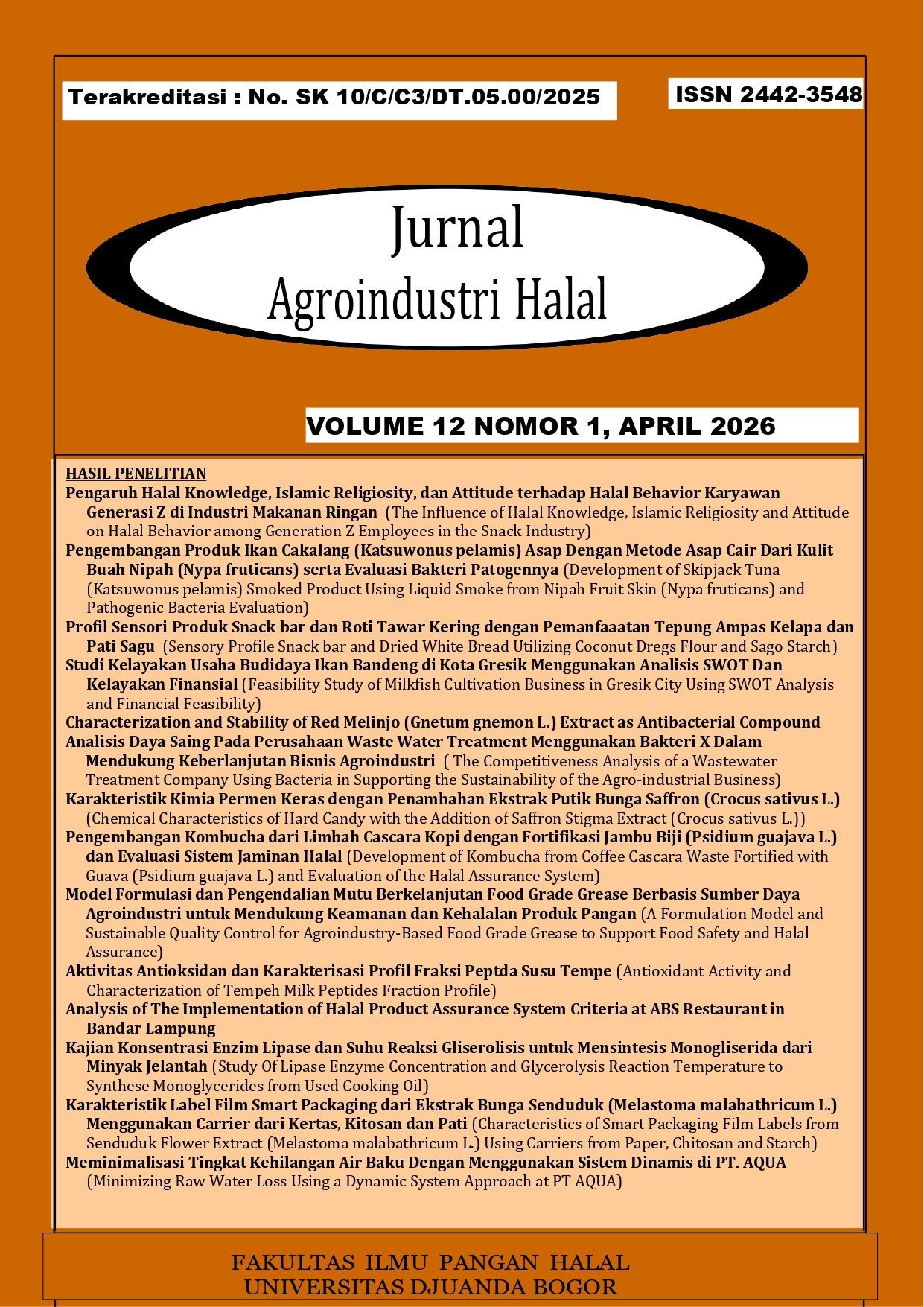
Profil Sensori Produk Pangan Kering dengan Pemanfaaatan Tepung Ampas Kelapa dan Pati Sagu
DOI:
https://doi.org/10.30997/jah.v12i1.22598Keywords:
Coconut dregs flour, sago starch, starch modification, snack bar, dry white bread, RATAAbstract
The potential of coconut pulp, which has not been optimally utilized, and the availability of sago starch in Riau Province presents a great opportunity for food product diversification. Food diversification can be carried out in snack bars and dry bread products. Sensory evaluation was conducted to determine acceptability, perceived quality attributes, and specific characteristics that arise from the use of coconut pulp flour and sago starch in the formulation. The objective of this study was to compare the sensory profiles of dry food products, namely snack bars and dry bread, with different coconut pulp flour and sago starch. A completely randomized design (CRD) with five treatments and four replicates was used. The results showed that coconut pulp flour and modified sago starch ratio (pregelatinization and HMT) had a significant effect on sensory attributes, especially brown color, while they had no significant effect on aroma, coconut pulp flavor, chewiness (snack bar), brittleness (dry white bread), or hedonic score. The best snack bar and dry bread treatments in this study were modified sago starch ratio and coconut pulp flour (80:20).
References
Adawiyah, D. R., Hunaefi, D., & Nurtama, B. (2024). Evaluasi Sensori Produk Pangan. Bumi Aksara.
Ansar, Sabariyah, S., & Spetriani. (2022). Pengaruh suhu dan lama pengeringan terhadap kualitas tepung ampas kelapa (Cocos nucifera L.). Jurnal Pengolahan Pangan, 7(2), 99–104. https://doi.org/10.31970/pangan.v7i2
Ariyantoro, A. R., Parnanto, N. H., & Kuntatiek, E. D. (2020). Pengaruh variasi suhu pre-gelatinisasi terhadap sifat fisikokimia tepung bengkuang yang dimodifikasi. Jurnal Teknologi Hasil Pertanian, 13(1), 12. https://doi.org/10.20961/jthp.v13i1.40124
Hasanah, N., & Rugayah, N. (2022). Pengaruh pemberian ampas virgin coconut oil (vco) dalam ransum terhadap produksi karkas ayam pedaging. J. Agrisains, 23(2), 113–122. https://doi.org/10.22487/jiagrisains.v23i2.2022.113-122
Jamilah, & Khaerunnisa. (2019). Aplikasi tepung kelapa dalam produk roti manis. Jurnal Riset Industri Indonesia, 14 (1), 1-10. Jurnal Industri Hasil Perkebunan, 14(1), 1–10. https://doi.org/10.33104/jihp.v14i1.4240
Kaseke, H. (2018). Mempelajari kandungan gizi tepung ampas kelapa dari pengolahan virgin coonut oil (vco) dan minyak kopra putih sebagai sumber pangan fungsional. Jurnal Penelitian Teknologi Industri, 9(2), 115. https://doi.org/10.33749/jpti.v9i2.3552
Khoirunnisah, F. M., Aji, A. S., Saloko, S., Aprilia, V., Sailendra, N. V., Djidin, R. T. S., & Rahmawati, S. (2024). Pengaruh teknik penanakan terhadap sifat fisik (tekstur dan warna) nasi dari beras analog berbahan baku tepung sorgum, mocaf, glukomanan, dan kelor. Amerta Nutrition, 8(4), 506–512. https://doi.org/10.20473/amnt.v8i4.2024.506-512
Mahmud, M. K., Hermana, Nazarina, Marudut, Zulfianto, N, A., Muhayatun, Jahari, A. B., Permaesih, D., Ernawati, F., Rugayah, Haryono, Prihatini, S., Raswanti, I., Rahmawati, R., Santi, D., Permanasari, Y., Fahmida, U., Sulaeman, A., Andarwulan, N., … Marlina, L. (2018). Tabel Komposisi Pangan Indonesia 2017. Kementrian Kesehatan Republik Indonesia.
Pratama, R. I., Sumaryanto, H., Santoso, J., & Zahirudin, W. (2012). Karakteristik sensori beberapa produk ikan asap khas daerah di Indonesia dengan menggunakan metode quantitative descriptive analysis. Jurnal Pascapanen Dan Bioteknologi Kelautan Dan Perikanan, 7(2), 117–129. https://doi.org/10.15578/jpbkp.v7i2.253
Putri, M. F. (2014). Kandungan gizi dan sifat fisik tepung ampas kelapa sebagai bahan pangan sumber srat. Teknobuga, 1(1), 32–43. https://doi.org/10.15294/teknobuga.v1i1.6402
Rahmawati, D., Andarwulan, N., Lioe, H. N., Studi, P., Profesional, M., Pangan, T., Sarjana, S. P., Pertanian, F. T., East, S., Food, A., & Sciences, A. (2015). Identifikasi atribut rasa dan aroma mayonnaise dengan metode quantitative descriptive analysis (QDA). 5(2), 80–86. https://journal.ipb.ac.id/jmpi/article/view/19891
Rifqi, M., Rohmayanti, T., Sania, F. R., & Hapsari, U. D. (2023). Profil sensori pada roti tawar dengan penambahan tepung kulit buah naga merah dengan menggunakan metode Rate-All-That-Apply (RATA). Jurnal Agroindustri Halal, 9(3), 332–342.
Rifqi, M., Sumantri, N. O., & Amalia, L. (2022). Kadar gula reduksi, sukrosa, serta uji hedonic pada hard candy dari penambahan ekstrak jagung manis (Zea mays saccharata), sukrosa, dan madu. Jurnal Agroindustri Halal, 8(1), 75–85.
Rumatumia, H., Breemer, R., & Picauly, P. (2023). Karakteristik roti manis berbahan dasar pati sagu HMT (Heat Moisture Treatment) dengan penambahan konsentrasi bubuk cengkeh (Syzygium aromaticum). Jurnal Agrosilvopasture-Tech, 2(2), 508–515. https://doi.org/10.30598/j.agrosilvopasture-tech.2023.2.2.508
Sabilla, N. F., & Murtini, E. S. (2020). Pemanfaatan tepung ampas kelapa dalam pembuatan flakes cereal (kajian proporsi tepung ampas kelapa: tepung beras). Jurnal Teknologi Pertanian, 21(3), 155–164. https://doi.org/10.21776/ub.jtp.2020.021.03.2
Seilatuw, E., Oessoe, Y. Y. E., & Lamaega, J. C. E. (2024). Pengaruh Pencampuran Tepung Ampas Kelapa dan Tepung Terigu terhadap Sifat Fisik, Organoleptik dan Daya Kembang Pancake. Jurnal Teknologi Pertanian (Agricultural Technology Journal, 14(2), 119–126. https://doi.org/10.35791/jteta.v14i2.50299
Utami, M., Wijaya, C. H., Efendi, D., & Adawiyah, R. (2020). Karakteristik fisikokimia dan profil sensori mangga gedong pada dua tingkat kematangan. 31(2), 113–126. https://doi.org/10.6066/jtip.2020.31.2.113
Vidal, N. P., Manful, C. F., Pham, T. H., Stewart, P., Keough, D., & Thomas, R. H. (2020). The use of XLSTAT in conducting principal component analysis (PCA) when evaluating the relationships between sensory and quality attributes in grilled foods. Journal Pre-Proof, 7, 100835. https://doi.org/10.1016/j.mex.2020.100835
Widiastuti, D., Mulyati, A. H., & Septiani, M. (2015). Karakteristik tepung limbah ampas kelapa pasar tradisional dan industri virgin coconut oil (VCO). Ekologia, 15(1), 29–34. https://doi.org/10.33751/ekol.v15i1.208
Winarno, F. G. (2004). Kimia Pangan dan Gizi. Gramedia Pustaka Utama.
Yulvianti, M., Ernayati, W., Tarsono, & R, M. A. (2015). Pemanfaatan Ampas Kelapa Sebagai Bahan Baku Tepung Kelapa Tinggi Serat Dengan Metode Freeze Drying. Jurnal Integrasi Proses, 5(2), 101–107. https://dx.doi.org/10.36055/jip.v5i2.246
Downloads
Published
How to Cite
Issue
Section
License
Copyright (c) 2026 Shanti Fitriani, Ayu Diana, Erpiani Siregar, Fikratul Ihsan, Masyitah, Fadlila Endyra, Ririn Oktavia Sitinjak, Dimas Wahyudi

This work is licensed under a Creative Commons Attribution-ShareAlike 4.0 International License.
Authors who publish with Jurnal Agroindustri Halal agree to the following terms:
- Authors retain copyright and grant the journal right of first publication with the work simultaneously licensed under a Creative Commons Attribution 4.0 International License that allows others to share the work with an acknowledgement of the work's authorship and initial publication in Jurnal Agroindustri Halal.
- Authors are able to enter into separate, additional contractual arrangements for the non-exclusive distribution of the journal's published version of the work (e.g., post it to an institutional repository or publish it in a book), with an acknowledgement of its initial publication in Jurnal Agroindustri Halal.
- Authors are permitted and encouraged to post their work online (e.g., in institutional repositories or on their website) prior to and during the submission process, as it can lead to productive exchanges, as well as earlier and greater citation of published work