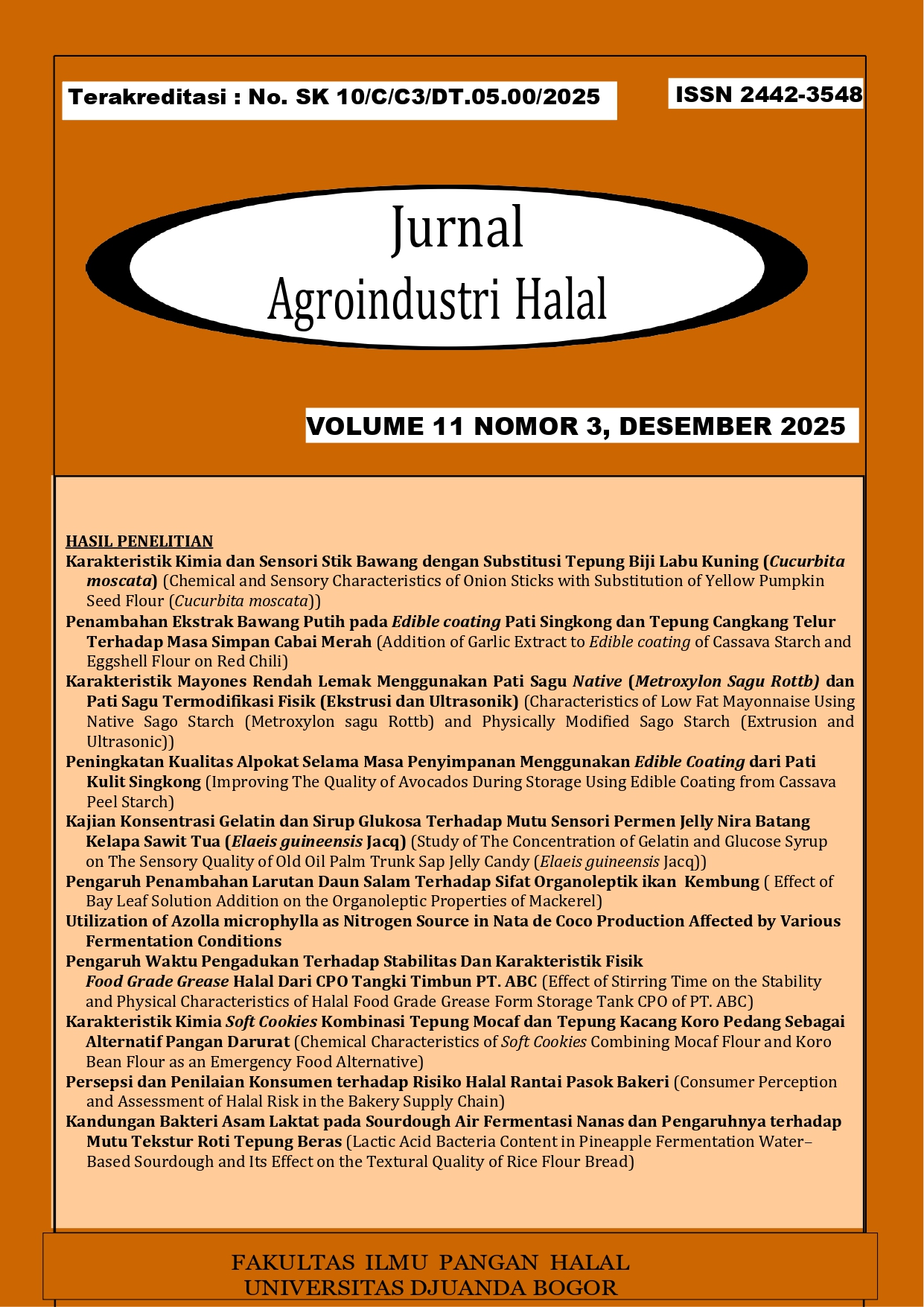
Penambahan Ekstrak Bawang Putih pada Edible coating Pati Singkong dan Tepung Cangkang Telur Terhadap Masa Simpan Cabai Merah
DOI:
https://doi.org/10.30997/jah.v11i3.16184Keywords:
edible coating, eggshell flour, garlic extract, red chilliAbstract
Red chili is a horticultural product that has a short shelf life at room temperature, one of which is due to microbial contamination. This is because metabolic activities such as respiration still occur after the product is harvested. Therefore, the application of Edible Coating is an alternative to extend the shelf life of red chili. This study aims to study the effect of different concentrations of garlic extract on weight loss, TPC value, and sensory quality of red chili. Randomized Block Design (RAK) 1 factor for weight loss parameters, TPC value, sensory quality with four treatment levels consisting of A1 (0%), A2 (3%), A3 (6%), A4 (9%). The results showed that differences in garlic extract concentrations affected the weight loss values around 8.52%-2.16%, the TPC values ranging from 6.93 to 5.17 Log CFU/g, the sensory quality of red color, slightly complex and smooth texture, and non-rotten aroma in red chilies during a 9-day storage period at room temperature.
References
Association of Official Analytical Chemists. (2005). Official methods of analysis (18th ed.). AOAC International.
Badan Pusat Statistik Provinsi Sumatera Barat. (2022). Produksi tanaman sayuran buah semusim (ton). Badan Pusat Statistik.
Badan Standardisasi Nasional. (2006). SNI 01-2346-2006: Petunjuk pengujian organoleptik dan atau sensori. Badan Standardisasi Nasional.
Badan Standardisasi Nasional. (2016). SNI 4480:2016: Syarat mutu cabai. Badan Standardisasi Nasional.
Coniwanti, P., Laila, L., & Alfira, M. R. (2014). Pembuatan film plastik biodegradabel dari pati jagung dengan penambahan kitosan dan pemlastis gliserol. Jurnal Teknik Kimia, 20(4), 22–30.
Debi, K., Juvita, L. A., Veronica, A. W., & Lusiana. (2022). Aktivitas bawang putih (Allium sativum L.) sebagai agen antibakteri. Jurnal Ilmu Farmasi dan Farmasi Klinik, 19(1), 46–53.
Devi, A., & Irma, D. D. (2023). Pemanfaatan cangkang telur ayam sebagai bahan aktif antibakteri untuk edible coating produk fillet ikan nila (Oreochromis niloticus). Jurnal Agroindustri Terapan Indonesia, 1(1), 11–21.
Erlinda, H. (2021). Jenis pengemasan dan penyimpanan terhadap kualitas cabai rawit (Capsicum frutescens L.). Jurnal Ilmiah Teknologi Pertanian, 8(1).
Erviani. (2021). Jenis pengemas dan penyimpanan terhadap kualitas cabai rawit (Capsicum frutescens L.). Jurnal Ilmiah Teknologi Pertanian, 8(1), 46–54.
Hendra, S. (2018). Efektivitas antibakteri perasan bawang putih (Allium sativum L.) terhadap pertumbuhan Staphylococcus aureus. Journal of Medical Laboratory Science Technology, 1(2), 44–53.
Ilmi, N., Aminah, & Suraedah, A. (2015). Pengaruh pelapisan agar dan jenis kemasan terhadap sifat fisik dan kimia buah cabai merah besar (Capsicum annuum L.). Jurnal AgrotekMAS, 4(3).
Jennylyn. (2015). Mutu cabai merah (Capsicum annuum L.) pada tingkat kematangan dan suhu yang berbeda selama penyimpanan. Jurnal Agrointek, 10(1), 12–20.
Jesica, A., Hidayat, G., & Wiguna. (2018). Pengaruh varietas dan ukuran umbi terhadap produktivitas bawang putih. Jurnal Hortikultura, 21(3), 206–213.
Khoshnoudi-Nia, S., & Moosavi-Nasab, M. (2019). Application of edible coatings and films to reduce postharvest losses in fruits and vegetables: A review. International Journal of Food Science & Technology, 54(5), 1523–1532. https://doi.org/10.1111/ijfs.14048
Kianto, D. (2023). Karakteristik smart edible packaging berbahan maizena, gelatin, dan sorbitol dengan penambahan ekstrak kubis merah (Brassica oleracea) dan tepung cangkang telur ayam [Skripsi, Universitas Katolik Widya Mandala Surabaya].
Latifa, W. (2018). Perubahan mutu cabai merah besar (Capsicum annuum L.) pada penyimpanan zero energy cool chamber (ZECC), refrigerator, dan suhu ruang [Skripsi, Universitas Hasanuddin].
Luqman, Rochayati, & Munika. (2019). Respon kualitas dan ketahanan simpan cabai merah (Capsicum annuum L.) dengan penggunaan jenis bahan dan tingkat kematangan buah. Jurnal Kultivasi, 14(1).
Lutfiah, A. A., Mia, W., & Reza, S. (2022). Analisis penambahan ekstrak bawang putih terhadap masa simpan ikan nila merah pada suhu rendah. Fakultas Perikanan dan Ilmu Kelautan, Universitas Padjadjaran.
Maskiyah, Juniawati, & Iriani, E. S. (2015). Potensi edible film antimikroba sebagai pengawet daging. Buletin Peternakan, 39(2). https://doi.org/10.21059/buletinpeternak.v39i2.6718
Nata, I. F., Irawan, C., Adawiyah, M., & Ariwibowo, S. (2020). Edible film cassava starch/eggshell powder composite containing antioxidant: Preparation and characterization. IOP Conference Series: Earth and Environmental Science, 524, 012008. https://doi.org/10.1088/1755-1315/524/1/012008
Novitarianti, J. L., & Hartuti. (2023). Penanganan segar dan penyimpanan tomat dengan pelapisan lilin untuk memperpanjang masa simpan. Balai Penelitian Tanaman Sayuran.
Nursyamsi, S., Sabahannur, S., & Suraedah, A. (2022). Pengaruh konsentrasi bawang putih sebagai pengawet alami terhadap umur simpan dan mutu cabai merah besar (Capsicum annuum L.). Jurnal AgrotekMAS, 8(2).
Poeloengasih, C. D., & Marseno, D. W. (2003). Characterization of composite edible film of winged bean seeds protein and tapioca. Jurnal Teknologi dan Industri Pangan, 14(3), 224–232.
Purseg. (2019). Uji kadar zat warna (β-karoten) pada cabe merah (Capsicum annuum L.) sebagai pewarna alami. Jurnal Pendidikan Biologi, 9(1).
Putri, N. N., Nurul, A., Ainun, N., & Kiki, R. (2023). Potensi senyawa aktif tanaman rempah terhadap kemasan edible film antimikroba. Jurnal Ilmu Pangan dan Hasil Pertanian, 5(1).
Soeid, I. (2012). Pengawet pengganti formalin. Dalam Kajian pustaka pengantar ilmu pangan, nutrisi dan mikrobiologi. Universitas Gadjah Mada.
Vonnie, J. M., Rovina, K., Azhar, R. A., Huda, N., Erna, K. H., Felicia, W. X. L., Nur’Aqilah, M. N., & Abdul Halid, N. F. (2022). Development and characterization of the biodegradable film derived from eggshell and cornstarch. Journal of Functional Biomaterials, 13(2), 67. https://doi.org/10.3390/jfb13020067
Yandriani, Y., & Asyeni, M. J. (2022). Karakteristik edible film kulit durian dengan penambahan antibakteri ekstrak bawang putih. Jurnal Teknik Kimia, 27(1), 10–19.
Yunita, M., Hendrawan, Y., & Yulianingsih, R. (2015). Analisis kuantitatif mikrobiologi pada makanan penerbangan (Aerofood ACS) Garuda Indonesia berdasarkan TPC (total plate count) dengan metode pour plate. Jurnal Keteknikan Pertanian Tropis dan Biosistem, 3(3), 237–248
Downloads
Published
How to Cite
Issue
Section
License
Copyright (c) 2025 Siti Nurhalimah, Lisania Amanah, Erna Puspasari, Wilna Iznilillah

This work is licensed under a Creative Commons Attribution-ShareAlike 4.0 International License.
Authors who publish with Jurnal Agroindustri Halal agree to the following terms:
- Authors retain copyright and grant the journal right of first publication with the work simultaneously licensed under a Creative Commons Attribution 4.0 International License that allows others to share the work with an acknowledgement of the work's authorship and initial publication in Jurnal Agroindustri Halal.
- Authors are able to enter into separate, additional contractual arrangements for the non-exclusive distribution of the journal's published version of the work (e.g., post it to an institutional repository or publish it in a book), with an acknowledgement of its initial publication in Jurnal Agroindustri Halal.
- Authors are permitted and encouraged to post their work online (e.g., in institutional repositories or on their website) prior to and during the submission process, as it can lead to productive exchanges, as well as earlier and greater citation of published work