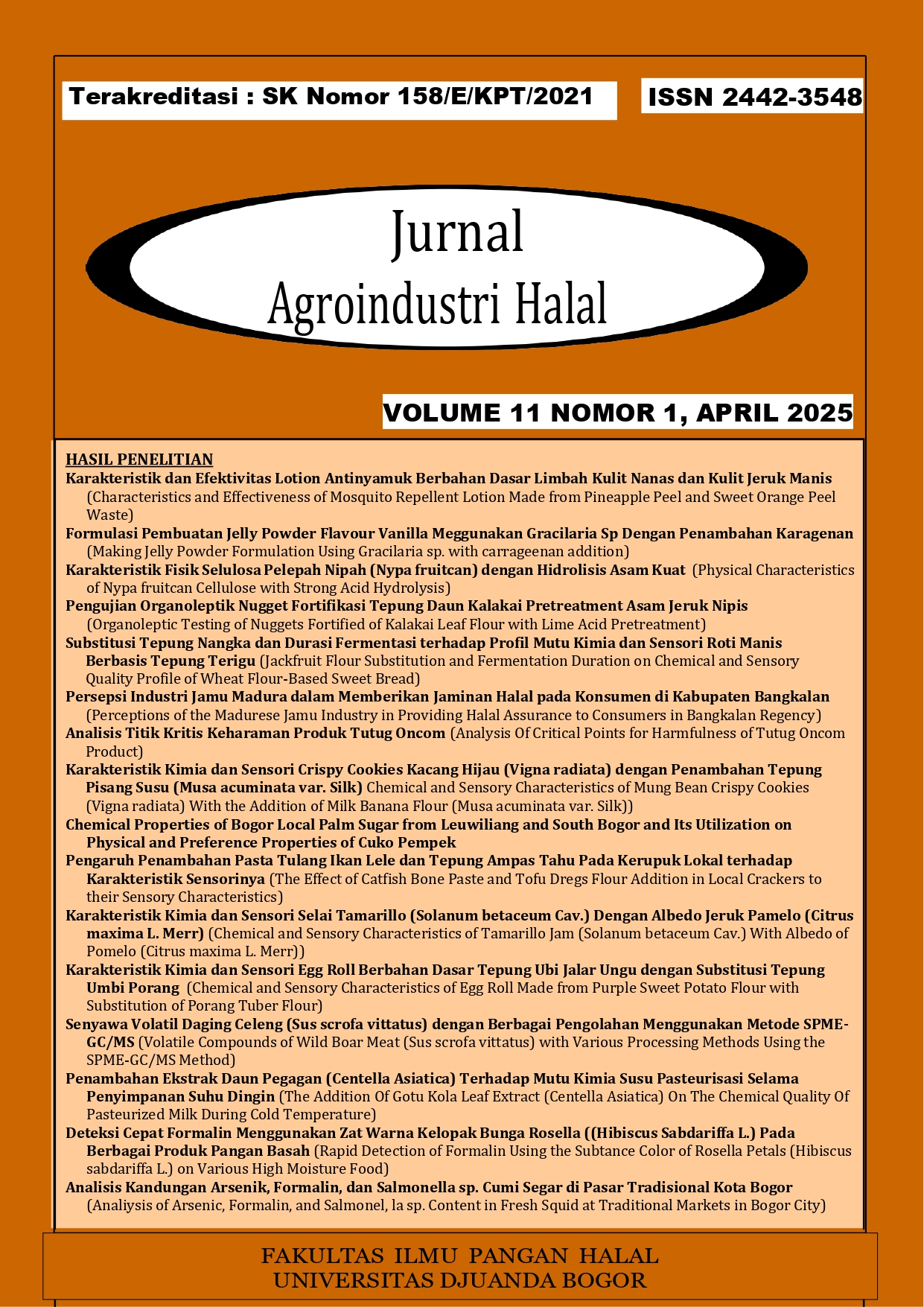
Deteksi Cepat Formalin Menggunakan Zat Warna Kelopak Bunga Rosella ((Hibiscus Sabdariffa L.) Pada Berbagai Produk Pangan Basah
DOI:
https://doi.org/10.30997/jah.v11i1.15681Keywords:
Rapid detection of formalin, Food Products, Anthocyanins, Rosella (Hibiscus sabdariffa L.), Extraction.Abstract
One of the dangerous substances still used in food goods as a preservative is formalin. The public finds it challenging to identify food products that contain formalin because formalin testing has so far been done in labs using chemical reagents. Formalin may be identified using anthocyanin dyes, according to the findings of multiple studies. Anthocyanin dyes are reported to be present in rosella flowers. Finding out if rosella flower extract can be utilized to detect formalin in different wet food products was the aim of this investigation. Using water and ethanol solvents, fresh rosella flower petal extract and dried rosella were prepared in different ratios of 1: 4, 1: 6, and 1: 8. The resulting food product samples were then tested on white tofu, lontong, and yellow noodles. The color changes that transpired in samples that were provided liquid rosella flower petal extract and the paper kit test were used to conduct qualitative observations. Formalin identification was analyzed by comparing the qualitative and quantitative findings of laboratory tests. The study's findings demonstrated that food samples containing formalin with a pH of greater than 8 underwent a color shift. In the paper kit test of fresh Rosella flower petal extract, the red color turned yellow and went from red to greenish blue. While the results of observations of color changes using dried rosella flower petal extract were more difficult to detect because the color was too thick. The fresh rosella flower petals ethanol extract with a 1:8 ratio produced the best results.
References
Agustin. (2015). Pengaruh konsentrasi pelarut pada proses ekstraksi antosianin dari bunga kembang sepatu. Konversi, 4(2).
Brouillard, R. (1982). Chemical structure of anthocyanins. In Anthocyanins as food colours (pp. 26–28). Academic Press.
Garmini, N. (2021). Identifikasi uji formalin pada mi basah menggunakan ekstrak ubi jalar ungu (Ipomoea batatas L.) di pasar tradisional Desa Niru Muara Enim. Jurnal Delima Harapan, 8.
Herfayati, P., Pandia, S., Nasution, & Halimatuddahliana, N. (2020). Karakteristik antosianin dari kulit buah nipah (Nypa frutican) sebagai pewarna alami dengan metode soxhletasi. Jurnal Teknik Kimia USU, 9(1), 26–33.
Made, S., Suryadnyani, D., Ananto, F., & Fersiyana. (2021). Pembuatan paper kit test ekstrak etanol bunga telang (Clitoria ternatea L.) untuk identifikasi formalin pada makanan. Jurnal Ilmu Kefarmasian, 2(2).
Mahmudatussa’adah, F., Fardiaz, S., Andarwulan, N., & Kusnandar, F. (2014). Karakteristik warna dan aktivitas antioksidan antosianin ubi jalar ungu. Jurnal Teknologi dan Industri Pangan, 25(2), 176–184.
Marco, G. J., Poppi, R. J., Scarminio, I. S., & Tauler, R. (2011). Investigation of the pH effect and UV radiation on kinetic degradation of anthocyanin mixture extracted from Hibiscus acetosella. Food Chemistry, 125(4), 1020–1027.
Mardiah, M., Zakaria, F. R., Prangdimurti, E., & Damanik, M. R. (2015). Perubahan kandungan kimia sari rosela merah dan ungu (Hibiscus sabdariffa L.) hasil pengeringan menggunakan cabinet dryer dan fluidized bed dryer. Jurnal Teknologi Industri Pertanian, 25(1).
Martinez, S., Thomas, D., Linard, M., Binct, A., & Guerard, F. (2005). Effect of Maillard reaction condition on browning and antiradical activity of sugar stomach hydrolysate model system. Food Research International, 38, 1045–1050.
Moulana, R., Rohaya, R., & Rosika, R. (2012). Efektivitas penggunaan jenis pelarut dan asam dalam proses ekstraksi pigmen antosianin kelopak bunga rosella (Hibiscus sabdariffa L.). Jurnal Teknologi dan Industri Pertanian Indonesia, 4.
Priska, D. P., Peni, R., & Carvallo, H. (2018). Review antosianin dan pemanfaatannya. Cakra Kimia: Indonesian E-Journal of Applied Chemistry, 6(2).
Rantesalu, R., & Orno, N. (2022). Pengaruh pemberian ekstrak kulit pisang untuk mendeteksi adanya formalin pada tahu. Prosiding Seminar Nasional MIPA UNIPA, 2022.
Ratna Dewi, R. (2019). Identifikasi formalin pada makanan menggunakan ekstrak kulit buah naga. Ilmu Kesehatan dan Farmasi Universitas Muhammadiyah Kalimantan Timur, 2.
Rein, M. (2005). Copigmentation reactions and color stability of berry anthocyanins [Doctoral dissertation, University of Helsinki].
Sukayada, I. M. K. (2006). Ada apa dengan formalin? Badan Penerbit Universitas Diponegoro.
Suyanti. (2008). Membuat mi sehat. Penebar Swadaya.
Wati, R., Rosdiana, D., & Kusumaningtyas, D. (2021). Rancang bangun pendeteksi kadar formalin pada mi basah menggunakan sensor warna TCS3200. Jurnal Sains dan Kesehatan, 3(5), 727–736.
Winarno, F. G. (2004). Kimia pangan dan gizi. Gramedia Pustaka Utama.
Winarti, S., & Firdaus, A. (2010). Stabilitas warna merah ekstrak bunga rosela untuk pewarna makanan dan minuman. Jurnal Teknologi Pertanian, 11, 87–93.
Yilmaz, Y., & Toledo, R. T. (2005). Antioxidant activity of water-soluble Maillard reaction products. Food Chemistry, 93, 273–278.
Downloads
Published
How to Cite
Issue
Section
License
Copyright (c) 2025 Desi Tirtawati, Mardiah, Siti Irma Rahmawati

This work is licensed under a Creative Commons Attribution-ShareAlike 4.0 International License.
Authors who publish with Jurnal Agroindustri Halal agree to the following terms:
- Authors retain copyright and grant the journal right of first publication with the work simultaneously licensed under a Creative Commons Attribution 4.0 International License that allows others to share the work with an acknowledgement of the work's authorship and initial publication in Jurnal Agroindustri Halal.
- Authors are able to enter into separate, additional contractual arrangements for the non-exclusive distribution of the journal's published version of the work (e.g., post it to an institutional repository or publish it in a book), with an acknowledgement of its initial publication in Jurnal Agroindustri Halal.
- Authors are permitted and encouraged to post their work online (e.g., in institutional repositories or on their website) prior to and during the submission process, as it can lead to productive exchanges, as well as earlier and greater citation of published work