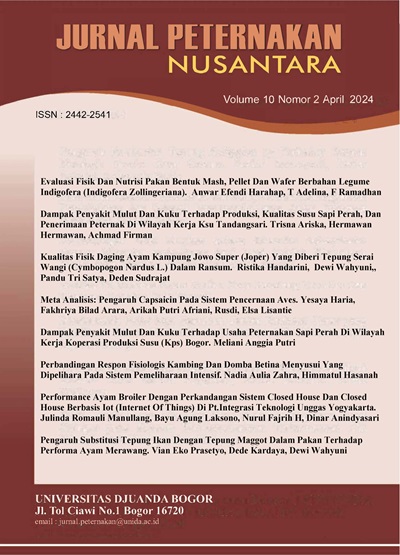
PERBANDINGAN RESPON FISIOLOGIS KAMBING DAN DOMBA BETINA MENYUSUI YANG DIPELIHARA PADA SISTEM PEMELIHARAAN INTENSIF
DOI:
https://doi.org/10.30997/jpn.v10i2.13564Keywords:
domba, fisiologis, kambing, sistem intensifAbstract
The system for rearing goats (Capra aegagrus) and sheep (Ovis aries) which is widely applied by Indonesian people is generally still intensive. This intensive rearing system is the physiological adaptability of livestock, especially female livestock that are currently breastfeeding. This research aimed to determine the comparison of the physiological responses of lactating goats and ewes in an intensive rearing system. This study used a quantitative research design with the T-test to compare the physiological responses of lactating ewes and goats. There were six lactating female goats and four ewes used in this study. The results showed that the THI value of the goat and sheep pens was in the severe heat stress category, but there was no significant comparison between the THI values of the two pens (P>0.05). The ocular temperature parameters of goats and sheep do not have a significant comparison (P>0.05), the surface temperature parameters of goats and sheep also do not have a significant comparison (0>0.05), while the respiration rate parameters of goats and sheep have a significant comparison (0<0,05). The correlation coefficient value between the sheep's ocular temperature and the back temperature, namely 0.96 and the rump, namely 0.68, has a positive correlation value, so that the higher the sheep's ocular temperature, the higher the temperature of the back and rump. In conclusion, lactating ewes and goats experience stress due to severe heat stress from the environment. In addition, there was no significant physiological comparison between goats and lactating ewes that were reared intensively on the physiological response parameters of ocular temperature and surface temperature. However, there is a comparison of physiological responses to respiratory rate parameters.
Downloads
References
BPS Jawa Tengah. (2022). Peternakan dalam Angka 2022. Jawa Tengah: Badan Pusat Statistik.
Syaikhullah, G., Adhyatma, M., & Khasanah, H. (2020). Respon fisiologis domba ekor tipis terhadap waktu pemberian pakan yang berbeda. Jurnal Sains Dan Teknologi Peternakan, 2(1), 33-39.
Santos, A. C. G., Yamin, M., Priyanto, R., & Maheshwari, H. (2019). Respon fisiologi domba pada sistem pemeliharaan dan pemberian jenis konsentrat berbeda. Jurnal Ilmu Produksi dan Teknologi Hasil Peternakan, 7(1), 1-9.
Gopar, R. A., Afnan, R., Rahayu, S., & Astuti, D. A. (2020). Respon fisiologis dan metabolit darah kambing dan domba yang ditransportasi dengan pick-up triple-deck. Jurnal Ilmu Produksi dan Teknologi Hasil Peternakan, 8(3), 109-116.
Ferro, M. M., Tedeschi, L. O., & Atzori, A. S. (2017). The comparison of the lactation and milk yield and composition of selected breeds of sheep and goats. Translational Animal Science, 1(4), 498-506.
Qisthon, A., & Hartono, M. (2019). Respons fisiologis dan ketahanan panas kambing boerawa dan peranakan ettawa pada modifikasi iklim mikro kandang melalui pengkabutan. Jurnal Ilmiah Peternakan Terpadu, 7(1), 206-211.
Joy, A., Taheri, S., Dunshea, F. R., Leury, B. J., DiGiacomo, K., Osei-Amponsah, R., ... & Chauhan, S. S. (2022). Non-invasive measure of heat stress in sheep using machine learning techniques and infrared thermography. Small Ruminant Research, 207, 106592.
Lins, A. C., Souza, I. J., Lourençoni, D., Yanagi Júnior, T., & Santos, I. E. D. A. (2021). Fuzzy logic modeling of the ocular temperature of cattle in thermal stress conditions. Engenharia Agrícola, 41, 418-426.
Marques, J. I., Leite, P. G., Lopes Neto, J. P., Furtado, D. A., & Lopes, F. F. D. M. (2021). Estimation of rectal temperature of goats based on surface temperature. Engenharia Agrícola, 41, 591-598.
Pulido-Rodríguez, L. F., Titto, C. G., de Andrade Bruni, G., Froge, G. A., Fuloni, M. F., Payan-Carrera, R., ... & Pereira, A. M. F. (2021). Effect of solar radiation on thermoregulatory responses of Santa Inês sheep and their crosses with wool and hair Dorper sheep. Small Ruminant Research, 202, 106470.
Lopes Neto, J. P., Marques, J. I., Furtado, D. A., Lopes, F. F. D. M., Borges, V. P., & Araújo, T. G. (2018). Pupillary stress index: A new thermal comfort index for crossbred goats. Revista Brasileira de Engenharia Agrícola e Ambiental, 22, 866-871.
Martello, L. S., da Luz e Silva, S., da Costa Gomes, R., da Silva Corte, R. R. P., & Leme, P. R. (2016). Infrared thermography as a tool to evaluate body surface temperature and its relationship with feed efficiency in Bos indicus cattle in tropical conditions. International journal of biometeorology, 60, 173-181.
Maia, A. S., Nascimento, S. T., Nascimento, C. C., & Gebremedhin, K. G. (2016). Thermal equilibrium of goats. Journal of Thermal Biology, 58, 43-49.
Ribeiro, M. N., Ribeiro, N. L., Bozzi, R., & Costa, R. G. (2018). Physiological and biochemical blood variables of goats subjected to heat stress–a review. Journal of Applied Animal Research, 46(1), 1036-1041.
Kaliber, M., Koluman, N. A. Z. A. N., & Silanikove, N. I. S. S. I. M. (2016). Physiological and behavioral basis for the successful adaptation of goats to severe water restriction under hot environmental conditions. Animal, 10(1), 82-88.
Dias, J. C. O., Veloso, C. M., da Rocha Santos, M. C., & Silveira, C. O. (2020). Physiological parameters of male goats raised under tropical climate conditions (Brazil). Research, Society and Development, 9(9), e768997698-e768997698.
Sarangi, S. (2018). Adaptability of goats to heat stress: A review. The Pharma Innovation Journal, 7(4), 1114-1126.
Downloads
Published
How to Cite
Issue
Section
License
Copyright (c) 2024 Nadia Aulia Zahra, Himmatul Hasanah

This work is licensed under a Creative Commons Attribution-ShareAlike 4.0 International License.
Authors who publish with Jurnal Peternakan Nusantara agree to the following terms:
- Authors retain copyright and grant the journal right of first publication with the work simultaneously licensed under a Creative Commons Attribution 4.0 International License that allows others to share the work with an acknowledgement of the work's authorship and initial publication in Jurnal Peternakan Nusantara.
- Authors are able to enter into separate, additional contractual arrangements for the non-exclusive distribution of the journal's published version of the work (e.g., post it to an institutional repository or publish it in a book), with an acknowledgement of its initial publication in Jurnal Peternakan Nusantara.
- Authors are permitted and encouraged to post their work online (e.g., in institutional repositories or on their website) prior to and during the submission process, as it can lead to productive exchanges, as well as earlier and greater citation of published work.