PERFORMAN OF BROILER CHICKENS USING CLOSED HOUSE AND CLOSED HOUSE SYSTEM BASED ON IoT (INTERNET OF THINGS) AT PT. INTEGRASI TEKNOLOGI POULTRY YOGYAKARTA
DOI:
https://doi.org/10.30997/jpn.v10i2.13407Keywords:
Broiler Chikens, Closed House, GAD Farm, IoT (Internet of Things)Abstract
The purpose of this research was to determine the difference in the effect of closed-house cages based on IoT (Internet of Things) and closed-house cages on broiler chicken performance, feed consumption, body weight gain, FCR, final body weight and mortality. The results of testing calculations and data processing of feed consumption in the GAD Farm cages showed that the IOT-based closed house cages were 907.6 g/head and in closed house cages 770 g/head. The increase in body weight obtained from closed house cages based on IOT was 522.8 g/head and in closed house cages the result was 434.81 g/head. Feed conversion results obtained from IOT-based closed house cages were 1.2 and closed house cages were 1.32. The temperature and humidity of the IoT-based closed house enclosure obtained an average temperature of 28.2˚ C with humidity of 84.2%. Closed house cages obtained an average temperature of 28.9˚C with humidity of 86.8%. final body weight or harvest during the broiler chicken rearing period, the average final body weight in the IOT-based closed house was 1,084.52 g/head and the closed house at GAD Farm was 1,040.75 g/head and the mortality value was 2.27% ; and the highest death occurred in the first week with 318 chickens. As for the lowest mortality, it was found in IoT-based closed house cages with a value of 2.914%. The conclusion of this research shows that the performance analysis results of IoT-based Closed House cages tend to be higher compared to Closed House cages at GAD Farm.
Downloads
References
[Desa Rejo Binangun, K. Raman Utara, K. LAMPUNG TIMUR Nadzir, A. Tusi, and A. Haryanto, “Design Evaluation of Broiler House in Rejo Binangun, Kecamantan Raman Utara, Kabupaten Lampung Timur,” J. Tek. Pertan. LampungVol, vol. 4, no. 4, pp. 255–266, 2015
DI. Baihaqi, A. N. Handayani, and U. Pujianto, “Perbandingan Metode Naïve Bayes Dan C4.5 Untuk Memprediksi Mortalitas Pada Peternakan Ayam Broiler,” Simetris J. Tek. Mesin, Elektrodan Ilmu Komput., vol. 10, no. 1, pp 383–390, 2019, doi: 10.24176/simet.v10i1.2846.
F Yosi and S. Sandi, “Pemanfaatan Asap Cair sebagai Bahan Aditif dan Implikasinya terhadap Sistem Imun dan Mortalitas Ayam Broiler,” J. Peternak. Sriwij., vol. 3, no. 2, pp. 28–34, 2014, doi: 10.33230/jps.3.2.2014.1760.[1] A.
Fahrudin, W. Tanwiriah, and H. Indrijani, “Konsumsi Ransum, Pertambahan Bobot Badan dan Konversi Ransum Ayam Lokal di Jimmy’s Farm Cipanas Kabupaten Cianjur Consumption,” pp. 1–9, 2016.
F. Yosi and S. Sandi, “Pemanfaatan Asap Cair sebagai Bahan Aditif dan Implikasinya terhadap Sistem Imun dan Mortalitas Ayam Broiler,” J. Peternak. Sriwij., vol. 3, no. 2, pp. 28–34, 2014, doi: 10.33230/jps.3.2.2014.1760.
Julinda, R. Manullang, and U. Mulawarman, “PROGRAM MATCHING FUND TAHUN ANGGARAN 2022 Digitalisasi Kandang Ayam Pintar Berbasis Internet of Things ( IoT ) Di Kalimantan Timur,” 2022
Kompiang and Supriyati, “Pengaruh cara pemberian pakan dan ampas sagu terfermentasiterhadap kinerja ayam pedaging,” Jitv, vol. 6, no. 1, pp. 14–20, 2001.
S. Saputra and S. Siswanto, “Prototype Sistem Monitoring Suhu Dan Kelembaban Pada Kandang Ayam Broiler Berbasis Internet of Things,” PROSISKO J. Pengemb. Ris. dan Obs. Sist. Komput., vol. 7, no. 1, 2020, doi: 10.30656/prosisko.v7i1.2132
S. Tampubolon et al., “Pembuatan Aplikasi Sistem Pemantauan Suhu Kandang Ayam Tipe Close-House Berbasis Internet of Things,” vol. 10, no. 1, pp. 94–99, 2023
Jamal, J., & Thamrin, T. (2021). Sistem Kontrol Kandang Ayam Closed House Berbasis Internet of Things. Voteteknika (Vocational Teknik Elektronika dan Informatika), 9(3), 79-9
Jamili RDMA, and Syam J. “Sistem Perkandangan Ayam Broiler Di Closed House Chandra Munarda Kabupaten Takalar,” J. Sains dan Teknol. Ind. Peternak., vol. 2, no. 1, pp. 16–22, 2022, doi: 10.55678/jstip.v2i1.606
Masriwilaga, T. A. J. M. Al-hadi, A. Subagja, and S. Septiana, “Monitoring System for Broiler Chicken Farms Based on Internet of Things (IoT),” Telekontran J. Ilm. Telekomun. Kendali dan Elektron. Terap., vol. 7, no. 1, pp. 1–13, 2019, doi: 10.34010/telekontran.v7i1.1641.
N. Azizah, H. D. Utami, and B. A. Nugroho, “Analisis Pola Kemitraan Usaha Peternakan Ayam Pedaging Sistem Closed House di Plandaan Kabupaten Jombang,” J. Ilmu- Ilmu Peternak., vol. 23, no. 2, pp. 1–5, 2013,
Rahayu H. S., S. Darwati, and A. Mu’iz, “Morfometrik Ayam Broiler dengan Pemeliharaan Intensif dan Akses Free Range di Daerah Tropis,” J. Ilmu Produksi dan Teknol. Has. Peternak., vol.7, no. 2, pp. 75–80, 2019, doi: 10.29244/jipthp.7.2.75-80
Sahiruddin, ‘Responses of Broiler on Restriction Time of Feed Accesibility’, 2013.
Surahman, B. Aditama, M. Bakri, and R. Rasna, “Sistem Pakan Ayam Otomatis Berbasis InternetOf Things,” J. Teknol. dan Sist. Tertanam, vol. 2, no. 1, p. 13, 2021, doi: 10.33365/jtst.v2i1.1025.21
T. Nuryati, “Performance Analysis of Broiler in Closed House and Opened House,” J. Peternak. Nusant., vol. 5, no. 2, p. 77, 2019, doi: 10.30997/jpnu.v5i2.1931.
Wibowo S, Sulistyoningsih M, and R. Rakhmawati, “Implementasi Internal Controller of KandangClose House berbasis IoT,” vol. 7, no. Sens 7, 2022.
Y. Adytia Nugraha, K. Nissa, N. Nurbaeti, F. Muhammad Amrullah, and D. Wahyu Harjanti, “Pertambahan Bobot Badan dan Feed Conversion Rate Ayam Broiler yang Dipelihara Menggunakan Desinfektan Herbal,” J. Ilmu-Ilmu Peternak., vol. 27, no. 2, pp. 19–24, 2017, doi:10.21776/ub.jiip.2017.027.02.03.
Y. I. Mukti, F. Rahmadayanti, and D. T. U. Diti, “A Smart Monitoring Berbasis Internet of Things (IoT) Suhu dan Kelembaban pada Kandang Ayam Broiler,” J. Comput. Sci. Informatics Eng., vol. 5,no. 1, pp. 77–84, 2021, doi: 10.29303/jcosine.v5i1.399.
Downloads
Published
How to Cite
Issue
Section
License
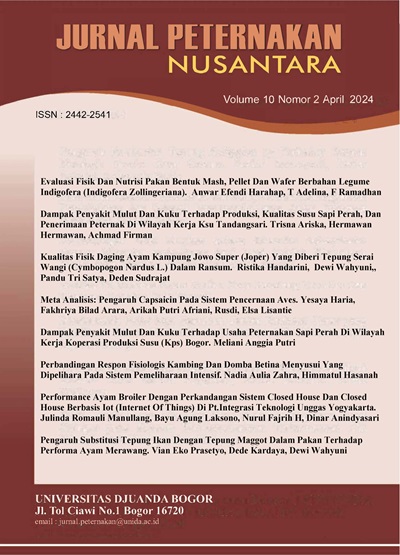
Copyright (c) 2024 Julinda Romauli Manullang, Bayu Agung Laksono, Nurul Fajrih H, dinar anindyasari

This work is licensed under a Creative Commons Attribution-ShareAlike 4.0 International License.
Authors who publish with Jurnal Peternakan Nusantara agree to the following terms:
- Authors retain copyright and grant the journal right of first publication with the work simultaneously licensed under a Creative Commons Attribution 4.0 International License that allows others to share the work with an acknowledgement of the work's authorship and initial publication in Jurnal Peternakan Nusantara.
- Authors are able to enter into separate, additional contractual arrangements for the non-exclusive distribution of the journal's published version of the work (e.g., post it to an institutional repository or publish it in a book), with an acknowledgement of its initial publication in Jurnal Peternakan Nusantara.
- Authors are permitted and encouraged to post their work online (e.g., in institutional repositories or on their website) prior to and during the submission process, as it can lead to productive exchanges, as well as earlier and greater citation of published work.