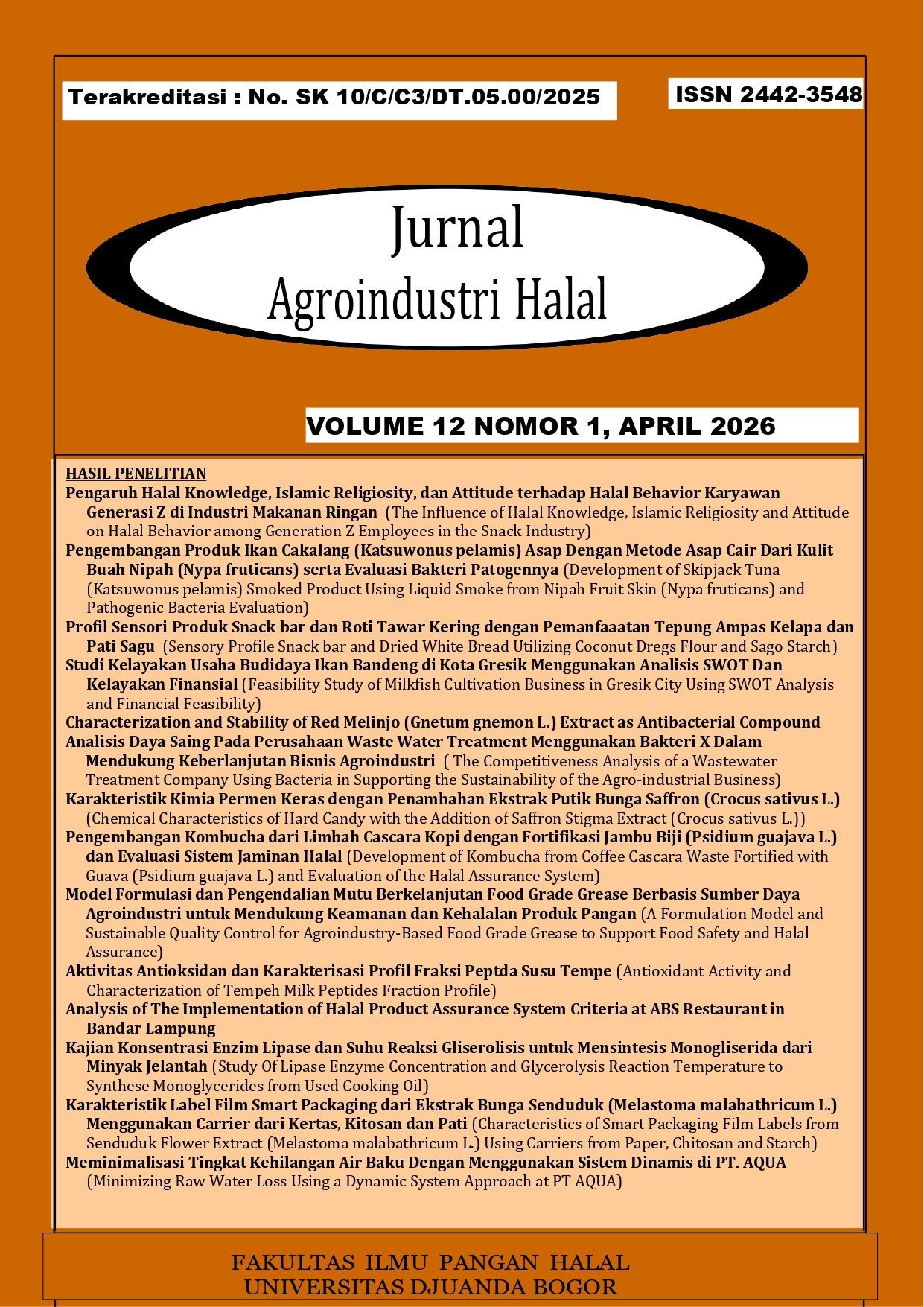
Characteristics of Smart Packaging Film Labels from Senduduk Flower Extract (Melastoma malabathricum L.) Using Carriers from Paper, Chitosan and Starch
DOI:
https://doi.org/10.30997/jah.v12i1.23633Keywords:
Senduduk flower extract, Chitosan, Film label, Starch, Smart packaging, Whatman paperAbstract
Smart packaging film labels are used as indicator labels to determine the freshness of a product by utilizing natural dyes. Senduduk flower extract contains anthocyanins that have the potential to be used as dyes for film labels because they are sensitive to pH changes. The type of carrier used to transport natural dyes affects the quality of the indicator film label. The purpose of this study was to determine the best type of carrier for smart packaging film labels that use senduduk flower extract as a color indicator. This study used three types of carriers (chitosan, paper, and starch). The test parameters included the label's response to NaOH and NH3, water vapor transmission rate, thickness, tensile strength, elongation percentage, moisture content, and barrier properties. Senduduk flower extract has a deep red color with a pH value of 2. The response of the indicator film label to NaOH and NH3 vapor for the three types of carriers underwent color changes based on the RGB value on each film label. These color changes were analyzed from digital photos and then read using an application to produce the average RGB color, Whatman paper had the lowest thickness was 0.05 mm, moisture content the lowest in the starch film label was 16.52%, water vapor transmission rate was the lowest in the starch film label was 0.74 g/hour m², and barrier strength Whatman paper the best was 17.67 mm, the mechanical properties of the film label with the lowest tensile strength on the chitosan film label were 26.89 N/cm2 and elongation the lowest on Whatman paper was 0.71%. All three types of carriers had good stability during five days of storage at room temperature as observed visually.
References
Ali, A., Ahmed, S., & Imran, M. (2021). Recent advances in label films and coatings for shelf-life extension of fruits and vegetables. Food Chemistry, 337(127674). https://doi.org/https://doi.org/10.1016/j.foodchem.2020.127674.
Aprilliani, & Cici. (2022). Keselamatan dan Kesehatan Kerja (K3). PT. Global Eksekutif Teknologi. http://www.globaleksekutifteknologi.co.id
Ayaseh, A., Alirezalu, K., Milad, Y., Zahra, R., Shima, J., Krystian, M., & Mousavi, K. A. (2022). Production of nitrite-free frankfurter-type sausages by combining ε-polylysine with beetroot extracts: An assessment of microbial, physicochemical , and sensory properties. Food Bioscience, 49, 101936. https://doi.org/https://doi.org/10.1016/j.fbio.2022.101936.
Baldwin, E. A., Hagenmaier, R. D., & Bai, J. (2011). Edible coatings and films to improve food quality, second edition. In Edible Coatings and Films to Improve Food Quality, Second Edition.
Distantina, S., Danarto, Y., & Moh Fahrurrozi, dan. (2009). Pengaruh Kondisi Proses pada Pengolahan Eucheuma Cottonii terhadap Rendemen dan Sifat Gel Karagenan. Ekuilibirum , 8(1), 35–40.
Enaru, B., Drețcanu, G., Pop, T. D., Stǎnilǎ, A., & Diaconeasa, Z. (2021). Anthocyanins: Factors affecting their stability and degradation. Antioxidants, 10(12). https://doi.org/10.3390/antiox10121967
Fadilla, A. A., Nurrahmi, S., & Rani, S. R. A. (2025). POTENSI KITOSAN DARI CANGKANG INTERNAL CUMI SEBAGAI ADSORBEN LOGAM BERAT TIMBAL (Pb) DI PERAIRAN SUNGAI TALLO SULAWESI SELATAN. Journal Online of Physics, 10(2), 123–128. https://doi.org/10.22437/jop.v10i2.38100
Fang, Y., Xu, Q., Wang, Y., & Zhang, X. (2023). Advances in anthocyanin-based smart packaging for food products. Trends in Food Science & Technology, 132, 82–94. https://doi.org/. https://doi.org/10.1016/j.tifs.2023.01.005
Fatriasari, W., Masruchin, N., & Hermiati, E. (2019). Selulosa Karakteristik dan Pemanfaatannya. In LIPI Press.
Guntur, A., Selena, M., Bella, A., Leonarda, G., Leda, A., Setyaningsih, D., & Riswanto, F. D. O. (2021). Kemangi (Ocimum basilicum L.): Kandungan Kimia, Teknik Ekstraksi, dan Uji Aktivitas Antibakteri. Journal of Food and Pharmaceutical Sciences, 9(3), 513–528. https://doi.org/10.22146/jfps.3376
Hasanah, P. ., R, B., & Nasution, E. . (2022). Karakterisasi Edible Film Dari Campuran Tepung Tapioka Kitosan, Gliserin, Dan Ekstrak Kulit Manggis (Graciniae Mangostana) Untuk Kemasan Buah Apel Malang (Malus Domestica). Jurnal Sains Kimia. https://repositori.usu.ac.id/handle/123456789/74165?show=full
Imawan, C., Fitriana, R., Listyarini, A., Sholihah, W., & Pudjiastuti, W. (2018). Kertas Label Kolorimetrik Dengan Ekstrak Ubi Ungu Sebagai Indikator Pada Kemasan Pintar Untuk Mendeteksi Kesegaran Susu. Jurnal Kimia Dan Kemasan, 40(1), 25. https://doi.org/10.24817/jkk.v40i1.3525
Jafarzadeh, S., Yildiz, Z., Yildiz, P., Strachowski, P., Forough, M., Esmaeili, Y., Naebe, M., & Abdollahi, M. (2024). Advanced technologies in biodegradable packaging using intelligent sensing to fight food waste. International Journal of Biological Macromolecules, 261(P1), 129647. https://doi.org/10.1016/j.ijbiomac.2024.129647
Joshi, P., & Brimelow, C. (2002). Color measurement of food by color reflectance. Color in Food. London. Blackie Academic Prof, P244-309.
Khoo, H. E., Azlan, A., Tang, S. T., & Lim, S. M. (2017). Anthocyanidins and anthocyanins: Colored pigments as food, pharmaceutical ingredients, and the potential health benefits. Food and Nutrition Research, 61(1). https://doi.org/10.1080/16546628.2017.1361779
Kumar, S., Pandey, C. M., Hatamie, A., Simchi, A., Willander, M., & Malhotra, B. D. (2019). Nanomaterial-Modified Conducting Paper: Fabrication, Properties, and Emerging Biomedical Applications. Global Challenges, 3(12). https://doi.org/10.1002/gch2.201900041
Lemon, K. (2025). Whatman No 1 filter paper-s why are they so frequently used. https://www.camlab.co.uk/blog/whatman-no-1-filter-papers-why-are-they-so-frequently-used [01
Mulyanti, S., & Kadraohman, A. (2021). Students Attitude Towards Green Chemistry And Its Application. Journal Of Physics: Conference Series, 1806(1). https://doi.org/https://doi.Org/10.1088/1742-6596/1806/1/012181
Muna, M. N., & Mulyanti, S. (2021). Indikator Asam-Basa Dari Alam: Review Literatur Berdasarkan Teori Dan Praktek. Prosiding Seminar Nasional Kimia Dan Pendidikan Kimia 2021, 62–71.
Ni, Y., Sun, J. S., & Wang, J. (2021). Enhanced antimicrobial activity of konjac glucomannan nanocomposite films for food packaging. Carbohydrate Polymers, 267. https://doi.org/10.1016/j.carbpol.2021.118215.%0A(https://www.sciencedirect.com/science/article/pii/S0144861721006020)
Ningsih, I. ., Chatri, M., & Advinda, L. (2023). Flavonoid Active Compounds Found In Plants Senyawa Aktif Flavonoid yang Terdapat Pada Tumbuhan. Serambi Biologi, 8, 126–132.
Nofrida, R., Warsiki, E., & Yuliasih, I. (2014). the Effect of Storage Temperature on the Erpa Leaf Color Indicator Label. Jurnal Teknologi Industri Pertanian, 23(3), 232–241.
Oroh, S. B., Kandou, F. E., Pelealu, J., & Pandiangan, D. (2015). Uji Daya Hambat Ekstrak Metanol Selaginella Delicatula Dan Diplazium Dilatatum Terhadap Bakteri Staphylococcus Aureus Dan Escherichia coli Inhibition Test Of Mrthanol Extract Of Selaginella Delicatula And Diplazium Dilatatum Againts Bacteria Staphylococcu. Jurnal Ilmiah Sains, 15(1), 53–57.
Panjaitan, N., Ulyarti, U., Mursyid, M., & Nazarudin, N. (2019). Modifikasi Pati Uwi Kuning (Dioscorea Alata) Menggunakan Metode Presipitasi Serta Aplikasinya Untuk Edible Film. Jurnal Teknologi Pertanian Andalas, 23(2), 196–204. https://doi.org/10.25077/jtpa.23.2.196-204.2019
Perdani, A. W. (2023). Mini Review : Ekstraksi Antosianin Sebagai Pewarna Makanan Dengan Bantuan Ultrasonik. Food and Nutrition Research, 18(1).
Pramasari, D. A., Sondari, D., Adi, D. S., Widyaningrum, B. A., Fajar, A., Putri, R., Restu, W. K., & Putri, E. H. (2020). KARAKTERISTIK PATI BERPORI MIKRO DARI TAPIOKA HASIL PERLAKUAN AMILASE SEBAGAI AGEN PENJERAPAN MINYAK [The Characteristic of Microporous Tapioca Starch After Amylase Treatment For Oil Adsorbent Agent]. Jurnal Teknologi & Industri Hasil Pertanian, 25(2), 71. https://doi.org/10.23960/jtihp.v25i2.71-80
Pu, I. M. (2005). Fundamental Data Compression. In Fundamental Data Compression. https://doi.org/10.1016/B978-0-7506-6310-6.X5000-4
Pudjiastuti, W., Listyarini, A., & Rizki, M. I. (2013). Pengaruh Laju Transmisi Uap Air Polimer Blend Polibutilen Suksinat (PBS) dan Linear Low Density Polyethylene (LLDPE) Terhadap Umur Simpan Sup Krim Instan Rasi. Jurnal Kimia Dan Kemasan, 35(1), 1. https://doi.org/10.24817/jkk.v35i1.1867
Putri, N. R., Nofiandi, D., & Khotimah, K. (2021). Pembuatan dan Karakterisasi Edible Film dari Pati Bonggol Pisang Kepok (Musa balbisiana Colla). Jurnal Katalisator, 6(2), 211–222.
Riyanto, R., Hermana, I., & Wibowo, S. (2014). Karakteristik Plastik Indikator sebagai Tanda Peringatan Dini Tingkat Kesegaran Ikan dalam Kemasan Plastik. Jurnal Pascapanen Dan Bioteknologi Kelautan Dan Perikanan, 9(2), 153. https://doi.org/10.15578/jpbkp.v9i2.108
Robertson, G. L. (2016). Food Packaging. CRC Press.
Sanyang, M. L., Sapuan, S. M., Jawaid, M., Ishak, M. R., & Sahari, J. (2019). Recent developments in sugar palm (Arenga pinnata) based biocomposites and their potential industrial applications: A review. Renewable and Sustainable Energy Reviews, 105, 196–207. https://doi.org/https://doi.org/10.1016/j.rser.2019.01.051.
Setiautami, A., & Warsiki, E. (2013). Pembuatan Kemasan Cerdas Indikator Warna dengan Pewarna Bit (B. vulgaris L. var cicla L.). [IPB]. http://repository.ipb.ac.id/handle/123456789/63517
Shen, W., Yan, M., Wu, S., Ge, X., Liu, S., Du, Y., Zheng, Y., Wu, L., Zhang, Y., & Mao, Y. (2022). Chitosan nanoparticles embedded with curcumin and its application in pork antioxidant edible coating. International Journal of Biological Macromolecules, 204. https://doi.org/10.1016/j.ijbiomac.2022.02.025.%0A(https://www.sciencedirect.com/science/article/pii/S0141813022002616)
Sondari, D., Kusumaningrum, W. B., Akbar, F., Putri, R., Fahmiati, S., Sampora, Y., & Muawanah, A. (2020). Penambahan Fraksi Amilosa Terhadap Sifat Fisik Dan Mekanis Edible Film Pati Tapioka. Jurnal Kimia Dan Kemasan, 42(2), 74. https://doi.org/10.24817/jkk.v42i2.6095
Syahputra, S. Y., Agustina, R., & Putra, B. S. (2022). Kuat Tarik Edible Film Bahan Dasar Pati Sagu Dengan Penambahan Sorbitol. Jurnal Ilmiah Mahasiswa Pertanian, 7(2), 464–471. https://doi.org/10.17969/jimfp.v7i2.19598
Tong, W. Y., Rafiee, A. R. A., Leong, Chean Ring, Tan, W. N., Dailin, Joe Daniel Joe Almarhoon, Zainab M Shelkh, M., Nawaz, A., & Chuah, L. F. (2023). Development of sodium alginate-pectin biodegradable active food packaging film containing cinnamic acid. Chemosphere, 336. https://doi.org/10.1016/j.chemosphere.2023.139212.%0A(https://www.sciencedirect.com/science/article/pii/S0045653523014790)%0A
Wang Suyang, Yan, M., Wang Feijie, Chenhui, L., Yichi, L., Shenzhuo, Z., Ma, M. S., & Liqiang, W. (2025). Development of cellulose-based self-healing hydrogel smart packaging for fish preservation and freshness indication. Carbohydrate Polymers, 348(Part A), 122806. https://doi.org/https://doi.org/10.1016/j.carbpol.2024.122806.
Warsiki, E., & Wahyono, D. (2012). Pembuatan label / film indikator warna dengan pewarna alami dan sintesis (colored label indicator using natural and synthetic dye). Jurnal Agroindustri Indonesia, 1(2), 82–88.
Widyastuti, S., Rhenny Ratnawati, & Priyono, N. S. (2022). Pembuatan Bioplastik Berbahan Baku Limbah Organik dengan Penambahan Tepung Tapioka dan Gliserol. Jurnal Pengelolaan Sumberdaya Alam Dan Lingkungan (Journal of Natural Resources and Environmental Management), 11(4), 677–684. https://doi.org/10.29244/jpsl.11.4.677-684
Yessica. (2023). Pemanfaatan Antosianin Sebagai Indikator Pada SmartFilmpackaging Untukmendeteksi Kesegaran ProdukPangan. Zigma, 38(2), 60–72.
Zhao, C., Wang, F., & Lian, Y. (2020). Extraction, characterization, and application of anthocyanins from fruits: A review. Journal of Food Processing and Preservation, 44(9), e14. https://doi.org/https://doi.org/10.1111/jfpp.14701
Zhao, L., Liu, Y., Zhao, L., & Wang, Y. (2022). Anthocyanin-based pH-sensitive smart packaging films for monitoring food freshness. Journal of Agriculture and Food Research, 9(July), 100340. https://doi.org/10.1016/j.jafr.2022.100340
Downloads
Published
How to Cite
Issue
Section
License
Copyright (c) 2026 Dini Novita Sari; Annisa Putri, Kiki Yulianto

This work is licensed under a Creative Commons Attribution-ShareAlike 4.0 International License.
Authors who publish with Jurnal Agroindustri Halal agree to the following terms:
- Authors retain copyright and grant the journal right of first publication with the work simultaneously licensed under a Creative Commons Attribution 4.0 International License that allows others to share the work with an acknowledgement of the work's authorship and initial publication in Jurnal Agroindustri Halal.
- Authors are able to enter into separate, additional contractual arrangements for the non-exclusive distribution of the journal's published version of the work (e.g., post it to an institutional repository or publish it in a book), with an acknowledgement of its initial publication in Jurnal Agroindustri Halal.
- Authors are permitted and encouraged to post their work online (e.g., in institutional repositories or on their website) prior to and during the submission process, as it can lead to productive exchanges, as well as earlier and greater citation of published work