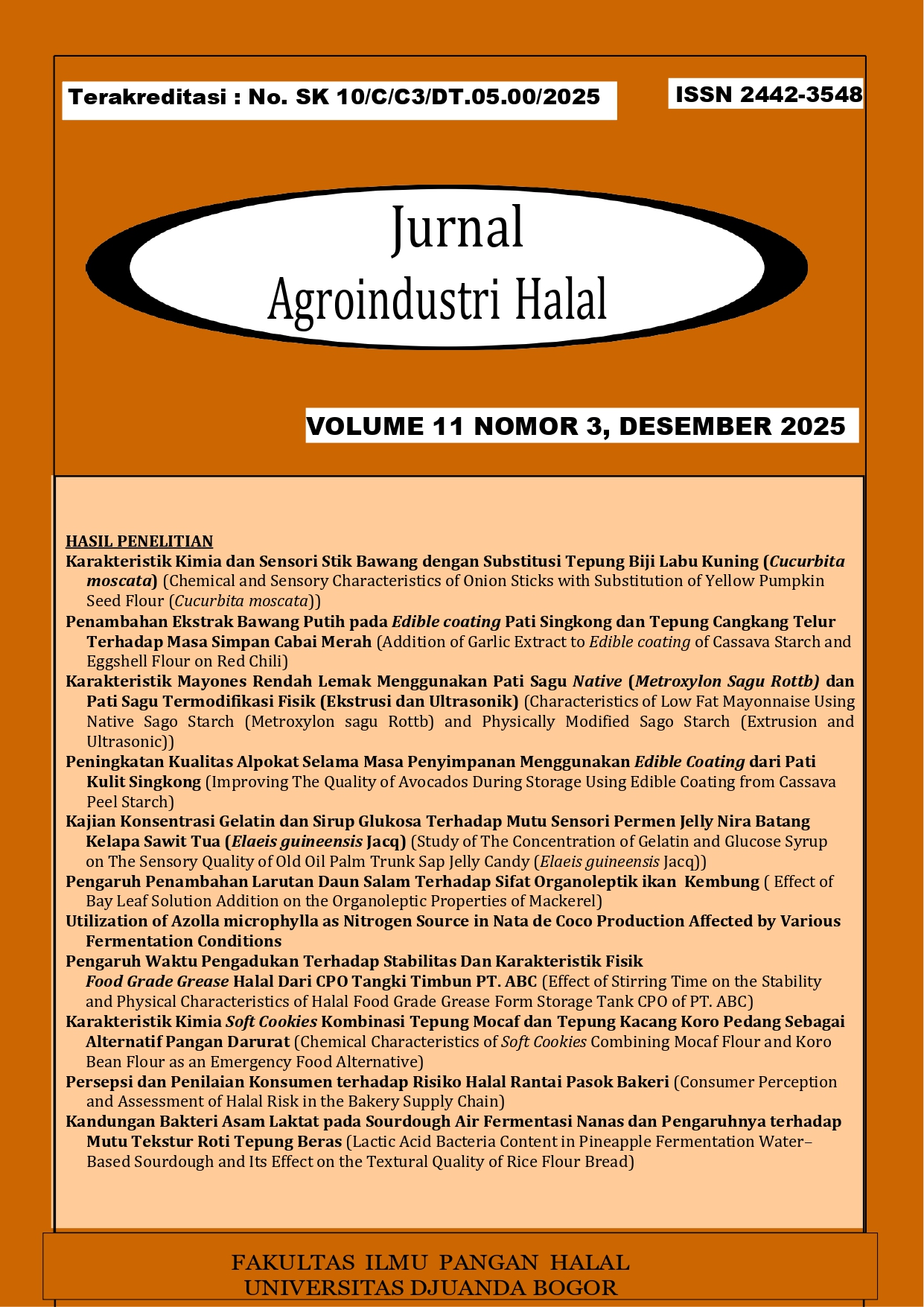
Persepsi dan Penilaian Konsumen terhadap Risiko Halal Rantai Pasok Bakeri
DOI:
https://doi.org/10.30997/jah.v11i3.21875Keywords:
halal, Halal Supply Chain, FMEA, bakery, persepsi konsumen, risiko, Rantai Pasok HalalAbstract
Halal is an important aspect for Muslim consumption. Innovation in food industry encourages business actors to maintain quality and halal assurance. The business process of bakery has contamination risks at every stage. Therefore, consumer awareness and thoroughness are crucial in choosing halal and thoyyib food. However, consumers often ignore the halal risk. Therefore, this study aims to determine the consumer perception of the halal risk of bakery. This research used a quantitative descriptive approach by distributing questionnaires. Halal supply chain risk assessment was conducted using FMEA method based on the plan, source, make, deliver, and return subprocesses. The results showed that the halal aspects, raw materials, production processes, and packaging according to halal standards were the most considered aspects by bakery consumers. The results of the halal risk assessment obtained 11 risk priorities based on the RPN value. The results showed that the highest risks from retail were the packaging damage, contamination from employees and product displays, and the difficulty of product returns by consumers. Potential risks at the producer are products do not have halal certificate and contamination from shipping transportation. Potential risks at the supplier were the packaging and meat ingredients that do not have halal supporting documents.
References
Awan, H. M., Siddiquei, A. N., & Haider, Z. (2015). Factors affecting Halal purchase intention – evidence from Pakistan’s Halal food sector. Management Research Review, 38(6), 640-660. https://doi.org/10.1108/MRR-01-2014-0022
Aziz, F., Setyorini, R., Hasanah, Y. N. (2021). Analisis halal supply chain pada usaha mikro kecil menengah (UMK) makanan di Kota Bandung. Jurnal Ilmiah Ekonomi Islam, 7(1), 293-301. http://dx.doi.org/10.29040/jiei.v7i1.1936
Azmi, F. R., Abdullah, A., Cahyadi, E. R., Musa, H., Sa’ari, J. R. (2020). Type of risk in halal food supply chain: a review. International Journal of Supply Chain Management, 9(4), 36.
Djunaidi, M., Oktavia, C. B. A., Fitriadi, R., & Setiawan, E. (2021). Perception and Consumer Behavior of Halal Product Toward Purchase Decision in Indonesia. Jurnal Teknik Industri, 22(2), 171-184. https://doi.org/10.22219/JTIUMM.Vol22.No2.171-184
Gojali, D., & Asih, V. S. (2020) Determinant factors of Indonesian muslim behavior in choosing halal products. Innovative Marketing, 16(4), 155. http://dx.doi.org/10.21511/im.16(4).2020.14.
Fikriati, M. (2015). Analisis Persepsi, Sikap, dan Perilaku Konsumen Terhadap Produk Private Brand Milik Supermarket XYZ. [Skripsi, Institut Pertanian Bogor].
Hajijah, R. N. (2018). Pengaruh Pengetahuan dan Persepsi Risiko Terhadap Perilaku Membaca Label Pangan Pada Remaja Di Perdesaan Dan Perkotaan Bogor. [Skripsi, Institut Pertanian Bogor].
Khalid, M. M., Yaakob, M. A. Z., Sirajuddin, M. D. M., Bhari, A., & Mahfot, M. (2016). Risk Analysis in the Halal Food Industry: An Exploratory Study. Contemporary Issues and Development in the Global Halal Industry, 67-79. DOI 10.1007/978-981-10-1452-9_7.
Kristiana, B. V., Indrasari, A., & Giyanti, I. (2020). Halal Supply Chain Management dalam Optimalisasi Penerapan Sertifikasi Halal UMK. Performa: Media Ilmiah Teknik Industri, 19(2), 113-120.
Makarim, A. S., Jahroh, S., & Ramadyanto, W. (2024). Supply Chain Risk of Animal Welfare, Halal, and Food Safety at RPH Jatimulya and Kranji Market in Bekasi City. Business Review and Case Studies, 5(1), 70. https://doi.org/10.17358/brcs.5.1.70
Maulidah, W. U., & Wahyuni, H. C. (2021). Food Safety and Halal Risk Mitigation in Fish Crackers Supply Chain with FMECA and AHP. Procedia of Engineering and Life Science, 1(1). https://doi.org/10.21070/pels.v1i1.844
Maulizah, R., Sugianto. (2024). Pentingnya Produk Halal di Indonesia: Analisis Kesadaran Konsumen, Tantangan Dan Peluang. El-Suffah: Jurnal Studi Islam, 1(2), 129-147.
Ma’rifat, T. N., & Rahmawan, A. (2018). Pengembangan Kerangka Konseptual Model Rantai Pasok Halal pada Komoditas Daging Ayam di Kabupaten Ponorogo. Jurnal Pertanian Cemara, 15(2), 29-35.
Miftah, A. H. (2019). Konsepsi halal dalam hukum Islam. Syaksia: Jurnal Hukum Perdata Islam, 20(1).
Mukhsin, R., Mappigau, P., & Tenriawaru, A. N. (2017). Pengaruh Orientasi Kewirausahaan Terhadap Daya Tahan Hidup Usaha Di Kota Makassar. Jurnal Analisis, 6(2), 188–193.
Nanda, K. F., & Ikawati, R. (2020). Hubungan Persepsi Label Halal Mui Terhadap Minat Beli Produk Makanan Pada Mahasiswa Fakultas Ilmu Kesehatan Universitas Muhammadiyah Surakarta. Journal of Food and Culinary, 3(1), 1.
Nurhayati, T., & Hendar, H. (2020). Personal intrinsic religiosity and product knowledge on halal product purchase intention. Journal of Islamic Marketing, 11(3), 603-620. https://doi.org/10.1108/JIMA-11-2018-0220
Nurwenda, R. R. (2021). Analisis Potensi Risiko Kontaminasi Dalam Aktivitas Halal Supply Chain Management Pada Umkm Produk Makanan Roti Dengan Metode Supply Chain Operation Reference (SCOR) Dan House of Risk (HOR). [Skripsi, Universitas Islam Indonesia].
Patradhiani, R., Novita, D. T., & Hastarina, M. (2023). Identifikasi Risiko Makanan Halal Untuk Menjamin Kualitas Produk Dengan Metode Failure Mode Effect Analysis (FMEA). Prosiding Seminar Nasional Teknik Industri (SENASTI) 2023, 782-789.
Resa, N. A., & Andjarwati, A. L. (2019). Kepercayaan dan Persepsi Risiko terhadap Keputusan Pembelian Online. Jurnal Ilmu Manajemen, 7(4), 1029-1036.
Sirait, N. P. (2021). Pengaruh Branding Terhadap Keunggulan Bersaing dan Keberhasilan Usaha Pada UKM Pangan Olahan di Kota Bogor. [Tesis, Institut Pertanian Bogor].
Wahyuni, D., Nasution, A. H., Budiman, I., Arfidhila, N. 2019. Halal Risk Analysis at Indonesia Slaughterhouses Using the Supply Chain Operations Reference (SCOR) and House of Risk (HOR) Methods. Journal of Physics: Conference Series, 1542, 1-8.
Wahyuni, H., Vanany, I., & Ciptomulyono, U. (2019). Food safety and halal food in the supply chain: Review and bibliometric analysis. Journal of Industrial Engineering and Management, 12(2), 373–391. https://doi.org/10.3926/jiem.2803
Wahyuni, H. C., Rosid, M. A., Azara, R., & Voak, A. (2018). Analisis Persepsi Konsumen Terhadap Aspek Risiko Keamanan Pangan Pada Sistem Rantai Pasok Makanan. Prozima, 2(2), 64-69. http://doi.org/10.21070/prozima.v2i2.2201
Downloads
Published
How to Cite
Issue
Section
License
Copyright (c) 2025 Azkia Yasna Nadhratuzzaman Ash-Shidiqie, Eko Ruddy Cahyadi, Furqon Syarief Hidayatulloh

This work is licensed under a Creative Commons Attribution-ShareAlike 4.0 International License.
Authors who publish with Jurnal Agroindustri Halal agree to the following terms:
- Authors retain copyright and grant the journal right of first publication with the work simultaneously licensed under a Creative Commons Attribution 4.0 International License that allows others to share the work with an acknowledgement of the work's authorship and initial publication in Jurnal Agroindustri Halal.
- Authors are able to enter into separate, additional contractual arrangements for the non-exclusive distribution of the journal's published version of the work (e.g., post it to an institutional repository or publish it in a book), with an acknowledgement of its initial publication in Jurnal Agroindustri Halal.
- Authors are permitted and encouraged to post their work online (e.g., in institutional repositories or on their website) prior to and during the submission process, as it can lead to productive exchanges, as well as earlier and greater citation of published work