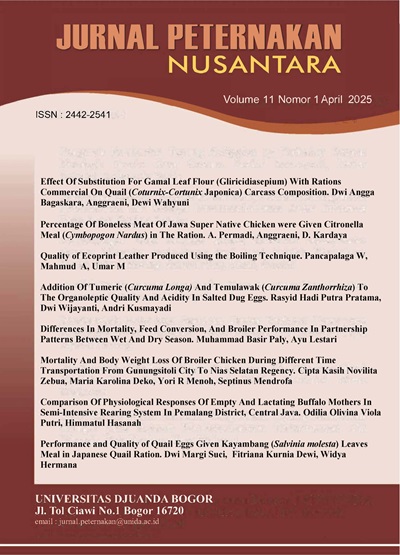
Percentage Of Boneless Meat Of Jawa Super Native Chicken Were Given Citronella Meal (Cymbopogon Nardus) In The Ration
DOI:
https://doi.org/10.30997/jpn.v11i1.13123Keywords:
carcass percentage, citronella, feed additive, Joper chicken.Abstract
Citronella is a plant from the grass family that has active compounds, namely antibiotics and antioxidants, so it has the potential to be used as a feed additive. The purpose of this study was to examine the effect of giving citronella meal (Cymbopogon nardus) in rations on the percentage of Joper chicken carcasses. This study used a complete randomized design (CRD) with 5 treatments and 4 replicates, where each replicate consisted of five Joper chickens. This data was analyzed by Anova and continued with Duncan Multiple Range-Test, if applicable. The treatments consisted of 1) R0= No provision of citronella meal in the ration, 2) R1= Provision of 2% citronella meal in the ration, 3) R2= Provision of 4% citronella meal in the ration, 4) R3= Provision of 6% citronella meal in the ration, and 5) R4= Provision of 8% citronella meal in the ration. The variables observed in this study were slaughter weight, carcass weight, carcass percentage, chest percentage, thigh percentage, wing percentage, and back percentage. The results of this study showed that giving citronella meal in rations up to 6% (as fed basis, w/w) had a significant effect (P<0.05) on slaughter weight, carcass weight, carcass percentage. Feeding 8% citronella meal showed a significant effect (P<0.05) on the back percentage of Joper chicken. The use of citronella in Joper chickens is limited to 8%, because it is high in fiber (34-36%). The addition of citronella meal up to level 6% in the ration increased weight, carcass weight, carcass percentage, and the 8% of citronella meal increased the back percentage of Joper chicken.
Downloads
References
Adinugraha BS, Wijayaningrum TN. 2017. Rancangan Acak Lengkap Dan Rancangan Acak Kelompok Pada Bibit Ikan. Indonesia One Search. 47-56.
Adnyana I, Dewi G, Wirapartha M. 2014. Pengaruh Imbangan Energi dan Protein Ransum Terhadap Karkas Ayam Kampung Betina Umur 30 Minggu. Journal of Tropical Animal Scieince. 2(3): 415–424.
Amelia DP, Purnomo SH, Sudiyono S. 2018. Faktor- Faktor yang Mempengaruhi Permintaan Daging Ayam Kampung di Pasar Tradisional Kota Surakarta. Sains Peternakan. 16(1): 23–29.
Azizah EM, Sjofjan O, Widodo E. 2013. Pengaruh Penggunaan Tepung Serai Wangi (Cymbopogon Nardus) dalam Pakan terhadap Penampilan Produksi Ayam Pedaging. 1–8.[Tesis]. Fakultas peternakan. Universitas Brawijaya. Malang.
Badan Pusat Statistik Provinsi. 2022. Populasi Ayam Buras Menurut Provinsi (Ekor). 2020-2022. Jakarta.
Balfas RF, Rahmawati YD. 2022. Skrining Fitokimia, Formulasi, dan Uji Sifat Fisik Sediaan Foot Sanitizer Spray Minyak Atsiri Sereh Wangi (Cymbopogon citratrus sp.). Jurnal Pharmascience. 9(2): 11–17.
Dewanti R, Irham M, Sudiyono. 2013. Pengaruh penggunaan enceng gondok (eichornia crassipes) terfermentasi dalam ransum terhadap persentase karkas, non karkas, dan lemak abdominal itik lokal jantan umur delapan minggu. Buletin Peternakan. 37(1): 19–25.
Fathan S, Supu PA, Mukhtar M, Djunu SS. 2023. Bobot Karkas dan Bagian-bagian Karkas Itik Petelur yang Diberi Pakan Mengandung Larva Maggot ( Black Soldier Fly ). Gorontalo Journal of Equatorial Animals. 2(2): 97–103.
Lee KW, Everets H, Beyne AC. 2004. Essential Oils in Broiler Nutrion. International Journal Poultry Sciences. 3(12): 738-752.
[Peraturan Menteri Pertanian Republik Indonesia]. 2016. Pemasukan Karkas Daging Jeroan dan atau Olahannya ke dalam Wilayah Negara Republik Indonesia. Number 34/PK.210/2016. Jakarta.
Pribady WA. 2008. Produksi Karkas Angsa (Angser cygnoides) Pada Berbagai Umur Pemotongan. [skripsi]. Bogor (ID): Institut Pertanian Bogor. Bogor.
Qadar R, Asmawati, Idrus M. 2022. Ukuran Persentase Bobot paha dan Persentase Bobot Sayap Ayam KUB dengan Penambahan Tepung Azolla (Azolla microphylla) Fermentasi ke Dalam Pakan Basal. Jurnal Ilmu dan Teknologi Peternakan Terpadu. 2(2): 136-144.
Samadi, Wajizah S., Khairi F., & . I. 2022. Optimalisasi Produktivitas Dan Reproduktivitas Ayam Joper Dengan Pemberian Feed Additives (Phytogenic) Dan Perbaikan Manajemen Pemeliharaan Ayam Joper Di Kabupaten Aceh Besar. Media Kontak Tani Ternak. 3(4): 102.
Sedya IW, Rinawidiastuti R. 2022. Pengaruh Perendaman Telur Menggunakan Estrak Daun Sereh Wangi (Cymbopogon Nardus L.) Terhadap Kualitas Internal Dan Daya Awet Telur Ayam Ras. Jurnal Sains Peternakan Nusantara. 2(1): 44–53.
Soeparno. 2015. Meat Science and Technology. 6th Printing (Revised Edition). Gadjah Mada University Press.
Suryanto T, Kurniawan R. 2018. Ayam Kampung Joper Panen 60 Hari. Jakarta: Penebar Swadaya.
Tahir M, Hafsah H, Damayanti AP, Tantu RY. 2022. Pengaruh Konsentrasi Penambahan Eugenol Daun Cengkeh Terhadap Kecernaan Nutrien Ransum Pada Ayam Pedaging. Jurnal Ilmiah Fillia Cendekia. 7(1): 33.
Ulupi N, Nuraini, Parulian J, Kusuma SQ. 2018. Karakteristik Karkas dan Non Karkas Ayam Broiler Jantan dan Betina pada Umur Pemotongan 30 Hari. Jurnal Ilmu Produksi dan Teknologi Hasil Peternakan. 6(1): 1-5.
Downloads
Published
How to Cite
Issue
Section
License
Copyright (c) 2025 Aditia Permadi, Dr. Ir. Anggraeni M.Si., Prof. Dr. Ir. Dede Kardaya M.Si.

This work is licensed under a Creative Commons Attribution-ShareAlike 4.0 International License.
Authors who publish with Jurnal Peternakan Nusantara agree to the following terms:
- Authors retain copyright and grant the journal right of first publication with the work simultaneously licensed under a Creative Commons Attribution 4.0 International License that allows others to share the work with an acknowledgement of the work's authorship and initial publication in Jurnal Peternakan Nusantara.
- Authors are able to enter into separate, additional contractual arrangements for the non-exclusive distribution of the journal's published version of the work (e.g., post it to an institutional repository or publish it in a book), with an acknowledgement of its initial publication in Jurnal Peternakan Nusantara.
- Authors are permitted and encouraged to post their work online (e.g., in institutional repositories or on their website) prior to and during the submission process, as it can lead to productive exchanges, as well as earlier and greater citation of published work.