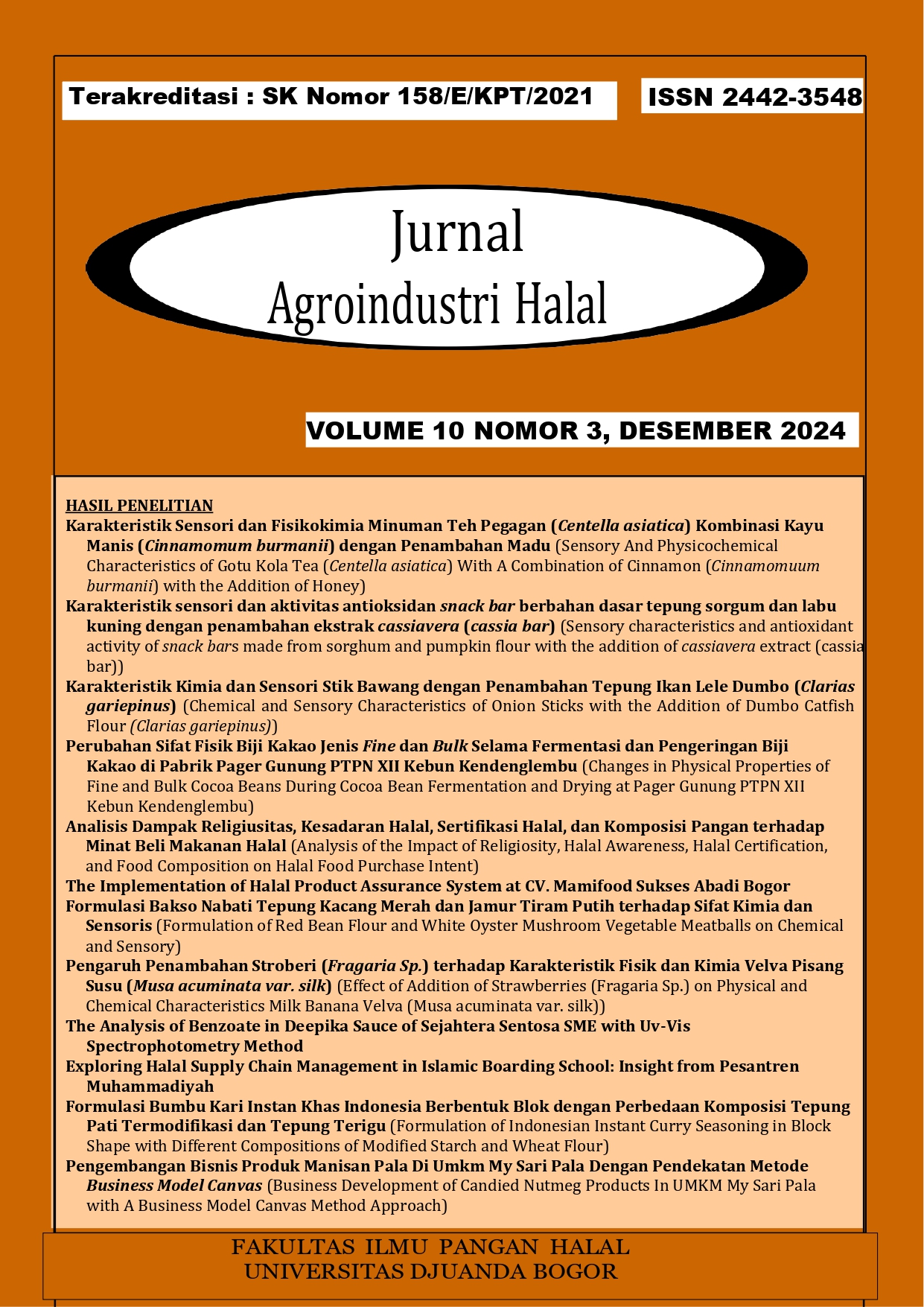
The Implementation of Halal Product Assurance System at CV. Mamifood Sukses Abadi Bogor
DOI:
https://doi.org/10.30997/jah.v10i3.9696Keywords:
Halal Product Assurance System (SJPH), CV. Mamifood Sukses Abadi Bogor, Halal ProductAbstract
Halal food is crucial for consumers, especially in Indonesia, which has the biggest Muslim population in the world. Halal food can be identified by a halal label on its packaging. Halal labels can be obtained through the Halal Product Assurance System (SPJH). This study evaluates the Halal Product Assurance System in CV. Mamifood Sukses Abadi Bogor, involving critical ingredients such as cheese sauce, cheese spread, and milk jam. The findings of this study suggest that CV. Mamifood Sukses Abadi Bogor is committed to and responsible for the implementation of the Halal Product Assurance System. All ingredients used for products have a halal certificate issued by the Institute for the Study of Food, Drugs, and Cosmetics of the Indonesian Ulema Council (LPPOM MUI). Its production has complied with the conditions regulated by the Halal Product Guarantee Agency (BPJPH). The name and sensory profile of the product does not link to the name and sensory profile of non-halal products. The top management has also conducted internal audits and management reviews, with the most recent one taking place in 2021, to monitor and evaluate the Halal Product Assurance System implementation. In general, CV. Mamifood Sukses Abadi Bogor has adhered to all of the Halal Product Assurance System criteria established by the Halal Product Guarantee Agency.
References
Abu Bakar, N., Peszynski, K., Azizan, N., Pandiyan, V., & Sundram, K. (2016). Abridgment of traditional procurement and E-Procurement: definitions, tools and benefits. Journal of Emerging Economies and Islamic Research, 4(1), 74–91. www.jeeir.com
Akim, A.-, Konety, N., Purnama, C., & Adilla, M. H. (2019). Pemahaman usaha mikro, kecil dan menengah (UMKM) di Jatinangor terhadap kewajiban sertifikasi halal pada produk makanan. Kumawula: Jurnal Pengabdian Kepada Masyarakat, 1(1), 31–49. https://doi.org/10.24198/kumawula.v1i1.19258
Apriyantono, A. (2007). Pedoman Produksi Pangan Halal. Khairul Bayan Press.
Ashadi, R. W. (2015). Halal science: an introduction. Journal of Halal Research, 1(1), 3–5.
Atma, Y., Taufik, M., & Seftiono, H. (2018). Identifikasi resiko titik kritis kehalalan produk pangan: Studi produk bioteknologi. Jurnal Teknologi, 10(1), 59–65. https://doi.org/10.24853/jurtek.10.1.59-66
Elizabeth, I. R., Suyatma, N. E., Yuliana, N. D., Ranasasmita, R., & Syaifullah, S. J. (2021). Integration of ISO 22000 (2018) and HAS 23000 through management system audit: case study in corned beef producer. Indonesian Journal of Halal Research, 3(2), 43–55. https://doi.org/10.15575/ijhar.v3i2.13515
Estiasih, T., Ahmadi, Kgs., & Harijono, H. (2019). Pengembangan sistem jaminan halal produk minuman herbal instan di industri kecil menengah (IKM) “DIA.” Teknologi Pangan: Media Informasi Dan Komunikasi Ilmiah Teknologi Pertanian, 10(2), 121–127. https://doi.org/10.35891/tp.v10i2.1651
Hanzaee, K. H., & Ramezani, M. R. (2011). Intention to halal products in the world markets. Interdisciplinary Journal of Research in Business, 1(5), 1–7.
Jannah, M., Mu’tamar, M. F. F., & Asfan. (2020). Analisis titik kritis keharaman produk pada UMKM kerupuk. Jurnal Agroindustri Halal, 6(2), 205–2016.
Jumiono, A., & Rahmawati, S. I. (2020). Kriteria sertifikasi halal barang gunaan di Indonesia. Jurnal Pangan Halal, 2(1), 10–16.
Nasrullah, A. (2018). Analisis potensi industri halal bagi pelaku usaha di Indonesia. At-Tahdzib: Jurnal Studi Islam Dan Muamalah, 6(1), 50–78.
Nukeriana, D. (2018). Implementasi sertifikasi halal pada produk pangan di kota Bengkulu. Qiyas: Jurnal Hukum Islam Dan Peradilan, 3(2), 154–165.
Prihandini, T. A., Widajanti, L., & Aruben, R. (2016). Titik kendali kritis (TKK) dan deteksi kehalalan nugget ikan “MJ”” Kabupaten Semarang tahun 2016. Jurnal Kesehatan Masyarakat, 4(4), 570–577. http://ejournal-s1.undip.ac.id/index.php/jkm
Putri, D. N., Windiana, L., Mardhiyah, N., & Author, C. (2021). Pendampingan penerapan sistem jaminan halal di industri kecil menengah (IKM) UMM Bakery. CARADDE: Jurnal Pengabdian Kepada Masyarakat, 4(1), 173–181. https://doi.org/10.31960/caradde.v4i1.861
Rajagopal, S., Ramanan, S., Visvanathan, R., & Satapathy, S. (2011). Halal certification: Implication for marketers in UAE. Journal of Islamic Marketing, 2(2), 138–153. https://doi.org/10.1108/17590831111139857
Suradi, N. R. M., Alias, N. A., Ali, Z. M., & Abidin, N. Z. (2015). Tanggapan dan faktor penentu pemilihan makanan halal dalam kalangan ibu bapa muslim. Journal of Quality Measurement and Analysis, 11(1), 75–88.
Susanto, A., Ginataka, A., Delfitriani, D. (2022). Perancangan Sistem Jaminan Halal Produk Hand Sanitizer Di PT. XYZ. Jurnal Agroindustri Halal, 8(1), 33–43. https://doi.org/10.30997/jah.v8i1.5284.
Yuwana, A. M. P., Novia, V., Octarina, A. D., Eureksa, R. M., Ramadhani, F. D., Wulandari, A., & Putri, D. N. (2021). Analisis pemenuhan kriteria sistem jaminan halal pada pengolahan lapis panggang di IKM Rezzen Bakery Malang. Jurnal Agroindustri Halal, 7(2), 195–206.
Zulaekah, S., & Kusumawati, Y. (2005). Halal dan haram makanan dalam islam. Suhuf, 18(1), 25–35.
Downloads
Published
How to Cite
Issue
Section
License
Copyright (c) 2024 Maulidian Maulidian, Moh. Taufik, Hermawan Seftiono

This work is licensed under a Creative Commons Attribution-ShareAlike 4.0 International License.
Authors who publish with Jurnal Agroindustri Halal agree to the following terms:
- Authors retain copyright and grant the journal right of first publication with the work simultaneously licensed under a Creative Commons Attribution 4.0 International License that allows others to share the work with an acknowledgement of the work's authorship and initial publication in Jurnal Agroindustri Halal.
- Authors are able to enter into separate, additional contractual arrangements for the non-exclusive distribution of the journal's published version of the work (e.g., post it to an institutional repository or publish it in a book), with an acknowledgement of its initial publication in Jurnal Agroindustri Halal.
- Authors are permitted and encouraged to post their work online (e.g., in institutional repositories or on their website) prior to and during the submission process, as it can lead to productive exchanges, as well as earlier and greater citation of published work