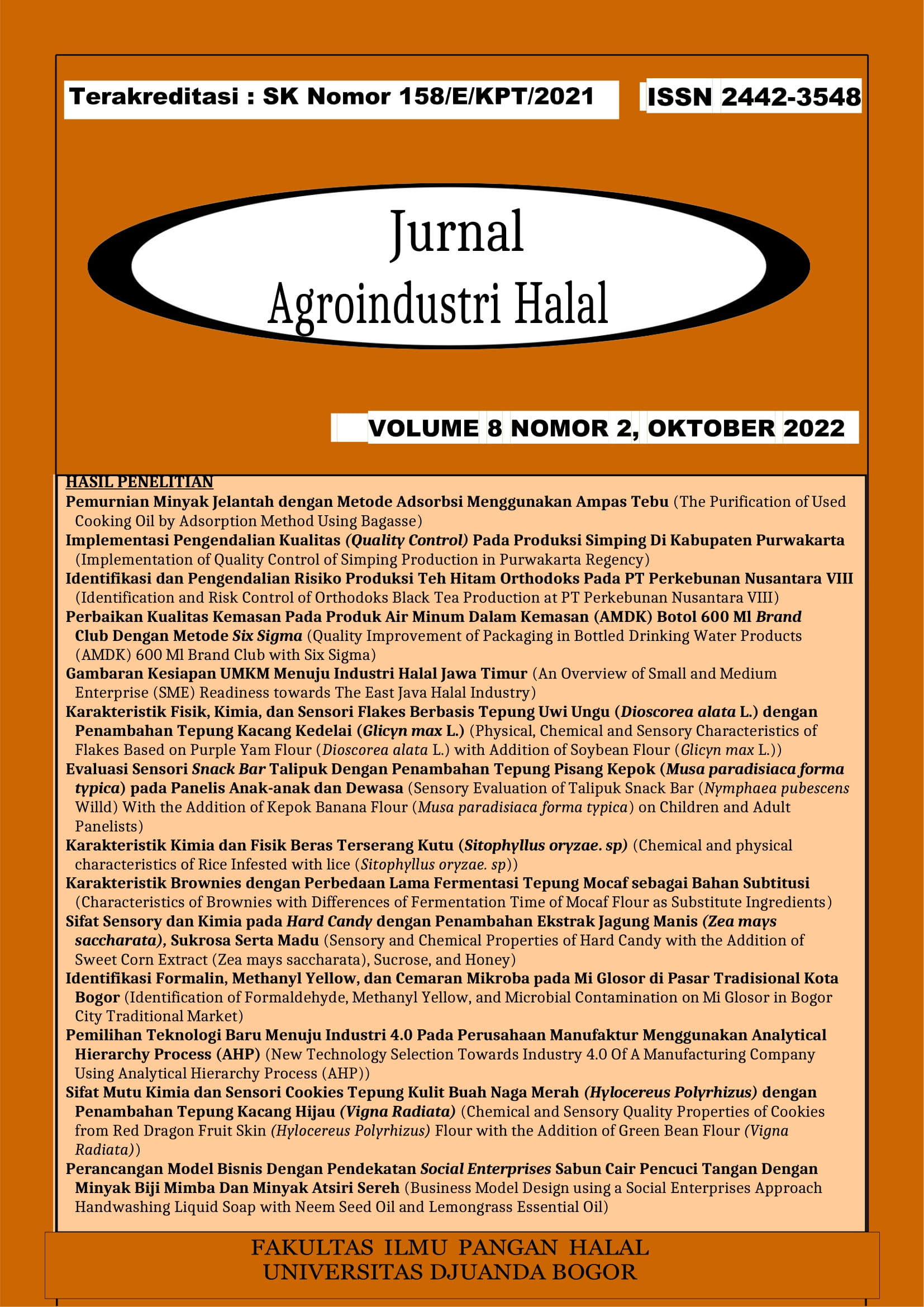
Identifikasi dan Pengendalian Risiko Produksi Teh Hitam Orthodoks Pada PT Perkebunan Nusantara VIII
Identification and Risk Control of Orthodox Black Tea Production at PT Perkebunan Nusantara VIII (Case Studi in Afdeling Sinumbra, Rancabali Tea Plantation, West Java)
DOI:
https://doi.org/10.30997/jah.v8i2.6352Keywords:
House of Risk (HOR), Risk Management, TeaAbstract
Tea is one of the leading commodities in Indonesia and is mostly produced in West Java, where Afdeling Sinumbra is one of the plantations that produce Orthodox black tea under the auspices of PT Perkebunan Nusantara VIII but has the smallest production contribution. This indicates that there are problems regarding production, and a risk management analysis is needed. The research was carried out from the plantation and processing levels using the House of Risk method consisting of stages 1 and 2. Stage 1 aims to identify risk events and the causes or sources of these risks. While stage 2 aims to formulate appropriate handling strategies to minimize the impact caused by risk sources. This study shows that crop failure is the biggest risk event at the plantation level stemming from delays in handling pests and diseases. The handling strategy that can be done is to increase discipline. Meanwhile, at the processing level, there is a risk that production and grading are not achieved, which stems from the implementation of SOPs that are not appropriate. The handling strategy that can be done is to warm up the engine, repair the engine, and train.
References
Assauri, S. (1999). Manajemen Produksi dan Operasi. Jakarta: LPFEUI.
Darmawi, H. (2010). Manajemen Risiko. Jakarta: PT Bumi Aksara.
Direktorat Jenderal Perkebunan. (2018). Produksi Teh Menurut Provinsi di Indonesia. Kementerian Perkebunan.
Gartina, D., & Sukriya, R. L. (2019). Statistik Perkebunan Indonesia 2018-2020. Jakarta: Direktorat Jenderal Perkebunan.
Kurniawati, O. (2011). Analisis Pengaruh Faktor-Faktor Kedisiplinan Terhadap Prestasi Kerja Pekerja Operasional pada PT Trimarina Jaya di Surabaya. Jurnal Ilmiah Ilmu-Ilmu Sosial dan Humaniora, 8(2), 108-111.
Nazaruddin & Paimin. (1993). In Faturrohmah, Analisis Risiko Produksi Teh Basah Pada PT Perkebunan Nusantara VIII Gunung Mas Kabupaten Bogor Jawa Barat (p. 61). Bogor: Departemen Agribisnis. Fakultas Ekonomi dan Manajemen. Institut Pertanian Bogor.
Pujawan, I. N., & Geraldin, L. H. (2009). House of Risk : a model for proactive supply chain risk management. Supply Chain Risk Management, 15(6), 953-967.
Rohdiana, D. (2015). Teh : Proses, Karakteristik & Komponen Fungsionalnya. 10(8), pp. 34-37.
Setyawan, E. Y., Lomi, A., & Saleh, C. (2021). Penggunaan Wood Pellet Untuk Bahan Bakar Produksi Tahu di UKM Kab.Kediri. Jurnal Aplikasi Sains Teknologi Nasional, 02(02), 22-28.
Silalahi, F. (1997). Manajemen Risiko dan Asuransi. Gramedia.
Soekartawi. (1993). Risiko dan Ketidakpastian Dalam Agribisnis : Teori dan Aplikasi. Jakarta: Raja Grafindo Persada.
Tambunan, R. M. (2013). Standard Operating Procedures (SOP) (2 ed.). Jakarta: Maeistas Publishing.
Vaughan, E. J. (1978). Fundamental of Risk and Insurance. New York: John Willey.
Downloads
Published
How to Cite
Issue
Section
License

This work is licensed under a Creative Commons Attribution-ShareAlike 4.0 International License.
Authors who publish with Jurnal Agroindustri Halal agree to the following terms:
- Authors retain copyright and grant the journal right of first publication with the work simultaneously licensed under a Creative Commons Attribution 4.0 International License that allows others to share the work with an acknowledgement of the work's authorship and initial publication in Jurnal Agroindustri Halal.
- Authors are able to enter into separate, additional contractual arrangements for the non-exclusive distribution of the journal's published version of the work (e.g., post it to an institutional repository or publish it in a book), with an acknowledgement of its initial publication in Jurnal Agroindustri Halal.
- Authors are permitted and encouraged to post their work online (e.g., in institutional repositories or on their website) prior to and during the submission process, as it can lead to productive exchanges, as well as earlier and greater citation of published work