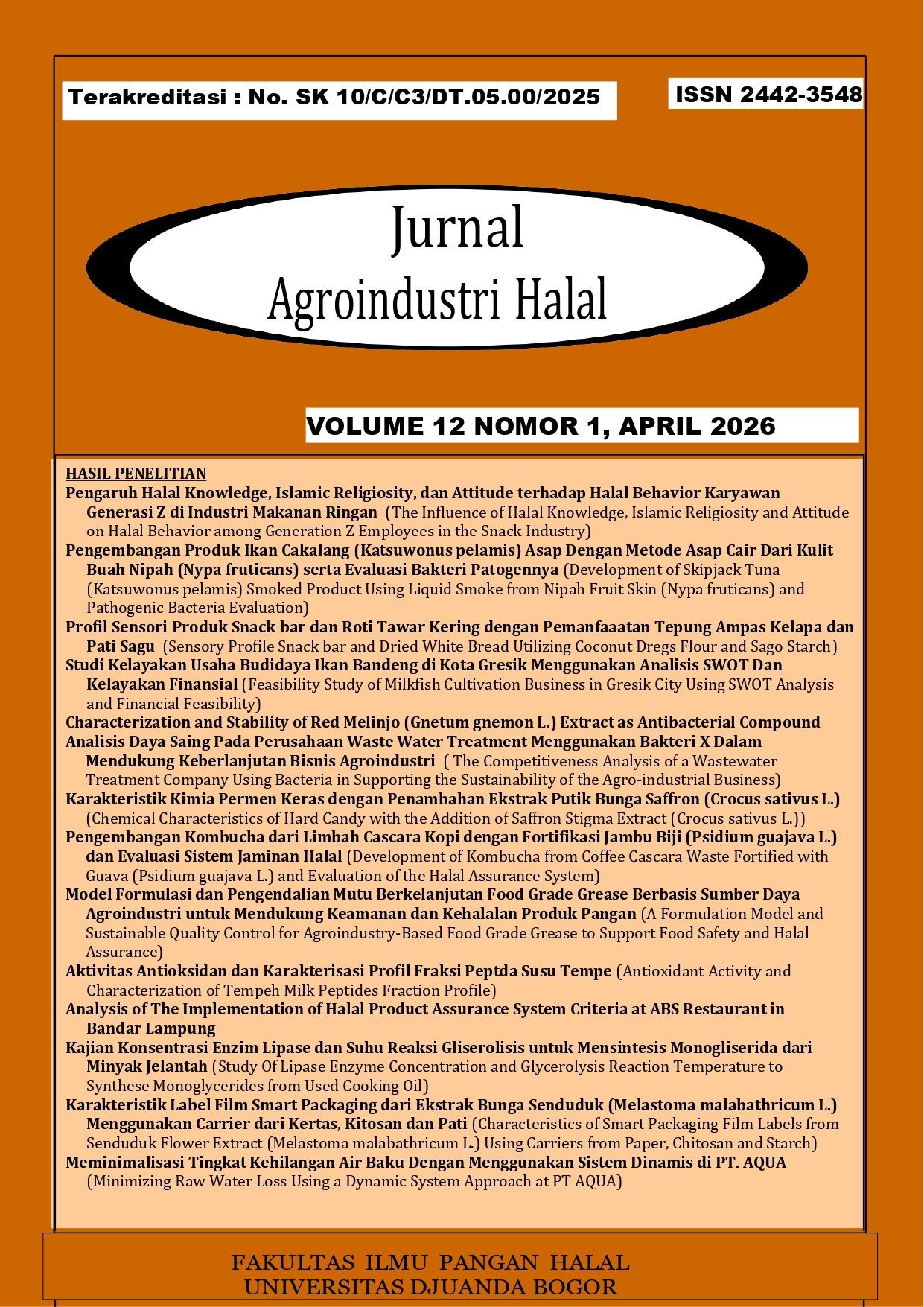
Analisis Daya Saing Pada Perusahaan Waste Water Treatment Menggunakan Bakteri X Dalam Mendukung Keberlanjutan Bisnis Agroindustri
DOI:
https://doi.org/10.30997/jah.v12i1.22376Keywords:
competitiveness, performance, strategy, VRIO, wastewaterAbstract
The need for agro-industrial wastewater management has become a business opportunity for management services. However, this business requires sustainable competitiveness to survive. PT XYZ is a wastewater management service company for the agro-industry with a fluctuating margin value. The objective of this study is to analyze the company's competitiveness based on its resources.This research uses a mixed-method approach, combining expert interviews and performance assessment of each indicator with the VRIO approach, as well as quantitative descriptive analysis using mean values and weights. The results of the identification and analysis indicate that the main resources owned by the company are intangible resources and core competencies, while two other resources require improvement in the aspects of difficult to imitate and being well-organized. The findings of this study recommend improvements through innovation in the technical, documentation, and marketing aspects so that the company can achieve sustainable competitiveness. Furthermore, the company also needs to invest in tangible resources with innovation for long-term competitiveness and enhance the performance of its existing resources.
References
Albalawneh A, Chang TK. (2015). Review of the greywater and proposed greywater recycling scheme for agricultural irrigation reuses. Int. J. Res. – Granthaalayah, 3(12), 16-35
Alifia, S., & Dalimunthe, G. P. (2024). Operationalisation of internal analysis using the vrio framework: assessing resource and capability management in a bandung-based coffee business (case study: kopi Anjis). International Journal of Economics and Management Research, 3(3), 286-296.
Ariyani, W., & Daryanto, A. (2018). Operationalization of internal analysis using the VRIO framework: Development of scale for resource and capabilities organization (Case study: XYZ company animal feed business unit). Asian Business Research Journal, 3, 9-14.
Barney, J. (1991). Firm resources and sustained competitive advantage. Journal of Management, 17(1), 99–120.
Kementerian PPN/Bappenas. (2020). RPJMN 2020–2024. Kementerian Perencanaan Pembangunan Nasional/Bappenas
Kindström, D. (2010). Towards a service-based business model—Key aspects for future competitive advantage. European Management Journal, 28(6), 479–490. https://doi.org/10.1016/j.emj.2010.07.002
Nzila A. Razzak SA, Zhu J. 2016. Bioaugmentation: an emerging strategy of industrial wastewater treatment for reuse and discharge. Int J Env. Res Public Health. 13(9):1-20.
Piyanto, D., & Susilowati, E. (2021). Efektivitas penggunaan bakteri dalam pengolahan limbah cair domestik. Jurnal Teknik Lingkungan, 27(2), 145–154.
Rahmawati, A., & Nugroho, R. (2020). Analisis pemanfaatan bioteknologi pada pengolahan limbah cair industri makanan. Jurnal Teknologi dan Industri Pangan, 31(1), 63–72.
Teece, D. J. (2010). Business models, business strategy and innovation. Long Range Planning, 43(2–3), 172–194. https://doi.org/10.1016/j.lrp.2009.07.003
UNICEF. (2021). Water, Sanitation and Hygiene in Urban Settings: Case Studies from Indonesia
Wheelen, T. L., & Hunger, J. D. (2018). Strategic Management and Business Policy: Globalization, Innovation and Sustainability (15th ed.). London: Pearson
Widodo, R. Y., Sudarsono, M. I., & Astuti, D. (2013). Teknologi pengolahan limbah cair berbasis biologi untuk industri rumah tangga. Jurnal Teknologi Lingkungan, 14(2), 141–148.
WWF Indonesia. (2019). Laporan Kondisi Sungai Indonesia.
Downloads
Published
How to Cite
Issue
Section
License
Copyright (c) 2026 Aufaa Afiffah Ainii, Yudha Heryawan Asnawi, Asep Taryana

This work is licensed under a Creative Commons Attribution-ShareAlike 4.0 International License.
Authors who publish with Jurnal Agroindustri Halal agree to the following terms:
- Authors retain copyright and grant the journal right of first publication with the work simultaneously licensed under a Creative Commons Attribution 4.0 International License that allows others to share the work with an acknowledgement of the work's authorship and initial publication in Jurnal Agroindustri Halal.
- Authors are able to enter into separate, additional contractual arrangements for the non-exclusive distribution of the journal's published version of the work (e.g., post it to an institutional repository or publish it in a book), with an acknowledgement of its initial publication in Jurnal Agroindustri Halal.
- Authors are permitted and encouraged to post their work online (e.g., in institutional repositories or on their website) prior to and during the submission process, as it can lead to productive exchanges, as well as earlier and greater citation of published work