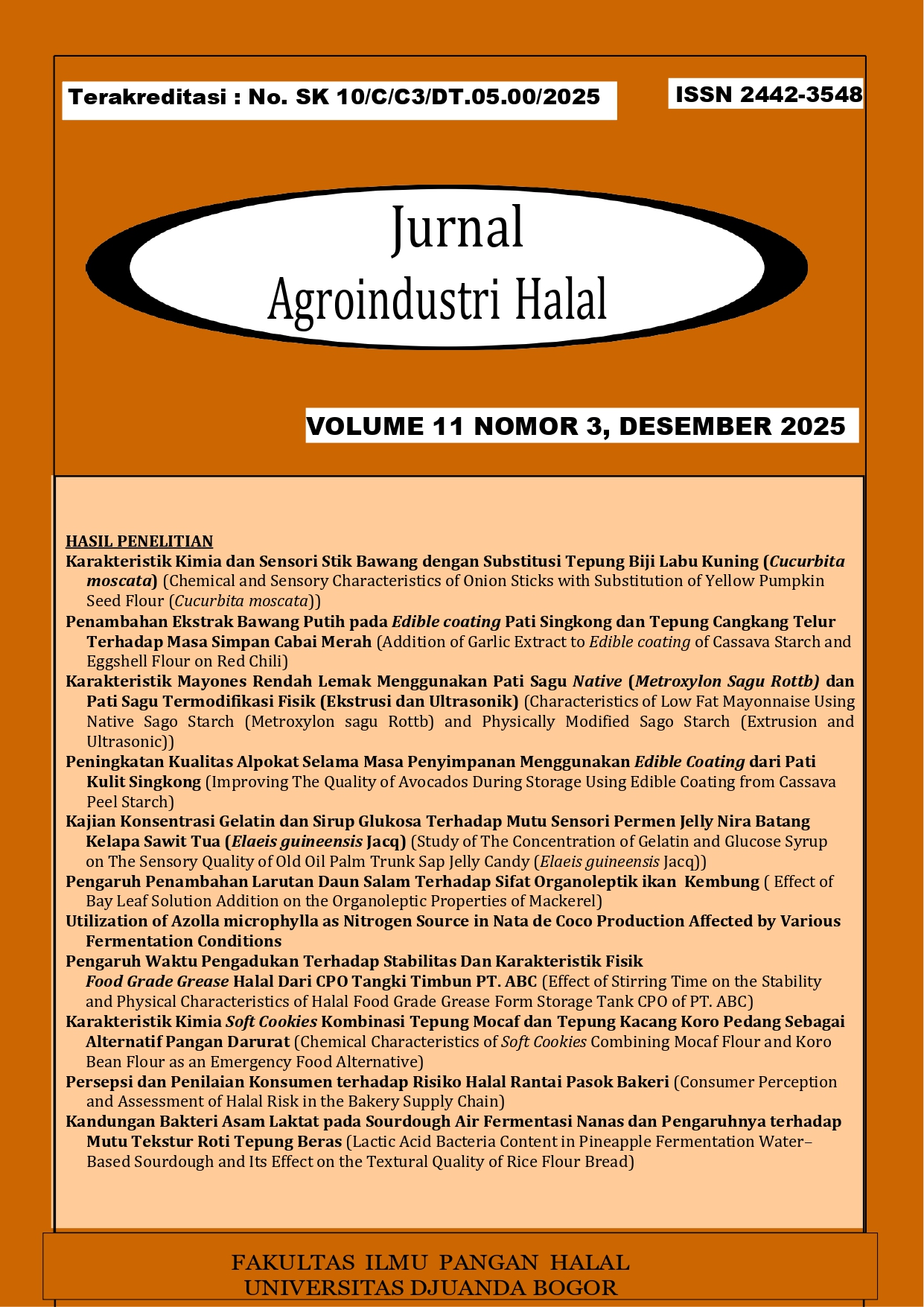
Utilization of Azolla microphylla as Nitrogen Source in Nata de Coco Production Affected by Various Fermentation Conditions
DOI:
https://doi.org/10.30997/jah.v11i3.21364Keywords:
Acetobacter xylinum, ammonium sulfate, edible cellulose, floating plants, optimizationAbstract
Ammonium sulfate (ZA) is commonly used as a nitrogen source in nata de coco production. However, its synthetic nature may leave harmful residues with long-term consumption. In this study, the floating aquatic plant Azolla microphylla was investigated as a natural alternative nitrogen source to replace ZA. The experiment evaluated the influence of fermentation temperature (26.3 °C and 30 °C), types of carbon sources (sucrose, glucose, fructose, and lactose), sugar concentrations (2%, 4%, 6%, and 8%), and starter concentrations (5% and 10%) on nata de coco production using A. microphylla as the nitrogen source. The results demonstrated that among the carbon sources tested, fructose at an incubation temperature of 30 °C was the most effective in supporting optimal nata formation, in terms of yield (39.08 %), thickness (1.15 cm), and crude fiber (8.59 %). Meanwhile, the combination of 6% sugar and 10% starter concentration produced the best nata de coco in terms of thickness (1.20 cm), yield (33.05 %), crude fiber content (8.69 %), and hardness value (8.34 N). This study confirms the potential of Azolla microphylla as a promising alternative to ammonium sulfate in nata de coco fermentation under well-optimized conditions.
References
Andasuryani, A. K., & Derosya, V. (2021). Analysis of proximate and mechanical characteristics of Nata de coco of three types of coconut fermentation media. Annals of Agri-Bio Research, 26(1), 85-89
AOAC International. (2005). Official Methods of Analysis of AOAC International, 18th Edition. AOAC.
Attaqy, F., Kurniasih, S., & Munarti, M. (2023). Effect of Sugar Type Variation on Nata de Coco Growth. Jurnal Ilmiah Biologi Eksperimen Dan Keanekaragaman Hayati (J-BEKH), 10(2), 48-52.
Chairunnissa, H., & Balia, R. L. (2018). Karakteristik fisik dan kimia nata de milko dari susu substandar dengan variasi lama inkubasi. Jurnal Ilmu Ternak Universitas Padjadjaran, 18(2), 86-94.
Bourne, M. C. (2002). Food texture and viscosity: concepts and measurements. Academic Press, UK.
Halib, N., Amin, M. C. I. M., & Ahmad, I. (2012). Physicochemical properties and characterization of nata de coco from local food industries as a source of cellulose. Sains Malaysiana, 41(2), 205-211.
Hamad, A., Andriyani, N. A., Wibisono, H., & Sutopo, H. (2011). Pengaruh penambahan sumber karbon terhadap kondisi fisik nata de coco. Techno (Jurnal Fakultas Teknik, Universitas Muhammadiyah Purwokerto), 12(2), 74-77.
Hamad, S., Widyawati, M., & Widyastuti, S. (2021). Pengaruh Jenis Gula Terhadap Ketebalan dan Rendemen Nata de Coco (Studi Pendahuluan). Techno: Jurnal Penelitian, 20(1), 17–24.
Hendrawati, H., Zulfitri, Z., & Yuliani, S. (2019). Utilization of whey waste as a substrate for making nata de whey. Jurnal Teknologi dan Industri Pangan, 30(2), 179–187.
Lasagni, F., Cassanelli, S., & Gullo, M. (2024). How carbon sources drive cellulose synthesis in two Komagataeibacter xylinus strains. Scientific Reports, 14(1), 20494.
Manurung, H., Naibaho, B., & Simbolon, E. (2024). Pengaruh amonium sulfat dan gula terhadap bobot produksi, ketebalan, kekerasan dan kadar serat nata de coco. AGRIVISI Journal of Agricultural Sciences (AJAS), 1(1).
Maulani, T. R., Hakiki, D. N., & Nursuciyoni, N. (2018). Karakteristik Sifat Fisikokimia Nata de Taro Talas Beneng dengan Perbedaan Konsentrasi Acetobacter xylinum dan Sumber Karbon. Jurnal Teknologi Industri Pertanian, 28(3), 295–300.
Maryam, A. (2020). Analisis karakteristik mutu nata de leri dengan variasi konsentrasi gula pasir sebagai sumber karbon. Cross-border, 3(2), pp.252-260.
Melindasari, F., Wahyudi, V. A., Husna, A., Utomo, J. S., & Elianarni, D. (2025). Pengaruh Konsentrasi Starter Acetobacter xylinum Terhadap Karakteristik Fisikokimia dan Organoleptik Nata de Mango (Mangifer indica L). Food Technology and Halal Science Journal, 8(1), 46-56.
Nurdin, G. M. (2023). Pengaruh Konsentrasi Starter Acetobacter xylinum dan Lama Fermentasi Terhadap Kualitas Produk Nata de coco. BIOMA: Jurnal Biologi dan Pembelajarannya, 5(2), 116-125.
Ota, Y., Hasumura, M., Okamura, M., Takahashi, A., Ueda, M., Onodera, H., Imai, T., Mitsumori, K., & Hirose, M. (2006). Chronic toxicity and carcinogenicity of dietary administered ammonium sulfate in F344 rats. Food and chemical toxicology, 44(1), 17-27.
Pa’e, N., Hamid, N. I. A., Khairuddin, N., Zahan, K. A., Seng, K. F., Siddique, B. M., & Muhamad, I. I., 2014. Effect of different drying methods on the morphology, crystallinity, swelling ability and tensile properties of nata de coco. Sains Malaysiana, 43(5), 767-773.
Purwani, E., Pramesti, A. C., & Sekarini, L. (2023). Sifat Fisiko Kimia Nata De Coco Berdasarkan Jumlah Starter yang Berbeda dengan Media yang Ditambahkan Bunga Rosella (Hibiscus sabdariffa Lynn), Prosiding University Research Colloquium, 485–497.
Rose, D., Ardiningsih, P., & Idiawati, N. (2018). Karakteristik nata de jackfruit (Artocarpus heterophyllus) dengan variasi konsentrasi starter Acetobacter xylinum. Jurnal Kimia Khatulistiwa, 7(4), 1-7.
Santosa, B., Rozana, R., & Astutik, A. (2021). Pemanfaatan sumber nitrogen organik dalam pembuatan nata de coco. Teknologi Pangan: Media Informasi Dan Komunikasi Ilmiah Teknologi Pertanian, 12(1), 52-60.
Sihmawati, R. R., Oktoviani, D., & Untag, W. (2014). Aspek mutu produk Nata de Coco dengan penambahan sari buah mangga. J. Tek. Ind. HEURISTIS.
Sudheerkumar Talawar, B., Narayanswamy, B., & Ravindra, S.N. (2015). Optimization of Fermentation Conditions for Nata‑de‑Coco Production. Journal of Pure and Applied Microbiology, 9(1), pp.335–340.
Sun, B., Zi, Q., Chen, C., Zhang, H., Gu, Y., Liang, G., & Sun, D. (2018). Study of specific metabolic pattern of Acetobacter xylinum NUST4. 2 and bacterial cellulose production improvement. Cellul. Chem. Technol, 52(9-10), 795-801.
Wardhana, E., Rusmarilin, H., & Yusraini, E. (2016). Pengaruh konsentrasi gula dan pH terhadap mutu nata de yammy dari limbah cair pati bengkuang. Jurnal Rekayasa Pangan Dan Pertanian, 4(3), 323-331.
Yanti, N. A., Ahmad, S. W., Tryaswaty, D., & Nurhana, A. (2017). Pengaruh penambahan gula dan nitrogen pada produksi nata de coco. BioWallacea: Jurnal Penelitian Biologi (Journal of Biological Research), 4(1), 541-546.
Downloads
Published
How to Cite
Issue
Section
License
Copyright (c) 2025 Afifa Husna, Nanda Reviana, Shelly Pradita, Elfi Saati, Devi Siskawardani, Ilmam Fahmi

This work is licensed under a Creative Commons Attribution-ShareAlike 4.0 International License.
Authors who publish with Jurnal Agroindustri Halal agree to the following terms:
- Authors retain copyright and grant the journal right of first publication with the work simultaneously licensed under a Creative Commons Attribution 4.0 International License that allows others to share the work with an acknowledgement of the work's authorship and initial publication in Jurnal Agroindustri Halal.
- Authors are able to enter into separate, additional contractual arrangements for the non-exclusive distribution of the journal's published version of the work (e.g., post it to an institutional repository or publish it in a book), with an acknowledgement of its initial publication in Jurnal Agroindustri Halal.
- Authors are permitted and encouraged to post their work online (e.g., in institutional repositories or on their website) prior to and during the submission process, as it can lead to productive exchanges, as well as earlier and greater citation of published work