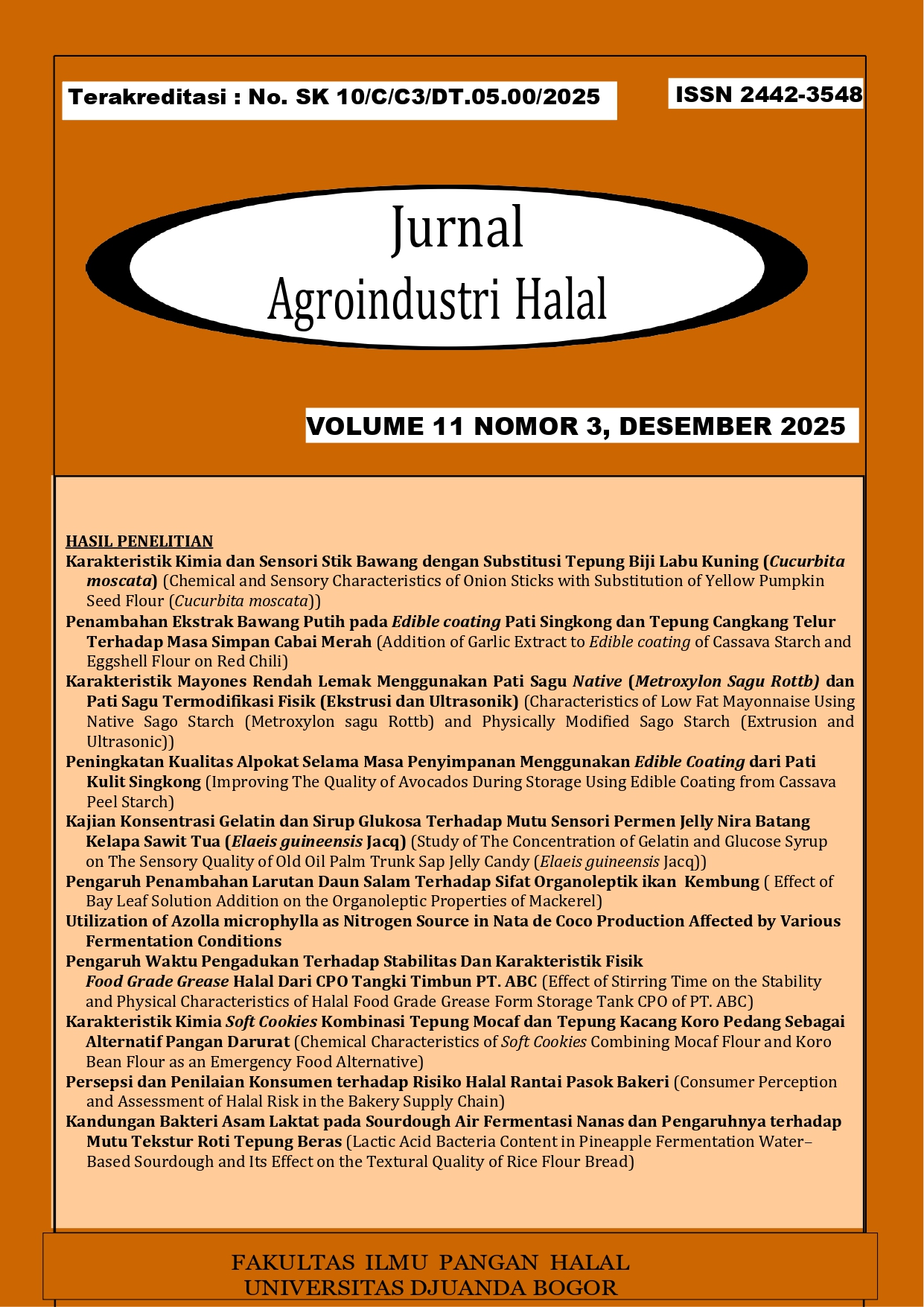
Kajian Konsentrasi Gelatin dan Sirup Glukosa Terhadap Mutu Sensori Permen Jelly Nira Batang Kelapa Sawit Tua (Elaeis guineensis Jacq)
DOI:
https://doi.org/10.30997/jah.v11i3.18922Keywords:
jelly candy, old oil palm trunk, sensory qualityAbstract
Old palm oil palm sap contains an appreciable amount of sugar. An alternatif to utilize the sap from old palm trunks is to process into jelly candy. This research was aimed to determine the right formulation of gelatin and glucose sugar to produce jelly candy made from palm tree sap with the best sensory quality and chemical properties. The research was carried out as a non-factorial, arranged in a Completely Randomized Design (CRD) with 5 replications. The experiment was conducted through two stages. The first stage was the addition of gelatin concentration of 2%, 3%, 4%, 5% and 6% with glucose syrup of 10 %. The best result from the first stage was then continued to find the best concentration of glucose syrup at 0%, 2.5%, 5%, 7.5% and 10% in the second stage. The test results show that the best gelatin concentration was 6%. In the second stage, the best glucose syrup concentration was 2.5%.
References
Alipal, J., Pu’ad, N. A. S. M., Lee, T. C., Nayan, N. H. M., Sahari, N., Basri, H., Idris, M. I., & Abdullah, H. Z. (2021). A review of gelatin: Properties, sources, process, applications, and commercialisation. Materials Today: Proceedings, 42, 240–250. https://doi.org/10.1016/j.matpr.2020.12.922
AOAC International. (2016). Official methods of analysis of AOAC International (20th ed.). AOAC International.
Assqiya, A. A. L. (2024). Karakteristik gula cair batang kelapa sawit tua berdasarkan penundaan waktu ekstraksi nira [Tesis, Universitas Lampung].
DeGarmo, E. P., Sullivan, W. G., & Canada, J. R. (1984). Engineering economy (7th ed.). Macmillan.
Déléris, I., Saint-Eve, A., Dakowski, F., Sémon, E., Le Quéré, J.-L., Guillemin, H., & Souchon, I. (2011). The dynamics of aroma release during consumption of candies of different structures, and relationship with temporal perception. Food Chemistry, 127(4), 1615–1624. https://doi.org/10.1016/j.foodchem.2011.02.028
Grace, P. A., Nurali, E. J. N., & Assa, J. R. (2021). Pengaruh konsentrasi gelatin dan sukrosa terhadap kualitas fisik, kimia dan sensoris permen jelly tomat (Lycopersicum esculentum Mill). Jurnal Teknologi Pertanian, 12(2), 80–88. https://doi.org/10.35791/jteta.v12i2.38962
Jiamjariyatam, R. (2018). Influence of gelatin and isomaltulose on gummy jelly properties. International Food Research Journal, 25(2), 776–783. http://www.ifrj.upm.edu.my/25%20(02)%202018/(46).pdf
Juliasti, R., Legowo, A. M., & Pramono, Y. B. (2015). Pemanfaatan limbah tulang kaki kambing sebagai sumber gelatin dengan perendaman menggunakan asam klorida. Jurnal Aplikasi Teknologi Pangan, 4(1), 5–10. https://core.ac.uk/download/pdf/294883417.pdf
Lesmayati, S., Qomariah, R., Awanis, & Anggreany, S. (2022). Effect of gelatin and citric acid concentration on chemical and organoleptic properties of jelly citrus. IOP Conference Series: Earth and Environmental Science, 1024(1), 012025. https://doi.org/10.1088/1755-1315/1024/1/012025
Miller, G. L. (1959). Use of dinitrosalicylic acid reagent for determination of reducing sugar. Analytical Chemistry, 31(3), 426–428. https://doi.org/10.1021/ac60147a030
Nelwan, B., Langi, T., Koapaha, T., & Tuju, T. (2015). Pengaruh konsentrasi gelatin dan sirup glukosa terhadap sifat kimia dan sensoris permen jelly sari buah pala (Myristica fragrans Houtt). Jurnal COCOS, 6(3), 16–25. https://ejournal.unsrat.ac.id/index.php/cocos/article/view/6818
Nurilmala, M., Darmawan, N., Putri, E. A. W., Jacoeb, A. M., & Irawadi, T. T. (2021). Pangasius fish skin and swimbladder as gelatin sources for hard capsule material. International Journal of Biomaterials, 2021, Article 6658002. https://doi.org/10.1155/2021/6658002
Pelawi, J. M., Bimantio, M. P., & Kusumastuti. (2023). Karakteristik permen gummy temumangga (Curcuma mangga Val.) dengan penambahan sari buah nangka. Biofoodtech: Journal of Bioenergy and Food Technology, 2(2), 61–74. https://doi.org/10.55180/biofoodtech.v2i02.614
Pop, D. M. (2023). Sensory evaluation techniques of food. Annals of “Valahia” University of Târgoviște. Agriculture, 15(2), 58–62. https://doi.org/10.2478/agr-2023-0019
Rather, J. A., Akhter, N., Ashraf, Q. S., Mir, S. A., Makroo, H. A., Majid, D., Barba, F. J., Mousavi Khaneghah, A., & Dar, B. N. (2022). A comprehensive review on gelatin: Understanding impact of the sources, extraction methods, and modifications on potential packaging applications. Food Packaging and Shelf Life, 34, 100945. https://doi.org/10.1016/j.fpsl.2022.100945
Rivero, R., Archaina, D., Sosa, N., & Schebor, C. (2023). Sensory characterization, acceptance, and stability studies on low calories fruit jelly candies. Journal of Food Science and Technology, 60(8), 2204–2212. https://doi.org/10.1007/s13197-023-05747-7
Sachlan, P. A. A. U., Mandey, L. C., & Langi, T. M. (2019). Sifat organoleptik permen jelly mangga kuini (Mangifera odorata Griff) dengan variasi konsentrasi sirup glukosa dan gelatin. Jurnal Teknologi Pertanian, 10(2), 113–118. https://ejournal.unsrat.ac.id/index.php/teta/article/download/29121/28318
Sari, E. M., Fitriani, S., & Ayu, D. F. (2022). Penggunaan sari buah kelubi dan gelatin dalam pembuatan permen jelly. Jurnal Teknologi dan Industri Pertanian Indonesia, 14(2), 81–87. https://doi.org/10.17969/jtipi.v14i2.23309
Simorangkir, T. R. S., Rawung, D., & Moningka, J. (2017). Pengaruh konsentrasi sukrosa terhadap karakteristik permen jelly sirsak (Annona muricata Linn). Jurnal COCOS, 9(3), 1–13. https://ejournal.unsrat.ac.id/index.php/cocos/article/view/17777
Ulum, K., Putriningrum, I., Yustina, R. D., Murdiyatmo, U., & Wardani, A. K. (2020). Studi komparasi: Produksi bioetanol nira batang kelapa sawit oleh flokulan dan non-flokulan Saccharomyces cerevisiae. AgriTech, 40(4), 322–331. https://doi.org/10.22146/agritech.40938
Wardhani, A. P. (2022). Karakteristik sensori permen jelly dari jeruk siam banjar (Citrus nobilis) dengan variasi konsentrasi gelatin dan agar. Jurnal Sains STIPER Amuntai, 12(1), 16–22. https://doi.org/10.36589/rs.v12i1.202
Downloads
Published
How to Cite
Issue
Section
License
Copyright (c) 2025 Siti Nurdjanah, Alif Fikri Nur Hidayat, Udin Hasanudin

This work is licensed under a Creative Commons Attribution-ShareAlike 4.0 International License.
Authors who publish with Jurnal Agroindustri Halal agree to the following terms:
- Authors retain copyright and grant the journal right of first publication with the work simultaneously licensed under a Creative Commons Attribution 4.0 International License that allows others to share the work with an acknowledgement of the work's authorship and initial publication in Jurnal Agroindustri Halal.
- Authors are able to enter into separate, additional contractual arrangements for the non-exclusive distribution of the journal's published version of the work (e.g., post it to an institutional repository or publish it in a book), with an acknowledgement of its initial publication in Jurnal Agroindustri Halal.
- Authors are permitted and encouraged to post their work online (e.g., in institutional repositories or on their website) prior to and during the submission process, as it can lead to productive exchanges, as well as earlier and greater citation of published work