Profiling Senyawa Volatil Daging Sapi dengan Berbagai Pengolahan Menggunakan Metode Headspace-GC/MS
The Profiling of Volatile Compounds in Beef with Various Processing Methods Using the Headspace GC/MS
DOI:
https://doi.org/10.30997/jiph.v8i1.24303Keywords:
Authentication , beef, volatile compounds, volatilomicsAbstract
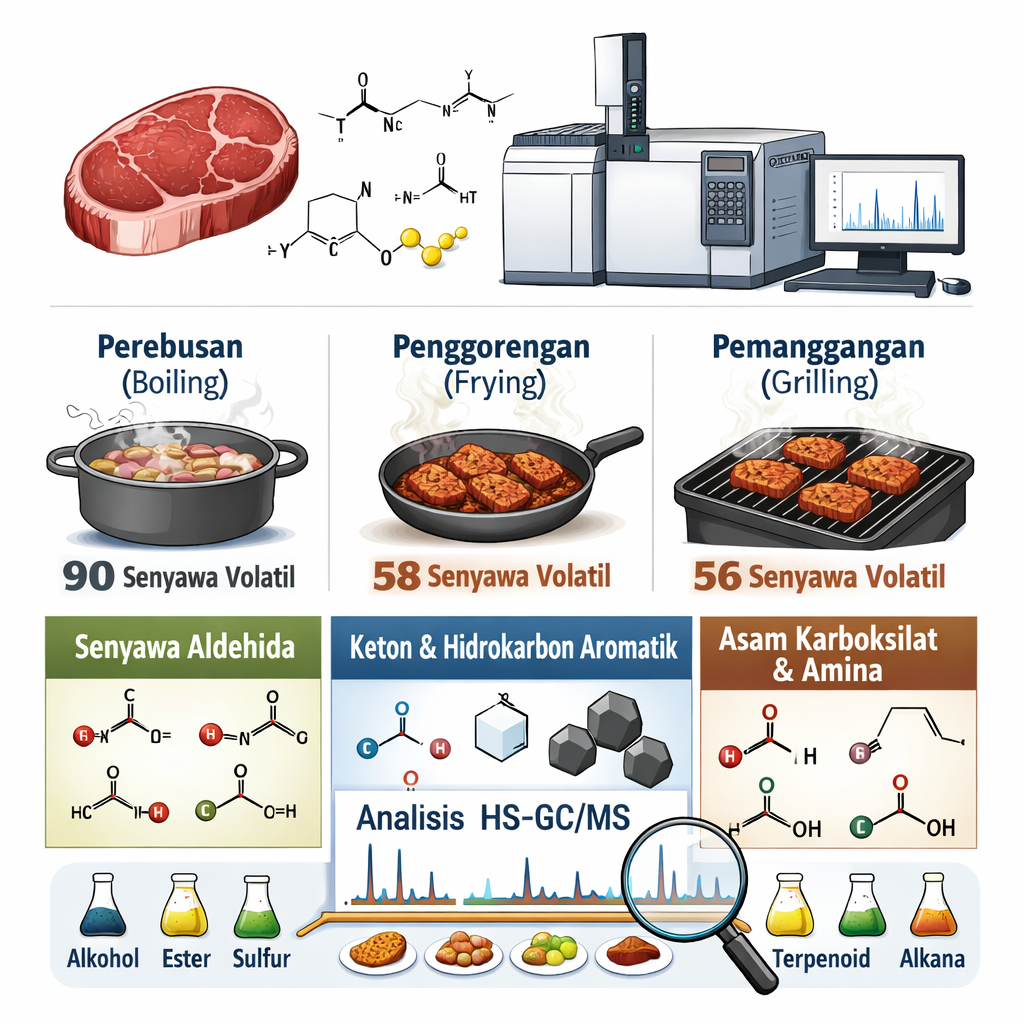
Volatile compound profiling is important for understanding the aroma characteristics of beef and supporting the authentication of meat-based products. This study aimed to examine the volatile profile of beef (Bos taurus) processed by boiling, frying, and roasting using the Headspace Gas Chromatography–Mass Spectrometry (HS-GC/MS) method. Round beef samples from five cattle were subjected to the three heat treatments and analyzed based on retention time and peak area to determine the types and relative abundances of volatile compounds. The results showed that boiled beef produced 91 volatile compounds, while fried and roasted beef generated 58 and 56 compounds, respectively. The identified compounds included aldehydes, ketones, carboxylic acids, alcohols, esters, aromatic hydrocarbons, sulfur compounds, alkanes, terpenoids, amides, and amines. Boiling was mainly characterized by compounds derived from mild lipid oxidation, frying by more intensive Maillard reactions, and roasting by advanced Maillard reactions and Strecker degradation. These findings indicate that processing methods influence the volatile composition and aroma characteristics of beef. The HS-GC/MS approach provides valuable information for food authentication.
References
Amalia, L., Kusnandar, F., Yuliana, N. D., & Sugita, P. (2022). Profiling of Volatile Compounds in Beef, Rat, and Wild Boar Meat using SPME-GC/ MS. Sains Malaysiana, 51(9), 2897–2911. https://doi.org/10.17576/jsm-2022-5109-13
Amalia, L., Novidahlia, N., Kusumaningrum, I., Mulya, S., Mardiah, M., Jumiono, A., Eliska, A., Ramadhan, M. F., & Lidiyani, N. (2025). Senyawa Volatil Daging Celeng (Sus scrofa vittatus) dengan Berbagai Pengolahan Menggunakan Metode SPME-GC/MS. 11(April), 123–133.
Bai, S., You, L., Ji, C., Zhang, T., Wang, Y., Geng, D., Gao, S., Bi, Y., & Luo, R. (2022). Formation of volatile flavor compounds , maillard reaction products and potentially hazard substance in China stir-frying beef sao zi. Food Research International, 159(March), 111545. https://doi.org/10.1016/j.foodres.2022.111545
Jung, Y., Kim, H. J., Kim, D., Joo, B., Jhoo, J. W., & Jang, A. (2023). Physicochemical Properties and Volatile Organic Compounds of Dairy Beef Round Subjected to Various Cooking Methods. Food Science of Animal Resources, 43(5), 767–791. https://doi.org/10.5851/KOSFA.2023.E35
Jumiono, A. (2022). Identifikasi Titik Kritis Kehalalan Bahan Hewani dan Produk Turunan Hewan. Jurnal Ilmiah Pangan Halal, 4(2), 51–58. https://doi.org/10.30997/jiph.v4i2.9909
Indriani, L., Hutami, R. ., & Amalia, L. (2024). Deteksi Cemaran Protein Babi Bakso Daging Sapi Pedagang Keliling Di Kota Bekasi. Jurnal Ilmiah Pangan Halal, 6(1), 22–29. https://doi.org/10.30997/jiph.v6i1.13136
Kosowska, M., Majcher, M. A., & Fortuna, T. (2017). Volatile compounds in meat and meat products. Food Science and Technology (Brazil), 37(1), 1–7. https://doi.org/10.1590/1678-457X.08416
Lammers, M., Dietze, K., & Ternes, W. (2009). A comparison of the volatile profiles of frying european and australian wild boar meat with industrial genotype pork by dynamic headspace-GC/MS analysis. Journal of Muscle Foods, 20(3), 255–274. https://doi.org/10.1111/j.1745-4573.2009.00146.x
Morsli, F., Moloney, A. P., Monahan, F. J., Dunne, P. G., Mannion, D. T., Skibinska, I., & Kilcawley, K. N. (2025). Impact of Different Grilling Temperatures on the Volatile Profile of Beef. 1–18.
Nawangsari, C. K., Istikharah, R., & Prabowo, M. H. (2025). Kajian Literatur: Validasi Metode Multiplex Real Time Polymerase Chain Reaction (Real Time PCR) Pada Identifikasi Babi. Jurnal Ilmiah Pangan Halal, 7(3), 390–404. https://doi.org/10.30997/jiph.v7i3.21356
Pavlidis, D. E., Mallouchos, A., Ercolini, D., Panagou, E. Z., & Nychas, G. J. E. (2019). A volatilomics approach for off-line discrimination of minced beef and pork meat and their admixture using HS-SPME GC/MS in tandem with multivariate data analysis. Meat Science, 151(January), 43–53. https://doi.org/10.1016/j.meatsci.2019.01.003
Sohail, A., Al-dalali, S., Wang, J., Xie, J., Shakoor, A., Asimi, S., Shah, H., & Patil, P. (2022). Aroma compounds identified in cooked meat : A review. 157(May).
Soria, A. C., García-Sarrió, M. J., & Sanz, M. L. (2015). Volatile sampling by headspace techniques. TrAC - Trends in Analytical Chemistry, 71, 85–99. https://doi.org/10.1016/j.trac.2015.04.015
Wojtasik-Kalinowska, I., Szpicer, A., Binkowska, W., Hanula, M., Marcinkowska-Lesiak, M., & Poltorak, A. (2023). Effect of Processing on Volatile Organic Compounds Formation of Meat—Review. Applied Sciences (Switzerland), 13(2). https://doi.org/10.3390/app13020705
You, L., Zhang, Y., Ma, Y., Wang, Y., & Wei, Z. (2025). Effect of Boiling Time on the Color, Water, Protein Secondary Structure, and Volatile Compounds of Beef. Foods, 14(8). https://doi.org/10.3390/foods14081372
Downloads
Published
How to Cite
Issue
Section
License
Copyright (c) 2026 Lia Amalia, Riyani, Sri Widowati, Aji Jumiono, Mardiah Mardiah

This work is licensed under a Creative Commons Attribution-NonCommercial-ShareAlike 4.0 International License.