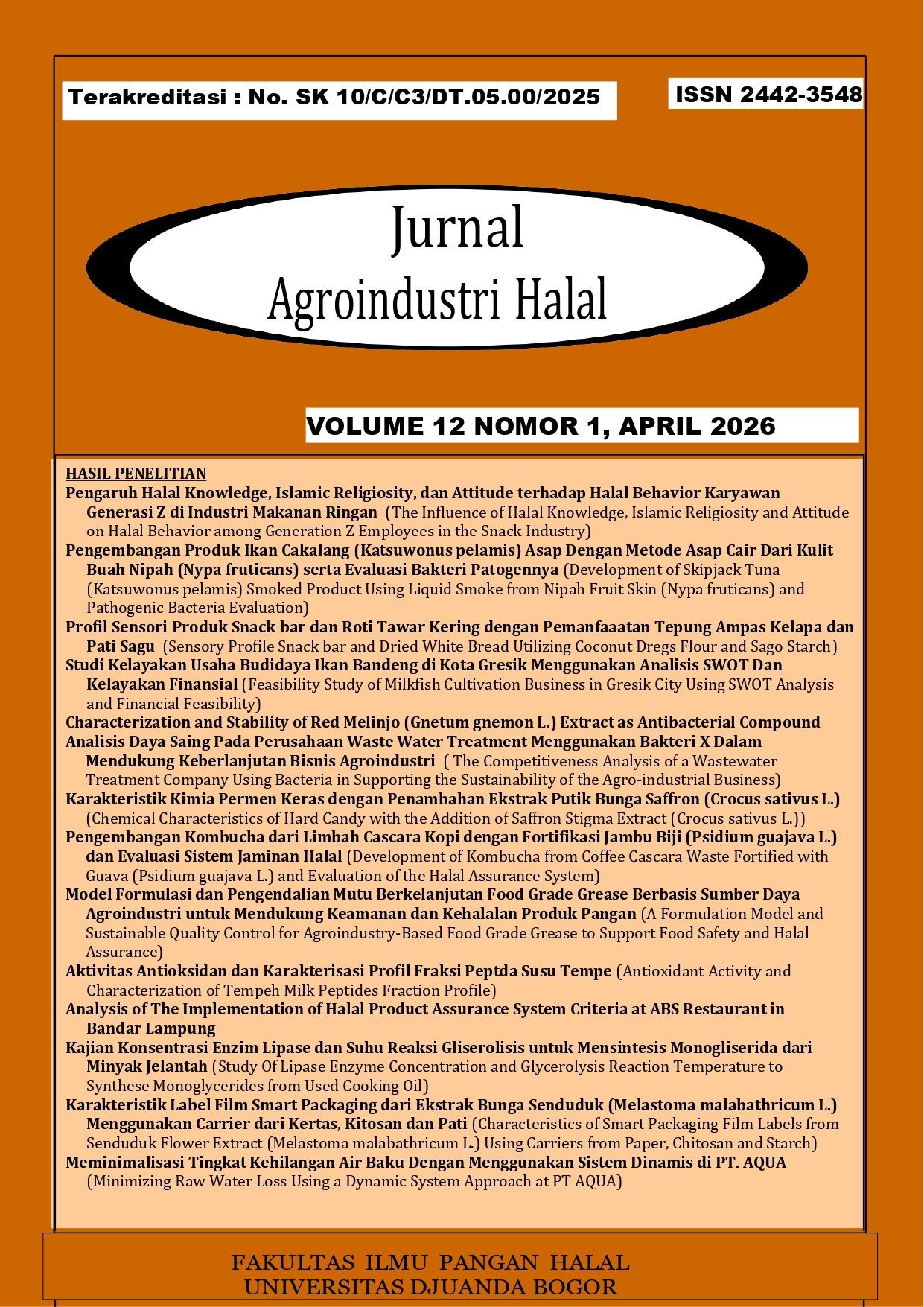
Karakteristik Kimia Permen Keras dengan Penambahan Ekstrak Putik Bunga Saffron (Crocus sativus L.)
DOI:
https://doi.org/10.30997/jah.v12i1.22353Keywords:
Crocus sativus, permen keras, aktivitas antioksidan, karakteristik kimia, pangan fungsionalAbstract
Permen keras merupakan kategori produk pangan yang memiliki tingkat penerimaan luas di berbagai segmen konsumen. Penelitian ini bertujuan untuk mengevaluasi pemanfaatan ekstrak putik bunga saffron (Crocus sativus L.) sebagai komponen fungsional dalam formulasi permen keras, dengan fokus pada kontribusi senyawa bioaktifnya terhadap peningkatan aktivitas antioksidan. Penelitian dilaksanakan menggunakan Rancangan Acak Lengkap (RAL) satu faktor dengan dua ulangan, yang terdiri atas empat tingkat konsentrasi ekstrak saffron, yaitu 0%, 2,5%, 5,0%, dan 7,5%. Parameter yang dianalisis mencakup aktivitas antioksidan, kadar air, dan kadar abu sebagai dasar penetapan perlakuan terbaik, diikuti oleh analisis kadar gula reduksi dan sakarosa pada perlakuan terpilih. Data dianalisis menggunakan analisis ragam (ANOVA) dan uji lanjut Duncan pada tingkat signifikansi 95%. Hasil penelitian menunjukkan bahwa penambahan ekstrak saffron pada konsentrasi 7,5% menghasilkan formulasi permen keras dengan karakteristik paling unggul. Formulasi ini memiliki aktivitas antioksidan sangat kuat dengan nilai IC50 sebesar 47,16 µg/mL, kadar air sebesar 0,76%, kadar abu 0,72%, kadar gula reduksi 15,22%, dan kadar sakarosa 60,12%. Secara keseluruhan, penambahan ekstrak putik bunga saffron terbukti berpengaruh signifikan terhadap karakteristik kimia permen keras. Temuan ini menegaskan potensi saffron sebagai bahan fungsional dalam pengembangan produk permen keras dengan nilai tambah bioaktif.
References
Agarwal, N., Kolba, N., Jung, Y., Cheng, J., & Tako, E. (2022). Saffron (Crocus sativus L.) flower water extract disrupts the cecal microbiome, brush border membrane functionality, and morphology in vivo (gallus gallus). Nutrients, 14(1), 220. https://doi.org/10.3390/nu14010220.
Ahmadian-Kouchaksaraie, Z., Niazmand, R., & Najafi, M. N. (2016). Optimization of the subcritical water extraction of phenolic antioxidants from Crocus sativus petals of saffron industry residues: Box-Behnken design and principal component analysis. Innovative Food Science & Emerging Technologies, 36, 234-244. https://doi.org/10.1016/j.ifset.2016.07.005.
Al-Snafi, A. E. (2016). The pharmacology of Crocus sativus-A review. IOSR Journal of Pharmacy, 6(6), 8-38.
Amalia, L., Sumantri, N. O., & Suryana, M. R. (2022). Sifat Sensory dan Kimia pada Hard Candy dengan Penambahan Ekstrak Jagung Manis (Zea mays saccharata), Sukrosa Serta Madu: Sensory and Chemical Properties of Hard Candy with the Addition of Sweet Corn Extract (Zea mays saccharata), Sucrose, and Honey. Jurnal Agroindustri HalaL, 8(2), 243-251. https://doi.org/10.30997/jah.v8i2.5377.
Anaeigoudari, F., Anaeigoudari, A., & Kheirkhah-Vakilabad, A. (2023). A review of therapeutic impacts of saffron (Crocus sativus L.) and its constituents. Physiological Reports, 11(15). 1-14. https://doi.org/10.14814/phy2.15785.
Andini, D. F., Mardiah, M., dan Kawaroe, M. (2017). Formulasi hard candy menggunakan pewarna alami fikosianin Spirulina platensis. Jurnal Agroindustri Halal, 3(2).
Arizona, K., Laswati, D. T., dan Rukmi, K. S. A. (2021). Studi pembuatan marshmallow dengan variasi konsentrasi gelatin dan sukrosa. Agrotech: Jurnal Ilmiah Teknologi Pertanian, 3(2), 11-17.
Badan Pengawas Obat dan Makanan Republik Indonesia. (2018). Peraturan Badan Pengawas Obat Dan Makanan Nomor 30 Tahun 2018 Tentang Angka Konsumsi Pangan.
Badan Standardisasi Nasional. (2008). SNI 3547.1:2008 Kembang Gula Keras. Badan Standar Nasional Indonesia, Jakarta.
Basrin, F. (2020). Pengaruh subtitusi tepung terigu dengan tepung sukun (Artocarpus altilis) terhadap mutu kimia kue semprong. Jurnal Pengolahan Pangan, 5(1), 7-14.
Chaudhary, P., Janmeda, P., Docea, A., Yeskaliyeva, B., Razis, A., Modu, B., Calina, D., & Sharifi‐Rad, J. (2023). Oxidative stress, free radicals and antioxidants: potential crosstalk in the pathophysiology of human diseases. Frontiers in Chemistry, 11, 1158198. https://doi.org/10.3389/fchem.2023.1158198.
Esati, N. K., La, E. O. J., dan Lestari, G. A. D. (2022). Antioxidant Activity Test of Rosemary Leaves (Rosemarinus officinalis L.) Ethanolic Extract with DPPH and FRAP Method and Its Application as an Active Substance in Lotion. Jurnal Sains dan Kesehatan, 4(4), 363-369.
Fikri, M. Z., Lubis, A. F., Diana, A., dan Suardi, E. (2022). Pengaruh Lama Pemasakan Terhadap Karakteristik Ikan Lele (Clarias batrachus) Asap Cair. Jurnal Riset Rumpun Ilmu Hewani (JURRIH), 1(2), 91-104.
Hutami, R., Nur’utami, D. A., & Joana, A. (2021). Antioxidant activity, sensory, chemical, and microbiology characteristics of muntok white pepper (Piper Nigrum Linn.) hard candy. Indonesian Journal of Applied Research (IJAR), 2(1), 147-27. https://doi.org/10.30997/ijar.v2i1.98.
Indriaty, F., Sjarif, S. R., dan Riset, B. (2016). Pengaruh Penambahan Sari Buah Nenas Pada Permen Keras. Jurnal Penelitian Teknologi Industri Vol, 8(2), 129-140.
Iznilillah, W., Amalia, L., & Aminah, S. (2025). Pengaruh Penambahan Ekstrak Habbatussauda (Nigella Sativa) dan Madu (Apis Mellifera Linneus) Terhadap Sifat Kimia Permen Keras. Jurnal Ilmiah Pangan Halal, 7(1). 128-140. https://doi.org/10.30997/jiph.v7i1.18045
Jomova, K., Alomar, S. Y., Alwasel, S. H., Nepovimova, E., Kuca, K., & Valko, M. (2024). Several lines of antioxidant defense against oxidative stress: antioxidant enzymes, nanomaterials with multiple enzyme-mimicking activities, and low-molecular-weight antioxidants. Archives of toxicology, 98(5), 1323-1367. https://doi.org/10.1007/s00204-024-03696-4
Kianmehr, M., & Khazdair, M. R. (2020). Possible therapeutic effects of Crocus sativus stigma and its petal flavonoid, kaempferol, on respiratory disorders. Pharmaceutical Biology, 58(1), 1149-1158. https://doi.org/10.1080/13880209.2020.1844762.
Mandei, J. H. (2014). Komposisi beberapa senyawa gula dalam pembuatan permen keras dari buah Pala. Jurnal Penelitian Teknologi Industri, 6(2), 1-10.
Maryam, M., Sitorus, T. M., Dewi, H., dan Lubis, R. F. (2022). Analysis of the Quality and Financial Viability of Hard Candy Innovation Products with the Addition of Gambir Catechins (Uncaria Gambir Roxb). Andalasian International Journal of Agriculture and Natural Sciences (AIJANS), 3(01), 26-36.
Mohd Hatta, F. A., R. Othman, Q. A. Ali, N. Hassan, and R. Ramya. "Carotenoids composition, antioxidant and antimicrobial capacities of Crocus sativus L. stigma." Food Res 7 (2023): 337-343. https://doi.org/10.26656/fr.2017.7(4).390.
Molyneux, P. (2004). The use of the stabel free radical diphenylpicrylhydrazyl (DPPH) for estimating antioxidant activity. Songklanakarin J. sci. technol, 26(2), 211-219.
Nahak, A. S., Mushollaeni, W., dan Rahmawati, A. (2023). Probiotic Herbal Beverage From Purple Sweet Potato Juice (Ipomoea Batatas L.): Study of Stabilizer Type and Concentration. Journal Of Industrial Engineering dan Technology Innovation, 1(2), 42-49.
Najafi, Z., Zahran, H. A., Yeşilçubuk, N. Ş., & Gürbüz, H. (2022). Effect of different extraction methods on saffron antioxidant activity, total phenolic and crocin contents and the protective effect of saffron extract on the oxidative stability of common vegetable oils. Grasas y Aceites, 73(4), 480-480. https://doi.org/10.3989/gya.0783211.
Nge, S. T. (2019). Pengaruh Konsentrasi Gula Yang Berbeda Dengan Penambahan Kayu Manis (Cinnamomum burmannii) Pada Manisan Rumput Laut (Eucheuma Cottonii) Terhadap Tingkat Penerimaan Konsumen. Indigenous Biologi: Jurnal Pendidikan Dan Sains Biologi, 2(1), 8-20.
Ozel, B., Kuzu, S., Marangoz, M., Doğdu, S., Morris, R., & Oztop, M. (2024). Hard Candy Production and Quality Parameters: A review. Open Research Europe, 4(6), 1-7. https://doi.org/10.12688/openreseurope.16792.1.
Petcu, C. D., Tăpăloagă, D., Mihai, O. D., Gheorghe-Irimia, R.-A., Negoiță, C., Georgescu, I. M., Tăpăloagă, P. R., Borda, C., & Ghimpețeanu, O. M. (2023). Harnessing Natural Antioxidants for Enhancing Food Shelf Life: Exploring Sources and Applications in the Food Industry. Foods, 12(17), 3176. https://doi.org/10.3390/foods12173176
Pourtau, L., Wauquier, F., Boutin-Wittrant, L., Gaudout, D., Moras, B., Vignault, A., Vaysse, C., Richard, T., Courtois, A., Krisa, S., Roux, V., Macian, N., Pickering, G., & Wittrant, Y. (2024). Reduced Production of Pro-Inflammatory and Pro-Catabolic Factors by Human Serum Metabolites Derived from a Patented Saffron Extract Intake. Pharmaceutics, 16(3), 336.
Ramanda, M. R., Nasution, S., Rahmadi, I., dan Munawaroh, N. L. (2023). Penentuan umur simpan keripik buah dengan metode accelerated shelf life test model kadar air kritis. Teknologi Pangan: Media Informasi dan Komunikasi Ilmiah Teknologi Pertanian, 14(2), 246-259.
Saputra, W., Widyasaputra, R., dan Ruswanto, A. (2023). Kajian Lama Pengeringan Dan Ketebalan Irisan Terhadap Karakteristik Jeruk Lemon (Citrus Limon) Kering. Agrotechnology, Agribusiness, Forestry, and Technology: Jurnal Mahasiswa Instiper (AGROFORETECH), 1(3), 1934-1940.
Sindopong, L. E., Oedjoe, M. D. R., dan Djonu, A. (2022). Kualitas Sifat Fisik Karaginan, Proksimat, dan Organoleptik Kappaphycus alvarezii pada Umur Panen Berbeda di Perairan Pasir Panjang Kota Kupang. Jurnal Aquatik, 5(1), 98-109.
Singh, N., & Yadav, S. (2022). A review on health benefits of phenolics derived from dietary spices. Current Research in Food Science, 5, 1508- 1523. https://doi.org/10.1016/j.crfs.2022.09.009.
Souiy, Z., Amri, Z., Sharif, H., Souiy, A., Cheraief, I., Hamden, K., & Hammami, M. (2023). The Use of D‐Optimal Mixture Design in Optimizing Formulation of a Nutraceutical Hard Candy. International Journal of Food Science, 2023(1), 1-12. https://doi.org/10.1155/2023/7510452.
Suhardiyanto, S., Ngatirah, N., dan Oktavianty, H. (2023). Karakteristik Permen Keras Ekstrak Daun Jambu Biji dengan Variasi Perbandingan Sukrosa dan Sirup Glukosa. BIOFOODTECH: Journal of Bioenergy and Food Technology, 2(02), 95-107.
Yulia, M., Azra, F. P., dan Ranova, R. (2022). Formulasi hard candy dari sari buah jeruk nipis (citrus aurantifolio), madu (mell depuratum) dan kayu manis (cinnamomum burmanii) berdasarkan perbedaan sirup glukosa. Jurnal Riset Kefarmasian Indonesia, 4(1), 89-100.
Downloads
Published
How to Cite
Issue
Section
License
Copyright (c) 2026 Wilna Iznilillah, Arti Hastuti, Tiara Amanda Lestari, Sri Rejeki Retna Pertiwi, Muhammad Rifqi, Tresna Ligar Aphafield

This work is licensed under a Creative Commons Attribution-ShareAlike 4.0 International License.
Authors who publish with Jurnal Agroindustri Halal agree to the following terms:
- Authors retain copyright and grant the journal right of first publication with the work simultaneously licensed under a Creative Commons Attribution 4.0 International License that allows others to share the work with an acknowledgement of the work's authorship and initial publication in Jurnal Agroindustri Halal.
- Authors are able to enter into separate, additional contractual arrangements for the non-exclusive distribution of the journal's published version of the work (e.g., post it to an institutional repository or publish it in a book), with an acknowledgement of its initial publication in Jurnal Agroindustri Halal.
- Authors are permitted and encouraged to post their work online (e.g., in institutional repositories or on their website) prior to and during the submission process, as it can lead to productive exchanges, as well as earlier and greater citation of published work