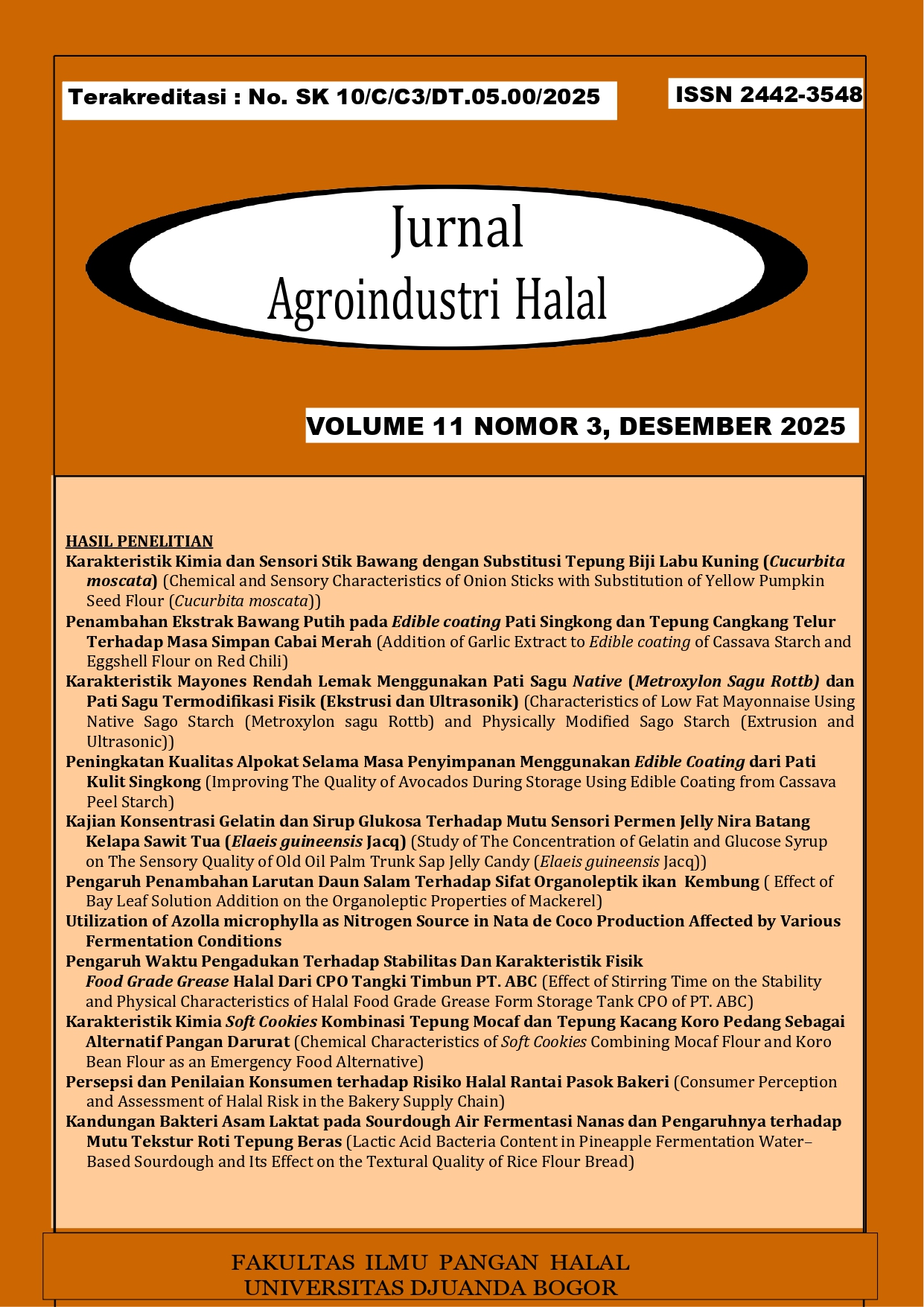
Kandungan Bakteri Asam Laktat pada Sourdough Air Fermentasi Nanas dan Pengaruhnya terhadap Mutu Tekstur Roti Tepung Beras
DOI:
https://doi.org/10.30997/jah.v11i3.22334Keywords:
fruit fermentation, gluten-free, rice bread, sourdough, textureAbstract
This study aimed to evaluate the utilization of pineapple fruit fermentation water as a natural starter in sourdough production and its effect on the textural properties of rice-based bread. The fermentation water was prepared from a mixture of pineapple, water, and sugar, and fermented at 30°C for 48 hours until reaching optimum microbial activity. The resulting sourdough was then applied in bread making using rice flour as the main ingredient, combined with tapioca and potato flours. The experimental design used a Completely Randomized Design with three treatments, namely control bread (commercial yeast), water-based sourdough bread, and pineapple sourdough bread, each repeated three times. Observed parameters included pH, titratable acidity, lactic acid bacteria and yeast counts, specific volume, crumb microstructure, and bread texture. The results showed that pineapple fermentation water supported the growth of lactic acid bacteria and yeast, reaching the highest population at 48 hours, indicated by a decrease in pH and an increase in acidity. Pineapple sourdough bread exhibited higher hardness, gumminess, and chewiness compared to the control and water sourdough bread, but maintained good springiness, resulting in a softer crumb structure that was not brittle. In conclusion, pineapple fermentation water can serve as a promising natural starter to improve the quality and texture of gluten-free rice bread.
References
Agustina, N. (2023). PENGARUH AIR FEMENTASI SALAK (Salacca zalacca) TERHADAP BAKTERI ASAM LAKTAT DAN YEAST DAN TEKSTURE ROTI TAWAR TEPUNG BERAS. Universitas Gadjah Mada, Yogyakarta.
Ambaye, T. G., Vaccari, M., Prasad, S., van Hullebusch, E. D., & Rtimi, S. (2022). Preparation and applications of chitosan and cellulose composite materials. Journal of Environmental Management, 301(January 2021), 113850. https://doi.org/10.1016/j.jenvman.2021.113850
Aplevicz, K. S., Mazo, J. Z., Kramer, N., Nalevaiko, S., Sebastião, E., & Anna, S. (2014). Acta Scientiarum Evaluation of sourdoughs for the production of bread using spontaneous fermentation technique. 713–719. https://doi.org/10.4025/actascitechnol.v36i4.19703
Arora, K., Ameur, H., Polo, A., Di Cagno, R., Rizzello, C. G., & Gobbetti, M. (2021). Thirty years of knowledge on sourdough fermentation: A systematic review. Trends in Food Science and Technology, 108(July 2020), 71–83. https://doi.org/10.1016/j.tifs.2020.12.008
Calvert, M. D., Madden, A. A., Nichols, L. M., Haddad, N. M., Lahne, J., Dunn, R. R., & McKenney, E. A. (2021). A review of sourdough starters: ecology, practices, and sensory quality with applications for baking and recommendations for future research. PeerJ, 9, 1–37. https://doi.org/10.7717/peerj.11389
Catzeddu, P. (2019). Sourdough Breads. In Flour and Breads and their Fortification in Health and Disease Prevention (pp. 177–188). Elsevier Inc. https://doi.org/10.1016/B978-0-12-380886-8.10004-2
Comasio, A., Van Kerrebroeck, S., & De Vuyst, L. (2021). Lemon juice and apple juice used as source of citrate and malate, respectively, enhance the formation of buttery aroma compounds and/or organic acids during Type 2 and Type 3 sourdough productions performed with Companilactobacillus crustorum LMG 23699. International Journal of Food Microbiology, 339(November 2020), 109020. https://doi.org/10.1016/j.ijfoodmicro.2020.109020
Gordún, E., Del Valle, L. J., Ginovart, M., & Carbó, R. (2015). Comparison of the microbial dynamics and biochemistry of laboratory sourdoughs prepared with grape, apple and yogurt. Food Science and Technology International, 21(6), 428–439. https://doi.org/10.1177/1082013214543033
Kemenkes RI. (2018). Buletin Stunting. Kementerian Kesehatan RI, 301(5), 1163–1178.
Kusuma Wardani, R., & Handrianto, P. (2019). Analisis kadar kalsium oksalat pada tepung dalam larutan asam. Journal of Research and Technolgy, 5(2), 1–10.
Lan, C. H., Son, C. K., Ha, H. P., Florence, H., Binh, L. T., Mai, L. T., Tram, N. T. H., Khanh, T. T. M., Phu, T. V., Dominique, V., & Yves, W. (2013). Tropical traditional fermented food, a field full of promise. Examples from the Tropical Bioresources and Biotechnology programme and other related French-Vietnamese programmes on fermented food. International Journal of Food Science and Technology, 48(6), 1115–1126. https://doi.org/10.1111/ijfs.12064
Liviawaty, E., & Afrianto, E. (2014). Penentuan Waktu Rigor Mortis Ikan Nila Merah ( Oreochromis Niloticus ) Berdasarkan Pola Perubahan Derajat Keasaman Determination of Time Rigor Mortis Red Tilapia ( Oreochromis Niloticus ) Laboratorium Teknologi Industri Hasil Perikanan. Jurnal Akuatika, 5(1), 40–44.
Minervini, F., Angelis, M. De, Cagno, R. Di, & Gobbetti, M. (2014). International Journal of Food Microbiology Ecological parameters in fl uencing microbial diversity and stability of traditional sourdough. International Journal of Food Microbiology, 171, 136–146. https://doi.org/10.1016/j.ijfoodmicro.2013.11.021
Parakhina, O., Lokachuk, M., Kuznetsova, L., Savkina, O., Pavlovskaya, E., & Gavrilova, T. (2021). Evaluation of selected lactic acid bacteria as starter cultures for gluten-free sourdough bread production. Agronomy Research, 19(Special Issue 3), 1260–1272. https://doi.org/10.15159/AR.21.087
Restuningtiyas, A. D. (2023). SOURDOUGH AIR FERMENTASI PAPAYA (Carica papaya L.) DAN PENGARUHNYA PADA KARAKTERISTIK TEKSTUR ROTI TEPUNG BERAS. Universitas Gadjah Mada, Yogyakarta.
Saleh, M. S. M., Siddiqui, M. J., Mediani, A., Ismail, N. H., Ahmed, Q. U., So’ad, S. Z. M., & Saidi-Besbes, S. (2018). Salacca zalacca: A short review of the palm botany, pharmacological uses and phytochemistry. Asian Pacific Journal of Tropical Medicine, 11(12), 645–652. https://doi.org/10.4103/1995-7645.248321
Scheuer, P. M., Augusto, J., Ferreira, S., Mattioni, B., Miranda, M. Z. De, & Francisco, A. De. (2015). Panes Sin Grasa Analisis De Imagenes. 35(1), 133–142.
Statistik, B. P. (2021). Rata-rata Konsumsi Perkapita Seminggu di Daerah Perkotaan dan Pedesaan Menurut Komoditi Makanan dan Golongan Pengeluaran per Kapita Seminggu (Satuan Komoditas), 2019-2020. https://www.bps.go.
Supasil, R., Suttisansanee, U., Santivarangkna, C., & Tangsuphoom, N. (2022). Improvement of Sourdough and Bread Qualities by Fermented Water of Asian Pears and Assam Tea Leaves with Co-Cultures of Lactiplantibacillus plantarum and Saccharomyces cerevisiae. 1–16.
Wang, W., Meng, Q., Li, Q., Liu, J., Zhou, M., Jin, Z., & Zhao, K. (2020). Chitosan derivatives and their application in biomedicine. International Journal of Molecular Sciences, 21(2). https://doi.org/10.3390/ijms21020487
Yu, Y., Wang, L., Qian, H., Zhang, H., & Qi, X. (2018a). Contribution of spontaneously-fermented sourdoughs with pear and navel orange for the bread-making. LWT - Food Science and Technology, 89(June 2017), 336–343. https://doi.org/10.1016/j.lwt.2017.11.001
Yu, Y., Wang, L., Qian, H., Zhang, H., & Qi, X. (2018b). Contribution of spontaneously-fermented sourdoughs with pear and navel orange for the bread-making. Lwt, 89, 336–343. https://doi.org/10.1016/j.lwt.2017.11.001
Zaidiyah, Lubis, Y. M., Putri, C. A. R. G., & Rohaya, S. (2020). Physicochemical properties of sourdough bread made from local variety sweet potato and pineapple juice. IOP Conference Series: Earth and Environmental Science, 425(1). https://doi.org/10.1088/1755-1315/425/1/012079
Downloads
Published
How to Cite
Issue
Section
License
Copyright (c) 2025 Nia Agustina, Helmi Haris

This work is licensed under a Creative Commons Attribution-ShareAlike 4.0 International License.
Authors who publish with Jurnal Agroindustri Halal agree to the following terms:
- Authors retain copyright and grant the journal right of first publication with the work simultaneously licensed under a Creative Commons Attribution 4.0 International License that allows others to share the work with an acknowledgement of the work's authorship and initial publication in Jurnal Agroindustri Halal.
- Authors are able to enter into separate, additional contractual arrangements for the non-exclusive distribution of the journal's published version of the work (e.g., post it to an institutional repository or publish it in a book), with an acknowledgement of its initial publication in Jurnal Agroindustri Halal.
- Authors are permitted and encouraged to post their work online (e.g., in institutional repositories or on their website) prior to and during the submission process, as it can lead to productive exchanges, as well as earlier and greater citation of published work