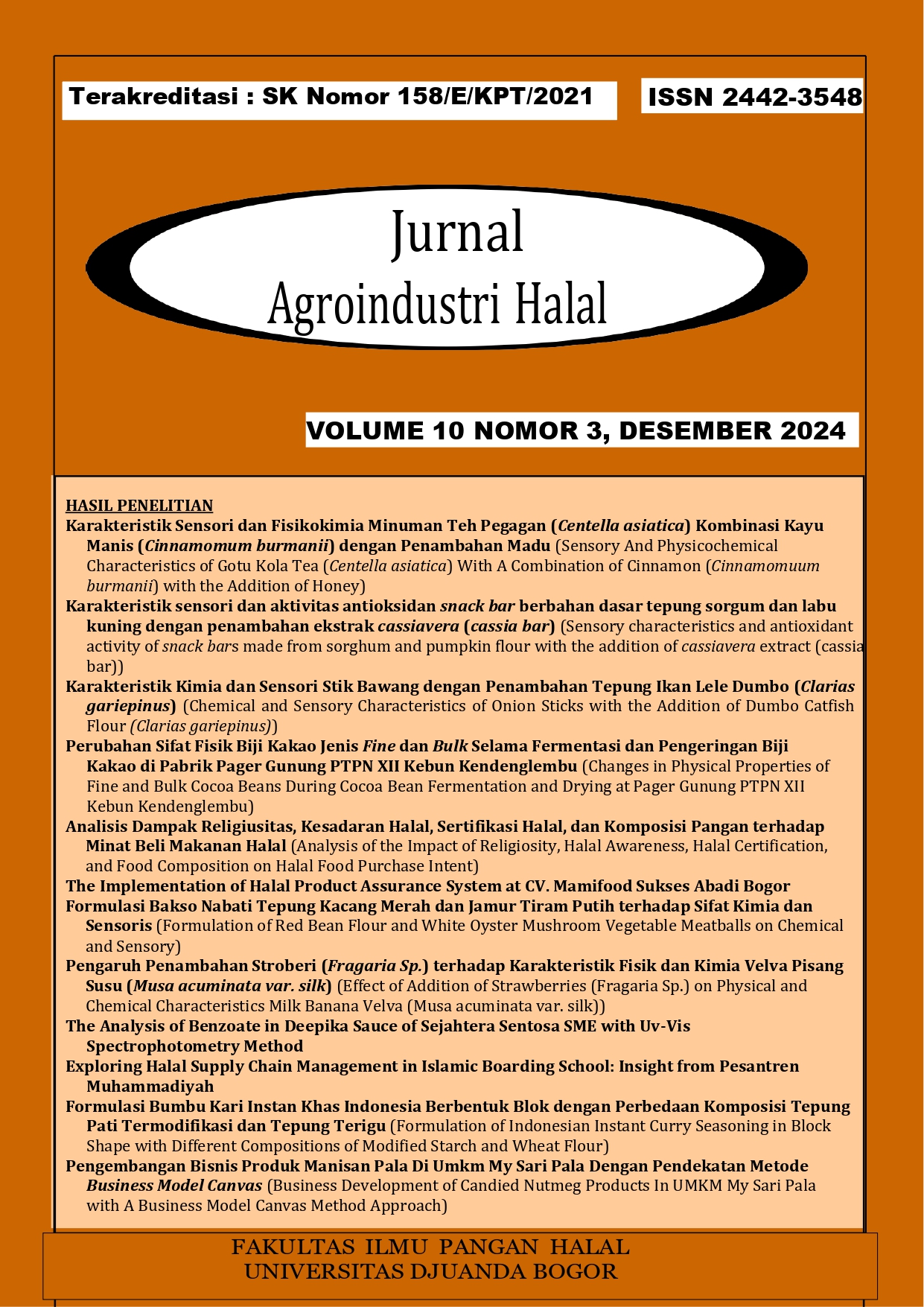
Formulasi Bumbu Kari Instan Khas Indonesia Berbentuk Blok dengan Perbedaan Komposisi Tepung Pati Termodifikasi dan Tepung Terigu
DOI:
https://doi.org/10.30997/jah.v10i3.15708Keywords:
Antimicrobial; Curry Block; Instant curry seasoning; Curcumin; TocopherolAbstract
Curry is a typical Indonesian dish that requires a long process to make. Therefore, innovation in making curry in block form is needed, as has been done for Japanese curry blocks. This research aims to obtain the best curry block formulation based on sensory quality tests, hedonic tests, and chemical analysis. The research was carried out by formulating 5 formulas through trial and error (BK001, BK002, BK003, BK004, and BK005). The research treatment was the difference in ratio between modified starch and wheat flour, namely BK005A, BK005B, and BK005C. Data analysis used ANOVA and continued with Duncan at the 5% level. The trial and error stage research results showed that the best formulation was code BK 005. From the results of hedonic and sensory quality tests, BK 005 was preferred compared to curry seasoning on the market. The results of further research showed that the research treatment had a significant effect on the results of the texture and block compactness tests as well as the hedonic test results as overall. BK 005B block curry seasoning is the best treatment based on the results of texture tests, sensory quality tests, cohesiveness parameters, and overall taste. The results of the curry seasoning analysis for block BK 005B were water content 2.17%, water activity (Aw) 0.49, viscosity 0.3 dPas/s3, hardness 981.0 gr/mm2, and pH 6.00.
References
[BSN] Badan Standarisasi Nasional. 1995. Rempah-rempah bubuk SNI 01-3709-1995. Badan Standarisasi Nasional, Jakarta.
Leviana, W., Paramita, V. 2017. Pengaruh Suhu Terhadap Kadar Air Dan Aktivitas Air Dalam Bahan Pada Kunyit (Curcuma Longa) Dengan Alat Pengering Electrical Oven. Metana, 13(2), 37-44. http://ejournal.undip.ac.id/index.php/metana.
Madsari, N. (2023). Effect of Sterilization on Antioxidant Activity: In the Case of Thai Halal Curry Paste. Journal of Halal Science and Technology, 2(1), 11–16. https://doi.org/10.59202/jhst.v2i1.660
Mussayadah, N., Abdiani, I. M., Imra, I., & Awalin, S. N. 2020. Evaluasi Sensori Bakso Ikan Gulamah ( Johnius spp .) dengan Penambahan Karaginan. Jurnal Teknologi Pengolahan Pertanian, 2(2), 20–26.
Nakayama, H., Tsuge, N., Sawada, H., Masamura, N., Yamada, S., Satomi, S., & Higashi, Y. (2014). A single consumption of curry improved postprandial endothelial function in healthy male subjects: A randomized, controlled crossover trial. Nutrition Journal, 13(1). https://doi.org/10.1186/1475-2891-13-67
Nursanty & Sugiarti, Y. (2020). The Effect of Packaging and Temperature on The Storage of Pindang Instant Seasoning. Journal of Food Technology and Nutrition, 19(2), 86 – 91.
Setyaningsih, Apriyantono, Puspita. Sensory Analysis. Bogor: IPB Press Publisher; 2010
Zafar, U., Vivacqua, V., Calvert, G., Ghadiri, M., & Cleaver, J. (2017). A review of bulk powder caking. Powder Technology, 313(C), 389–401. https://doi.org/10.1016/j. powtec.2017.02.024.
Downloads
Published
How to Cite
Issue
Section
License
Copyright (c) 2024 Julia Kusumaningrum, Mardiah Mardiah, Aji Jumiono, Lia Amalia

This work is licensed under a Creative Commons Attribution-ShareAlike 4.0 International License.
Authors who publish with Jurnal Agroindustri Halal agree to the following terms:
- Authors retain copyright and grant the journal right of first publication with the work simultaneously licensed under a Creative Commons Attribution 4.0 International License that allows others to share the work with an acknowledgement of the work's authorship and initial publication in Jurnal Agroindustri Halal.
- Authors are able to enter into separate, additional contractual arrangements for the non-exclusive distribution of the journal's published version of the work (e.g., post it to an institutional repository or publish it in a book), with an acknowledgement of its initial publication in Jurnal Agroindustri Halal.
- Authors are permitted and encouraged to post their work online (e.g., in institutional repositories or on their website) prior to and during the submission process, as it can lead to productive exchanges, as well as earlier and greater citation of published work