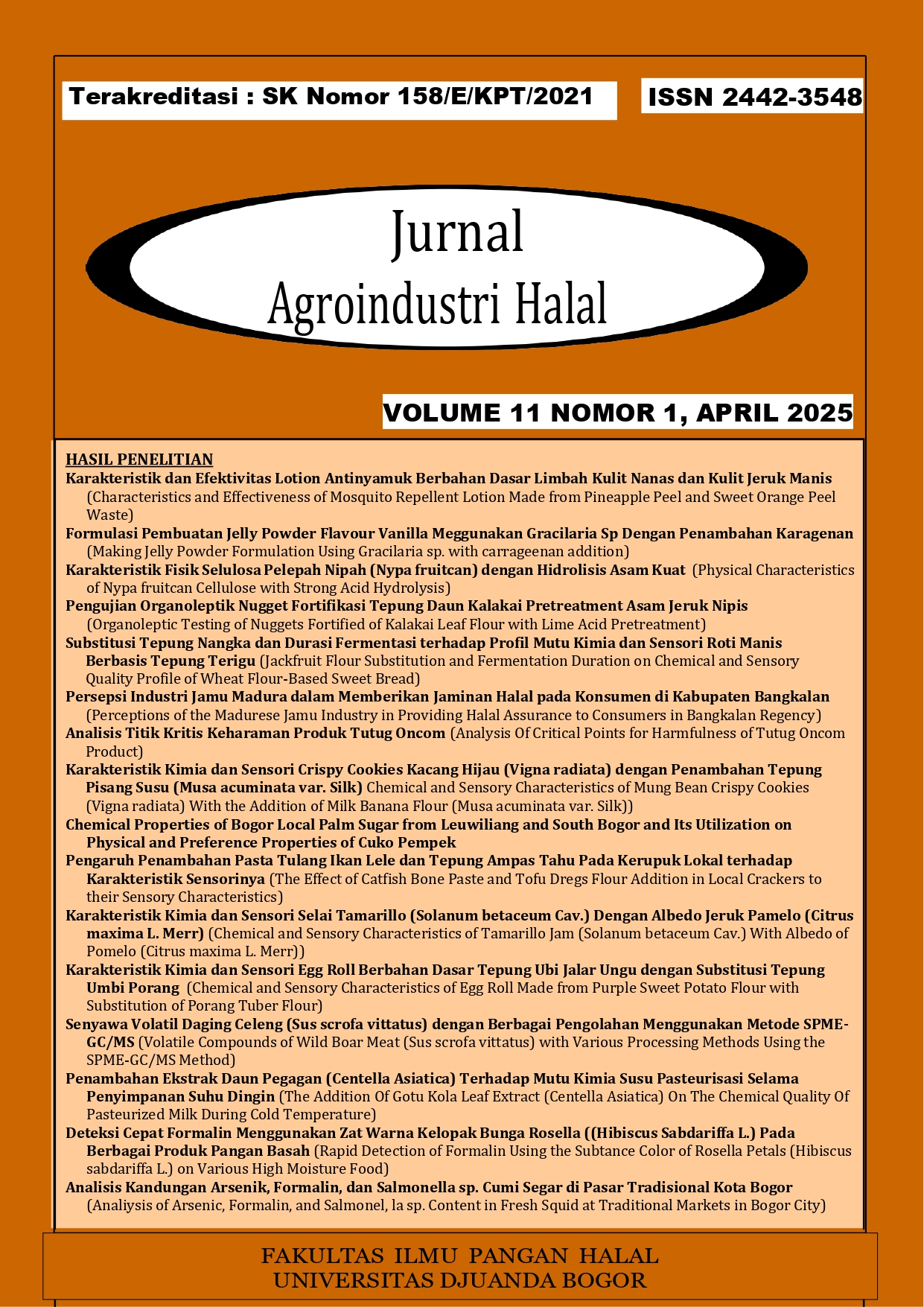
Karakteristik Fisik Selulosa Pelepah Nipah (Nypa fruitcan) dengan Hidrolisis Asam Kuat
DOI:
https://doi.org/10.30997/jah.v11i1.10789Keywords:
Acid Hydrolysis, nanocellulose, nipah, fiberAbstract
Nypa palm (Nypa fruticans) possesses various potential uses, one of which is as a source of cellulose. Cellulose can be a raw material in industries such as paper production, pharmaceuticals, and biomaterials. However, the fiber of the nipa palm frond tends to be brittle and fragile. Reducing the particle size of the fiber can enhance its mechanical strength, which can be achieved through acid hydrolysis using a 10% strong acid solution. This study aims to characterize the cellulose extracted from nipa palm fronds after acid hydrolysis. The alpha-cellulose content obtained was 39.626%, with a lignin content of 18.633%. Morphological characterization revealed that the cellulose particles ranged from 615.814 μm to 840.719 μm in size. Scanning Electron Microscope–Energy Dispersive X-ray (SEM-EDX) analysis showed that the fibers were elongated with irregular lengths and were composed primarily of carbon and oxygen elements. Fourier Transform Infrared (FTIR) spectroscopy identified the presence of O–H, C–H, and C–O functional groups as the main components of cellulose, along with C=O groups associated with lignin. These findings indicate that acid hydrolysis effectively reduces the particle size of nipa palm frond fibers and enhances their physical characteristics, making them more suitable for advanced material applications.
References
Akpakpan, A. E., Akpabio, U. D., Ogunsile, B. O., & Eduok, U. M. (2011). Influence of cooking variables on the soda and soda-ethanol pulping of Nypa fruticans petioles. Australian Journal of Basic and Applied Sciences, 5(12), 1202–1208.
Aminah, D., Fatriani, F., & Arryati, H. (2020). Sifat fisik dan kimia pelepah aren (Arenga pinnata Merr) untuk bahan baku alternatif pulp dan kertas. Jurnal Sylva Scienteae, 3(3), 460. https://doi.org/10.20527/jss.v3i3.2179
Atsari, I., Wijana, S., Rahmah, N. L., & Sugiarto, E. (2015). Ketahanan tarik kertas seni dari serat pelepah nipah (Nypa fruticans): Kajian proporsi bahan baku dan perekat. Prosiding Seminar Agroindustri dan Lokakarya Nasional FKPT-TPI, September, 128–132. https://doi.org/10.13140/RG.2.1.5174.3764
Hanum, F. F., Rahayu, A., Amrillah, N. A. Z., & Mustafa, Y. N. H. (2023). Utilization and extraction method of nanocellulose: A review. Jurnal Sains Natural, 13(3), 107–114. https://doi.org/10.31938/jsn.v13i3.565
Hasfita, F. (2012). Studi pembuatan biosorben dari limbah daun Acacia mangium untuk aplikasi penyisihan logam. Jurnal Teknologi Kimia Unimal, 1, 36–48. http://www.ft.unimal.ac.id/jurnal_teknik_kimia
Ikhsan, A. N., Azmiati, Y., Delvianti, U., & Syauqiah, I. (2021). Karakteristik biosorben pelepah nipah (Nypa fruticans) untuk penurunan kadar logam berat air merkuri (Hg). Jukung: Jurnal Teknik Lingkungan, 7(1), 46–55. https://doi.org/10.20527/jukung.v7i1.10814
Maryam, M., Rahmad, D., & Yunizurwan, Y. (2019). Sintesis mikro selulosa bakteri sebagai penguat (reinforcement) pada komposit bioplastik dengan matriks PVA (poli vinil alcohol). Jurnal Kimia dan Kemasan, 41(2), 110. https://doi.org/10.24817/jkk.v41i2.4055
Ningtyas, K. R., Muslihudin, M., & Sari, I. N. (2020). Sintesis nanoselulosa dari limbah hasil pertanian dengan menggunakan variasi konsentrasi asam. Jurnal Penelitian Pertanian Terapan, 20(2), 142–147. https://doi.org/10.25181/jppt.v20i2.1631
Pine, A. T. D., Base, N. H., & Angelina, J. B. (2021). Produksi dan karakterisasi serbuk selulosa dari batang pisang (Musa paradisiaca L.). Jurnal Kesehatan Yamasi Makassar, 5(2), 115–120.
Pradana, M. A., Ardhyananta, H., & Farid, M. (2017). Pemisahan selulosa dari lignin serat tandan kosong kelapa sawit dengan proses alkalisasi untuk penguat bahan komposit penyerap suara. Jurnal Teknik ITS, 6(2), 413–416. https://doi.org/10.12962/j23373539.v6i2.24559
Syabana, D. K., & Widiastuti, R. (2018). Karakteristik fisik pada serat pelepah nipah (Nypa fruticans). Dinamika Kerajinan dan Batik: Majalah Ilmiah, 35(1), 9–15. https://doi.org/10.22322/dkb.v35i1.3771
Downloads
Published
How to Cite
Issue
Section
License
Copyright (c) 2025 Ari Kristiningsih, Khoeruddin Wittriansyah, Hety Dwi Hastuti, Jenal Sodikin

This work is licensed under a Creative Commons Attribution-ShareAlike 4.0 International License.
Authors who publish with Jurnal Agroindustri Halal agree to the following terms:
- Authors retain copyright and grant the journal right of first publication with the work simultaneously licensed under a Creative Commons Attribution 4.0 International License that allows others to share the work with an acknowledgement of the work's authorship and initial publication in Jurnal Agroindustri Halal.
- Authors are able to enter into separate, additional contractual arrangements for the non-exclusive distribution of the journal's published version of the work (e.g., post it to an institutional repository or publish it in a book), with an acknowledgement of its initial publication in Jurnal Agroindustri Halal.
- Authors are permitted and encouraged to post their work online (e.g., in institutional repositories or on their website) prior to and during the submission process, as it can lead to productive exchanges, as well as earlier and greater citation of published work