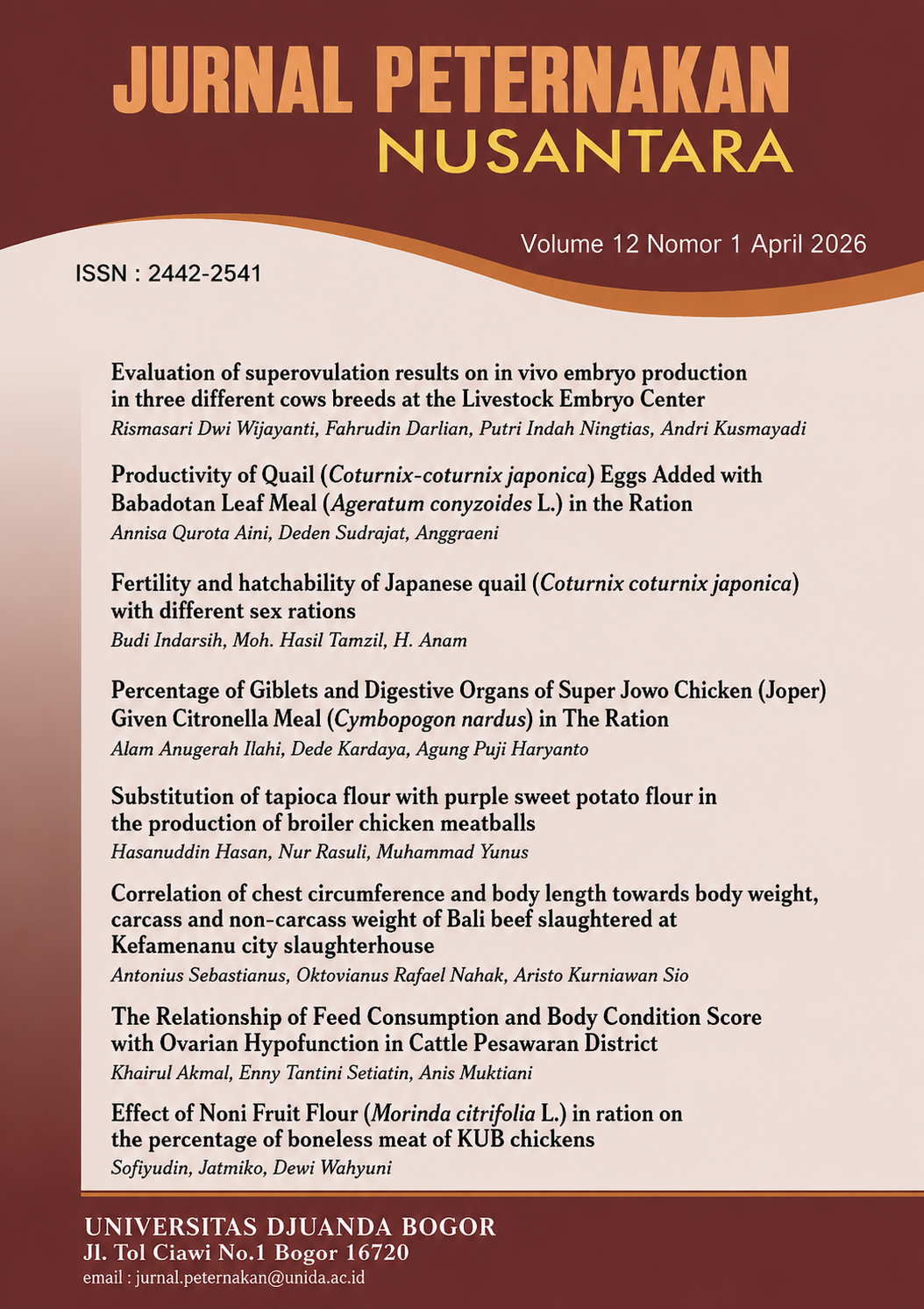
Fertility And Hatchability Of Japanese Quail (Coturnix Coturnix Japonica) With Different Sex Ratio
DOI:
https://doi.org/10.30997/jpn.v12i1.15129Keywords:
Sex Ratio, Fertility, HatchabilityAbstract
This study was conducted to determine the fertility and hatchability of Japanese quails (Coturnix coturnix japonica) eggs at different sex ratios. Using a completely randomized design, a total of 246 female and 57 male quail were placed in colony cages which were divided based on sex ratios of 1:3 (R1), 1:4 (R2), 1:5 (R2) and 1:6 (R4) with 3 replicates per treatment. Quails were offered a commercial quail feed with 18-21% crude protein and metabolizable energy of 2,800 kcal/kg. A total of 540 fertile eggs for three hatching batches, per batch using 135 eggs were imposed. Sex ratios affected fertility and hatchability, and intermediate embryo mortality (P<0.05). Fertility was the highest in R2 (94.9%) and the lowest in R4 (74.1%). The hatchability of eggs was highest at R1 (82.4%) and lowest at R4 (63.2%). Middle embryo mortality was the highest at R4 (12.9 %) and the lowest at R2 (1.5%). A sex ratio of 1:3 or 1:4 produces the best fertility and hatchability in Japanese quail breeding
Downloads
References
Abuoghaba A.A.K., Ali F, Selim D.A.F, Abdelwahab A.A.M, Abdelfattah M.G. 2022. Impact of Male-Female Cohabitation Period on Behavioral Aspects, Fertility, Hatchability, and Hormonal Estimates of Japanese quail. Poultry Science 101:101530. https://doi.org/10.1016/j.psj.2021.101530
Ayoola A.A., Adeyemi A.O., Egbeyale1 L.T., Sobayo R. A., Yusuf, A.O. 2017. Effect of Mating Ratio on The Laying Performance, Hatching Characteristics, Feeding and Housing Cost of Japanese Quails. Malaysian Journal of Animal Science 20 (2): 25-37.
Baser, E., Erensayin C, Orhan H. 2002. The Effect of Mating Interval and Different Sex Ratio on Reproductive Performance and Some Yielding Traits of Japanese Quail. Journal of Central Animal Research Institute 12(2): 16-20
Dogan, N., Ali A, Tolga S. 2013. Effects of Cage Type and Mating Ratio on Fertility in Japanese Quails (Coturnix Coturnix Japonica) Eggs. Agriculture. Science Developments 2(1): 4-7.
Ernst R.A, Bradley F.A, Abbott U.K, Craig R.M, 2004. Egg Candling and Breakout Analysis. ANR Publication 8134. Available in http://anrcatalog.ucdavis.edu/pdf/8134.pdf Ernst et al., 2019).
González-Redondo P, Robustillo P, Caravaca FP. 2023. Effects of Long-Term Storage on Hatchability and Incubation Length of Game Farmed Quail Eggs. Animals (Basel). 13(13):2184. doi: 10.3390/ani13132184.
Ipek A., Canbolat O., Karabulat A. 2007. The effect of Vitamin E and Vitamin C on The Performance of Japanese Quails (Coturnix Coturnix Japonica) Reared Under Heat Stress During Growth and Egg Production Period. Asian-Australasian Journal of Animal Sciences 20 (2): 252 – 256.
Ipek A., Sahan U, Yilmaz B. 2004. The Effect of Live Weight, Male to Female Ratio and Breeder Age on Reproduction Performance in Japanese Quails (Coturnix Coturnix Japonica). South African Journal of Animal Science, 34 (2): 130-134
Karousa M.M., Ahmed S.A, Elaithy S.M., Elgazar E.A. 2015. Effect of Housing System and Sex Ratio of Quails on Egg Production, Fertility and Hatchability. Benha Veterinary Medical Journal 28 (2): 241-247
Kruenti F., Okai M.A, Lamptey V.K. G. ,Adu-Aboagye G. Oduro-Owusu A.D., Suurbesig B., Mewu B. 2023. Age Effect on Quality Traits of Breeder Japanese Quail Eggs. Ghana Journal of Agricultural Sciences. 58 (2), 167 -181. 181https://dx.doi.org/10.4314/gjas.v58i2.14
van der Pol C.W, van Roovert-Reijrink I.A, Maatjens C.M, van den Brand H, Molenaar R. 2013. Effect of Relative Humidity During Incubation at A Set Eggshell Temperature and Brooding Temperature Posthatch on Embryonic Mortality and Chick Quality. Poultry Science. (8):2145-55. doi: 10.3382/ps.2013-03006.
Narinc D., Aygun A., Sari T. 2013. Effects of Cage Type and Mating Ratio on Fertility in Japanese Quails (Coturnix Coturnix Japonica) Eggs. Journal Agricultural Science Developments 2(1): 4-7
Ophir A.G, Galef. B.G 2003. Female Japanese quail affiliate with live males that they have seen mate on video. Journal Animal Behaviour, 66: 369–375
Pedroso A.A, Chaves L.S, Lopes K.L.A, Leandro N.S.M, Café M.B, Stringhini JH. 2006. Nutrient Inoculation in Eggs from Heavy breeders. Revista Brasileira de Zootecnia 5:2018–2026.
Santos T.C., Murakami A.E., Oliveira C.A.L., Moraes G.V., Stefanello C.I., Carneiro T.V., Feitosa C.C.G., Kaneko I.N. 2015. Influence of European Quail Breeders Age on Egg Quality, Incubation, Fertility and Progeny Performance. Brazil. Journal of Poultry Science 17 (1): 49-56.
Sheikh T. M., Essa N.M, Elsagheer M.A. 2016. Effect of Cages Type and Mating Management on Fertility and Hatchability of Japanese Quail. Scientific Papers Animal Science Series, 67: 54-59.
Seker I., Kul S., Bayraktar M. 2004. Effects of Parental Age and Hatching Egg Weight of Japanese quails on Hatchability and Chick Weight. International Journal of Poultry Science. 3 (4):259-265
Soliman FNK, Rizk R.E., Brake J. 1994. Relationship Between Shell Porosity, Shell Thickness, Egg Weight Loss, and Embryonic Development in Japanese Quail Eggs. Journal of Poultry Science. 73 :1607-1611.
Sreenivasiah P.V., 2006. Incubation and Hatching. In: Scientific Poultry Production. A Unique Encyclopedia, 3rd ed., chapter-24. pp. 364-428
SPSS (Statistical Package for Social Sciences) version 15.0, USA 2006. Comman Syntax Reference. 233, South Wacker Drive, Chicago
Downloads
Published
How to Cite
Issue
Section
License
Copyright (c) 2026 Budi Indarsih

This work is licensed under a Creative Commons Attribution-ShareAlike 4.0 International License.
Authors who publish with Jurnal Peternakan Nusantara agree to the following terms:
- Authors retain copyright and grant the journal right of first publication with the work simultaneously licensed under a Creative Commons Attribution 4.0 International License that allows others to share the work with an acknowledgement of the work's authorship and initial publication in Jurnal Peternakan Nusantara.
- Authors are able to enter into separate, additional contractual arrangements for the non-exclusive distribution of the journal's published version of the work (e.g., post it to an institutional repository or publish it in a book), with an acknowledgement of its initial publication in Jurnal Peternakan Nusantara.
- Authors are permitted and encouraged to post their work online (e.g., in institutional repositories or on their website) prior to and during the submission process, as it can lead to productive exchanges, as well as earlier and greater citation of published work.