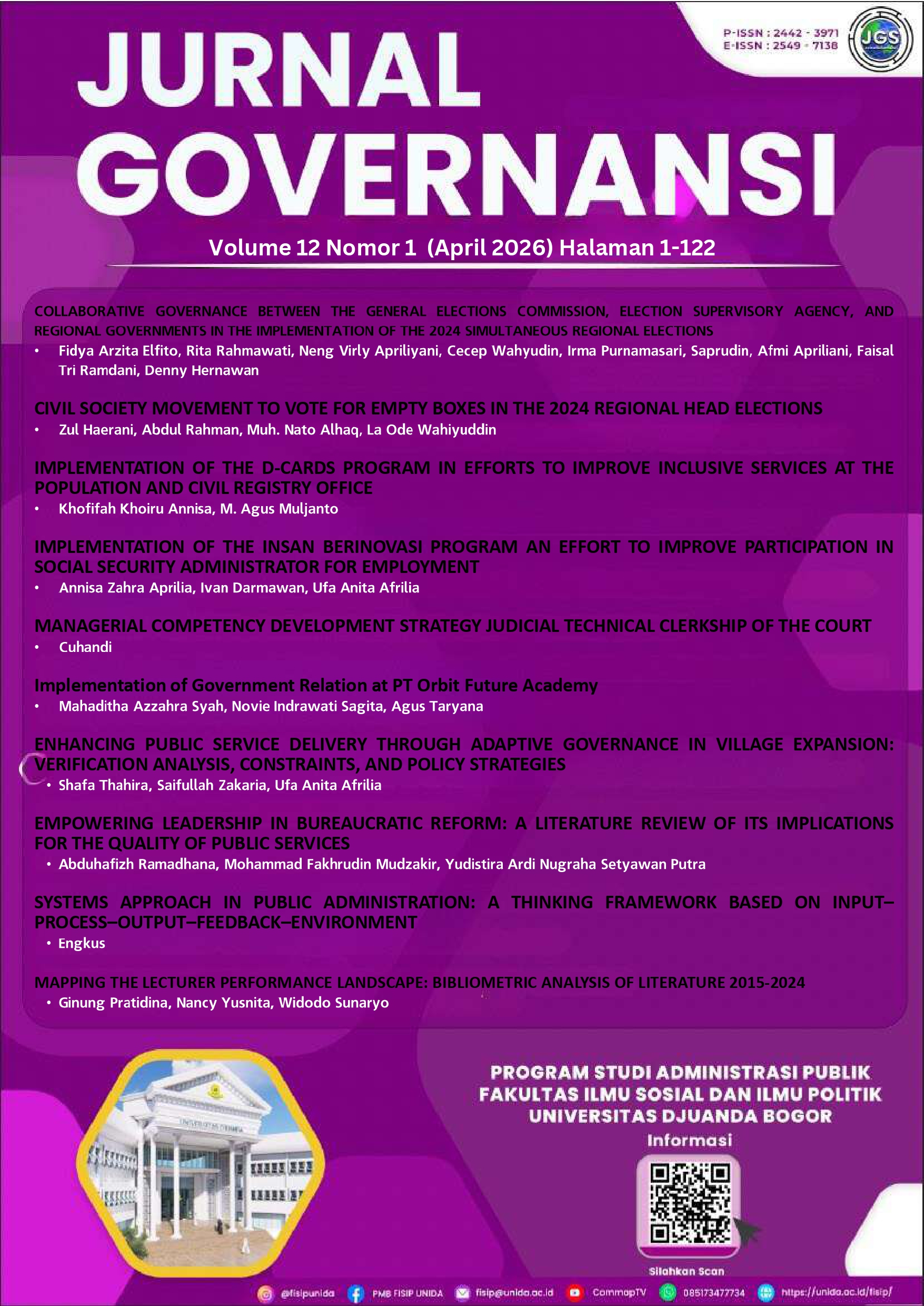
EMPOWERING LEADERSHIP DALAM REFORMASI BIROKRASI: SEBUAH KAJIAN LITERATUR TERHADAP IMPLIKASI PADA KUALITAS PELAYANAN PUBLIK
DOI:
https://doi.org/10.30997/jgs.v12i1.21413Kata Kunci:
Empowering Leadership, Bureaucratic Reform, Quality of Public ServicesAbstrak
Reformasi birokrasi di Indonesia menghadapi tantangan serius akibat budaya korupsi, prosedur berbelit, dan struktur hierarkis yang kaku sehingga menghambat efektivitas penyelenggaraan pemerintahan. Dalam konteks ini, kepemimpinan berperan sebagai faktor kunci untuk mendorong perubahan. Penelitian ini bertujuan menganalisis peran kepemimpinan yang memberdayakan dalam mendukung reformasi birokrasi dan peningkatan kualitas pelayanan publik. Metode yang digunakan adalah tinjauan literatur dengan kriteria seleksi ketat terhadap publikasi akademis yang relevan, mencakup studi empiris, konseptual, dan laporan kelembagaan. Analisis dilakukan secara kualitatif melalui sintesis tematik untuk mengidentifikasi pola, hubungan kausal, serta kontradiksi antar penelitian. Hasil penelitian menunjukkan bahwa kepemimpinan yang memberdayakan, melalui pendelegasian wewenang, komunikasi terbuka, dan keterlibatan pegawai dalam pengambilan keputusan, mampu mengurangi inefisiensi birokrasi, meningkatkan motivasi kerja aparatur, serta memperkuat akuntabilitas pelayanan publik. Namun demikian, temuan juga mengindikasikan bahwa praktik pemberdayaan yang berlebihan dapat menimbulkan beban psikologis bagi pegawai sehingga berdampak negatif pada kinerja layanan. Di sisi lain, reformasi birokrasi terbukti memiliki hubungan erat dengan kualitas pelayanan publik, meskipun implementasinya di lapangan kerap menghadapi hambatan yang menyebabkan hasil yang tidak konsisten. Kesimpulan penelitian ini menegaskan bahwa keberhasilan reformasi birokrasi sangat dipengaruhi oleh penerapan kepemimpinan yang memberdayakan secara proporsional, adaptif, dan sesuai konteks, sehingga dapat mewujudkan birokrasi yang lebih responsif, akuntabel, dan berorientasi pada kebutuhan masyarakat.
Referensi
Adeinat, I. M., & Gregg, C. (2018). Does ownership matter in service quality? International Journal of Services and Operations Management, 30(2), 254. https://doi.org/10.1504/IJSOM.2018.091908
Amundsen, S., & Martinsen, Ø. L. (2014). Empowering leadership: Construct clarification, conceptualization, and validation of a new scale. The Leadership Quarterly, 25(3), 487–511. https://doi.org/10.1016/j.leaqua.2013.11.009
Ashraf, A., & Sahni, N. (2024). Leading by Tackling Employee Resistance (pp. 63–84). https://doi.org/10.4018/979-8-3693-3820-9.ch003
Bowornwathana, B., & Poocharoen, O. (2010). Bureaucratic Politics and Administrative Reform: Why Politics Matters. Public Organization Review, 10(4), 303–321. https://doi.org/10.1007/s11115-010-0129-0
Burhan, Q., & Khan, M. A. (2024). “Unveiling the empowering elixir: exploring the impact of HEXACO traits on leadership and their ripple effect on employee engagement and creative performance.” European Journal of Training and Development. https://doi.org/10.1108/EJTD-08-2024-0107
Cheng, J., Usman, M., Bai, H., He, Y., & Mehmood, K. (2024). Too much of a good thing: how to buffer the unintended adverse effects of empowering leadership? Asia Pacific Journal of Management. https://doi.org/10.1007/s10490-024-09988-8
Cougot, B., Gillet, N., Gauvin, J., Caillet, P., Fleury‐Bahi, G., Ollierou, F., Armant, A., Peltier, A., Getz, I., Bach‐Ngohou, K., Tripodi, D., & Moret, L. (2022). Impact of empowering leadership on emotional exhaustion: A controlled interventional study in a large French university hospital complex. Journal of Nursing Management, 30(8), 4234–4250. https://doi.org/10.1111/jonm.13829
Dahlström, C., Nistotskaya, M., & Tyrberg, M. (2018). Outsourcing, bureaucratic personnel quality and citizen satisfaction with public services. Public Administration, 96(1), 218–233. https://doi.org/10.1111/padm.12387
Dong, Y., & Tang, M. (2023). Enable to innovate: A review of the influence of empowering leadership on follower creativity and innovation. In Handbook of Organizational Creativity (pp. 33–50). Elsevier. https://doi.org/10.1016/B978-0-323-91841-1.00004-X
Elsye, R. (2024). The Development Strategy of The Civil Apparatus of Pemalang Regency Through the Bureaucratic Evaluation Information System (Serabi). Revista de Gestão Social e Ambiental, 18(5), e05260. https://doi.org/10.24857/rgsa.v18n5-145
Govender, K. (2017). Empowering Leadership and Municipal Service Delivery: A Case Study of a Metropolitan Municipality in South Africa. International Journal of Public Administration, 40(5), 427–433. https://doi.org/10.1080/01900692.2015.1127964
Kim, H. J. (2006). Measuring Citizen Satisfaction with Contracted-Out Public Service Quality: An Application of Servqual Measures. International Review of Public Administration, 11(2), 1–14. https://doi.org/10.1080/12294659.2003.10805081
LIU, P., PHAWITPIRIYAKLITI, C., & TERASON, S. (2024). Leadership and Innovation Management: Driving Performance through Agility and Resilience in Automotive Enterprises. Journal of Ecohumanism, 3(6), 834–848. https://doi.org/10.62754/joe.v3i6.4054
Meier, K. J., Compton, M., Polga-Hecimovich, J., Song, M., & Wimpy, C. (2019). Bureaucracy and the Failure of Politics: Challenges to Democratic Governance. Administration & Society, 51(10), 1576–1605. https://doi.org/10.1177/0095399719874759
Msosa, S. K., & Govender, J. P. (2015). Exploring the relationship between service quality and customer satisfaction in postal financial services. Risk Governance and Control: Financial Markets and Institutions, 5(3), 186–193. https://doi.org/10.22495/rgcv5i3c2art4
ng, S., ia, Z., ti, R., & Setini, M. (2020). Improvement of Satisfaction with the Quality of Customer Service at the Four Start Hotel in Jayapura Papua Indonesia. Webology, 17(2), 475–486. https://doi.org/10.14704/WEB/V17I2/WEB17046
Nurung, J., Rakhmat, Tamsah, H., Burhanuddin, & Azis, M. (2020). The effect of leadership on public service quality. IOP Conference Series: Earth and Environmental Science, 473(1), 012070. https://doi.org/10.1088/1755-1315/473/1/012070
Patra, P. K., Ray, A. K., Padhy, R., & Patnaik, S. (2015). Electronic governance service quality: a study in the state of Odisha. International Journal of Services Technology and Management, 21(4/5/6), 238. https://doi.org/10.1504/IJSTM.2015.073924
Pribadi, U. (2021). Bureaucratic Reform, Public Service Performance, And Citizens’ Satisfaction: The Case Of Yogyakarta, Indonesia. Public Policy and Administration, 20.
Rahmat, B., Hartanto, B., & Hilman, A. (2024). Bureaucratic Reform in Indonesia: From “Public Administration" to “Public Management.” Journal of Local Government Issues, 7(2), 144–158. https://doi.org/10.22219/logos.v7i2.33848
Rahmawati, R., Alfitri, A., Widodo, S., & Putra, R. (2025). Bureaucracy behavior in earth tax services and urban and rural building (un-p2) (case study of ogan ilir regency). Revista Brasileira de Políticas Públicas, 14(3). https://doi.org/10.5102/rbpp.v14i3.9163
Rai, A. (2025). Empowering leadership in cognitive processes and behavioural dynamics: a thematic analysis. International Journal of Human Resources Development and Management, 24(1/2), 1–19. https://doi.org/10.1504/IJHRDM.2025.147099
Ravelonarivo, M., Dolce, V., & Sarnin, P. (2024). Adaptation et validation de la version française de l’échelle de leadership d’empowerment. Psychologie Française, 69(2), 171–183. https://doi.org/10.1016/j.psfr.2022.08.001
Rousseau, V., & Aubé, C. (2020). Disentangling the relationship between empowering leader behaviors and adaptive performance in work teams. Group Processes & Intergroup Relations, 23(5), 761–777. https://doi.org/10.1177/1368430219854801
She, Z., & Li, Q. (2023). Too Much of a Good Thing? The Curvilinear Effects of Empowering Leadership on Employee Well-being. Academy of Management Proceedings, 2023(1). https://doi.org/10.5465/AMPROC.2023.136bp
Siachou, E., Gkorezis, P., & Adeosun, F. (2020). The relationship between empowering leadership and volunteers’ service capability: intention to share knowledge as mediator. Evidence-Based HRM: A Global Forum for Empirical Scholarship, 8(2), 215–235. https://doi.org/10.1108/EBHRM-07-2019-0058
Tajibu, S. (2015). Effective Leadership in Public Service Perspective. Public Policy and Administration Research, 5(3). www.iiste.org
Tang, G., Chen, Y., van Knippenberg, D., & Yu, B. (2020). Antecedents and consequences of empowering leadership: Leader power distance, leader perception of team capability, and team innovation. Journal of Organizational Behavior, 41(6), 551–566. https://doi.org/10.1002/job.2449
van Knippenberg, D., Giessner, S. R., Sleebos, E., & van Ginkel, W. P. (2021). A motivated information processing perspective on the antecedents of empowering leadership. Journal of Applied Social Psychology, 51(2), 79–89. https://doi.org/10.1111/jasp.12718
Webber, S. S., O’Neill, R. M., & Dossinger, K. (2020). The Empowering Leadership Project. Journal of Management Education, 44(3), 342–361. https://doi.org/10.1177/1052562919884717
Unduhan
Diterbitkan
Cara Mengutip
Terbitan
Bagian
Lisensi
Hak Cipta (c) 2026 Abduhafizh Ramadhana, Mohammad Fakhrudin Mudzakir, Yudistira Ardi Nugraha Setyawan Putra

Artikel ini berlisensiCreative Commons Attribution-ShareAlike 4.0 International License.
Authors who publish with Jurnal Governansi agree to the following terms:
- Authors retain copyright and grant the journal right of first publication with the work simultaneously licensed under a Creative Commons Attribution 4.0 International License that allows others to share the work with an acknowledgement of the work's authorship and initial publication in Jurnal Governansi.
- Authors are able to enter into separate, additional contractual arrangements for the non-exclusive distribution of the journal's published version of the work (e.g., post it to an institutional repository or publish it in a book), with an acknowledgement of its initial publication in Jurnal Governansi.
- Authors are permitted and encouraged to post their work online (e.g., in institutional repositories or on their website) prior to and during the submission process, as it can lead to productive exchanges, as well as earlier and greater citation of published work.