E-SERVICE QUALITY IN POPULATION ADMINISTRATION SERVICES THROUGH THE E-OPEN APPLICATION
DOI:
https://doi.org/10.30997/jgs.v11i1.14204Keywords:
E-service, E-open Application, Public Service, Population AdministrationAbstract
Public services in the era of Society 5.0 encourage the government to make breakthroughs in e-service. Problems with e-service quality that are not optimal in the e-service implementation process through the e-Open application, such as limited access, delays in service fulfilment, and system constraints in service application, are the background for this research. Based on these problems, an in-depth study is needed to provide a more comprehensive picture of the quality of e-service in implementing the e-Open application in Bekasi City. This research discusses the quality of e-service in population administration services through the e-Open application in Bekasi City in 2023. This research uses the e-service quality theory proposed by Parasuraman, Zeithal, and Malhotra (2005), which uses four dimensions: efficiency, fulfilment, system availability, and privacy. This research uses a mixed research method with a concurrent embedded strategy design and a purposive sampling technique. In addition, purposive and snowball techniques are used to determine informants. The results of this study indicate that research on the quality of e-service of population administration services through the e-open application based on the dimensions of efficiency and privacy is in a good category, while the dimensions of fulfilment and system availability are in the neutral category. However, the results of qualitative research indicate that there are still access limitations, service fulfilment that is often interrupted, and system constraints. The conclusion obtained from the results of this study is that although the quantitative results do not show a lousy category, the data has a medium and even high data distribution. This shows that some respondents in low numbers experience problems. However, the government also strives to provide quality e-service for the community so that this application can run and develop and be valued by the community.
References
Creswell, J. W. (2012). Research Design Pendekatan Kualitatif, Kuantitatif, dan Mixed. Yogyakarta: Pustaka Pelajar
Damayanthi, S. P., & Hermawati, N. R. (2023). “Analisis Implementasi Aplikasi E-Open di Kota Bekasi Tahun 2022”. Journal of Politic and Government Studies, 12 (3): 195-211.
Firdaus, and Susi Lawati. (2019). “Keterjangkauan Informasi Dalam Pelayanan Publik.” Jurnal Ilmu Administrasi Dan Studi Kebijakan 2:1–7.
Hanna, Y., Marom, A., & Nurcahyanto, H. (2023). “Aplikasi E-Open Sebagai Wujud E-Government Dalam Inovasi Pelayanan Administrasi Kependudukan di Disdukcapil Kota Bekasi”. Journal of Public Policy and Management Review, 12 (2): 251-273.
Hidayat, S. F. B. (2022). “Sosialisasi Kebijakan E-Government Melalui Aplikasi Elektronik Online Pelayanan (E-Open) di Dinas Kependudukan dan Pencatatan Sipil Kota Bekasi”. Skripsi. Bandung: Universitas Komputer Indonesia.
Indrajit, Richardus Eko. (2006). Electronic Government: Strategi Pembangunan Dan Pengembangan Sistem Pelayanan Publik Berbasis Teknologi Digital. Edisi Ketiga. Yogyakarta: Andi.
Indrajit, Richardus Eko. (2016). Konsep Dan Strategi Electronic Government. Yogyakarta: Andi.
Irawan, D., Agustina, D., Febrianto, S., Novita, D. G. R. D., & Purwantono. (2022). ”Analisis Pelayanan Kependudukan dan Pencatatan Sipil Melalui Aplikasi e-Open di Kelurahan Bintarajaya Kota Bekasi”. Jurnal Reformasi Administrasi: Jurnal Ilmiah Untuk Mewujudkan Masyarakat Madani, 9, 111–115.
Jihadi, F. A., & Purnamasari, H. (2023). “Implementasi Kebijakan Pelayanan Administrasi Kependudukan Melalui E-Open di Kota Bekasi”. Jurnal Ilmiah Ilmu Administrasi Negara, 10 (2): 340–349.
Nugraha, J. T. (2018). “E-Government dan Pelayanan Publik (Studi Tentang Elemen Sukses Pengembangan E-Government Di Pemerintah Kabupaten Sleman)”. Jurnal Komunikasi Dan Kajian Media, 2, 32–42.
Parasuraman, A., Zeithaml, V. A., & Malhotra, A. (2005). “E-S-QUAL: A Multiple-Item Scale for Assessing Electronic Service Quality”. Journal of Service Research, 7 (3): 213–233.
Puriwat, W., & Tripopsakul, S. (2017). “The Impact of E-Service Quality On Customer Satisfaction and Loyalty In Mobile Banking Usage: Case Study of Thailand”. Polish Journal of Management Studies, 183–193.
Rafli. (2022, October 20). Antisipasi Aplikasi e-Open Tidak Bisa Digunakan, Masyarakat Dihimbau Datang Langsung Ke Kecamatan. Lensa Potret.
Rowley Jennifer. (2006). “An Analysis of The E-Service Literature: Towards a Research Agenda.” Emerald, 16:339–59.
Rust, R. T., and K. N. Lemon (2001), “E-Service and the Consumer,” International Journal of Electronic Commerce, 5 (3): 83-99.
Sugiyono. (2014). Metode Penelitian Kuantitatif Kualitatif dan R&D. Bandung: ALFABETA.
Suprianto. (2014). “Fungsi Pemerintah Dalam Pelayanan Publik (Kasus Pengujian Kendaraan Bermotor Pada UPTD Dinas Perhubungan Informasi Dan Komunikasi Di Kabupaten Kampar).” Jom FISIP 1:1–13.
Turahmawati, L., & Suryani, E. (2022). “Inovasi Pelayanan Publik Berbasis Aplikasi e-Open Pada Dinas Kependudukan dan Catatan Sipil Kota Bekasi”. Jurnal Kybernan, 13, 23–32.
Tjiptono, Fandi. (2002). Riset Pemasaran. Jakarta: PT. Elex Media Komputindo.
Thoha, Miftah. (1995). “Deregulasi dan Debirokratisasi dan Upaya Peningkatan Mutu Pelayanan Masyarakat dalam Pembangunan Administrasi Indonesia”. Jakarta: LP3ES.
Wilona, M. Z., Riwanto, A., & Madalina, M. (2017). “Fungsi Pemerintah Dalam Memberikan Pelayanan Administrasi Kependudukan Berdasarkan Prinsip Good Governance (Studi Kelurahan Sumber Kecamatan Banjarsari Surakarta)”. RES PUBLICA, 1, 57–68.
Winarno, B. (2007). Kebijakan Publik: Teori dan Proses. Yogyakarta: Media Pressindo.
Yulianto, Davis Billy. (2023). Implementasi Aplikasi E-Open Dalam Pelayanan Administrasi Pembuatan Dokumen Kependudukan Di Kota Bekasi Tahun 2022 (Studi Pada Dinas Kependudukan Dan Pencatatan Sipil Kota Bekasi). Skripsi. Jatinangor: Universitas Padjadjaran
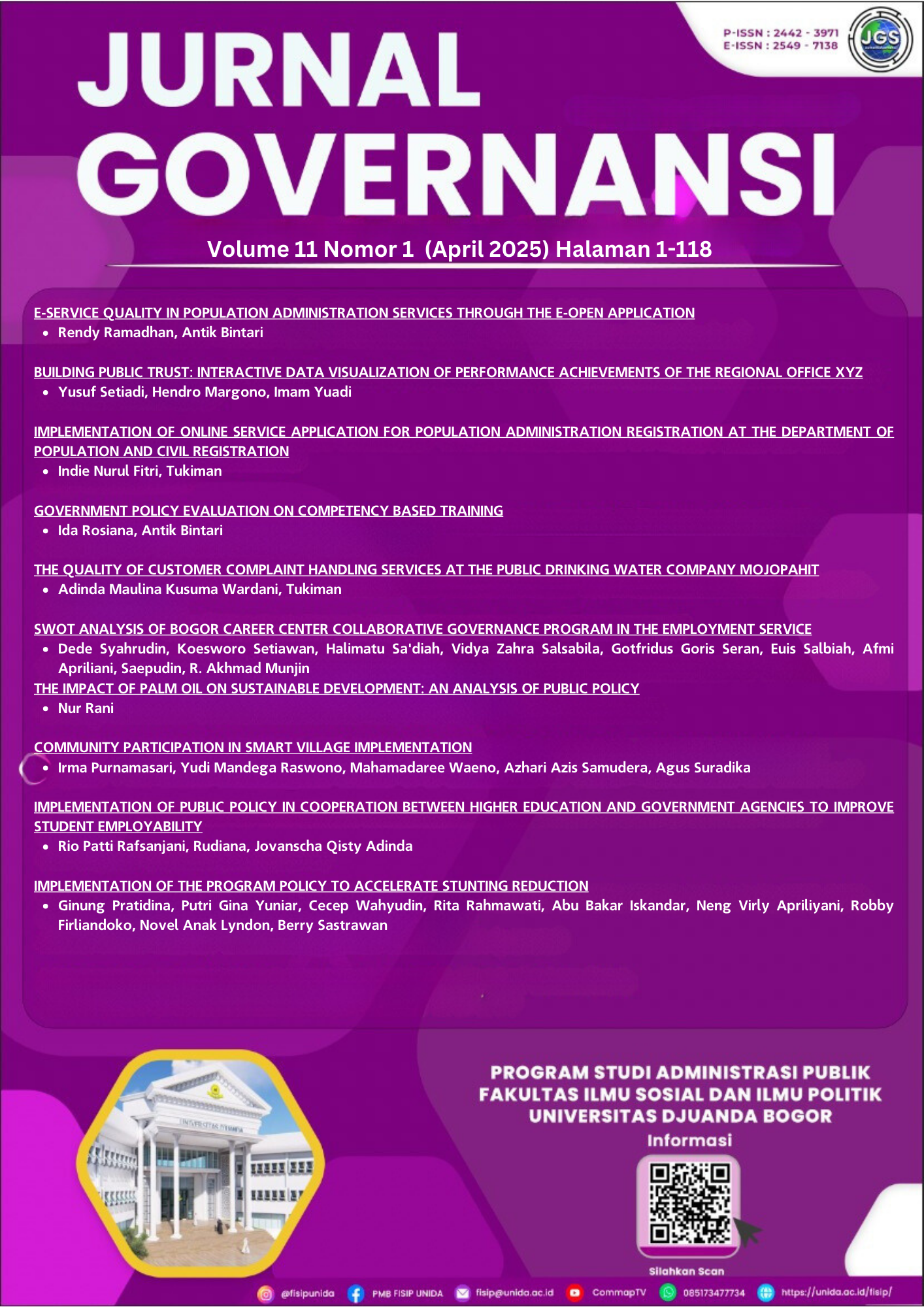
Downloads
Published
How to Cite
Issue
Section
License
Copyright (c) 2025 Rendy Ramadhan, Antik Bintari

This work is licensed under a Creative Commons Attribution-ShareAlike 4.0 International License.
Authors who publish with Jurnal Governansi agree to the following terms:
- Authors retain copyright and grant the journal right of first publication with the work simultaneously licensed under a Creative Commons Attribution 4.0 International License that allows others to share the work with an acknowledgement of the work's authorship and initial publication in Jurnal Governansi.
- Authors are able to enter into separate, additional contractual arrangements for the non-exclusive distribution of the journal's published version of the work (e.g., post it to an institutional repository or publish it in a book), with an acknowledgement of its initial publication in Jurnal Governansi.
- Authors are permitted and encouraged to post their work online (e.g., in institutional repositories or on their website) prior to and during the submission process, as it can lead to productive exchanges, as well as earlier and greater citation of published work.