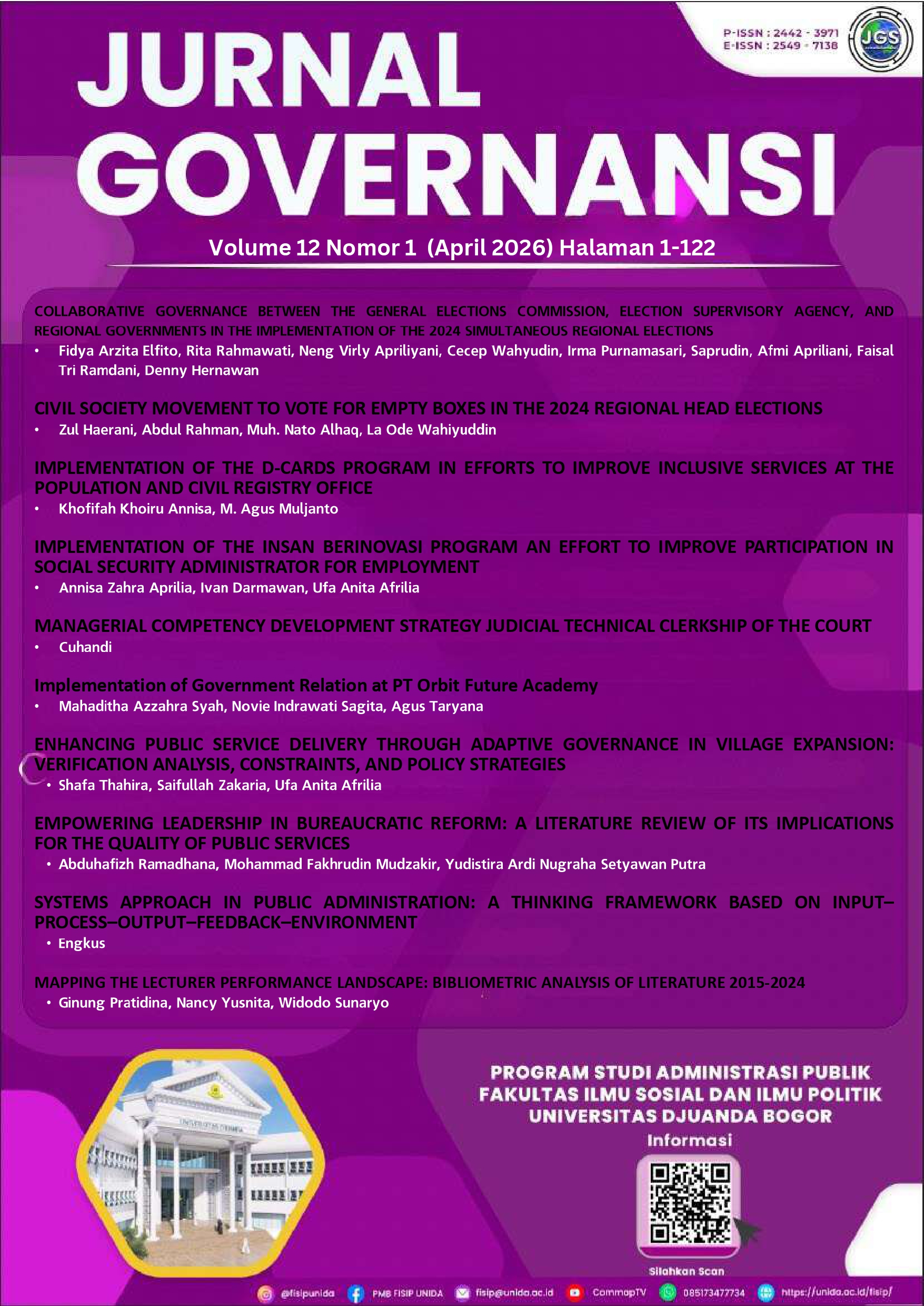
SYSTEMS APPROACH IN PUBLIC ADMINISTRATION: A THINKING FRAMEWORK BASED ON INPUT–PROCESS–OUTPUT–FEEDBACK–ENVIRONMENT
DOI:
https://doi.org/10.30997/jgs.v12i1.24172Keywords:
Public Administration, Public Policy, Framework, Public Services, Systems ApproachAbstract
Public administration faces complex and increasingly dynamic public policy and service issues. However, in many public administration studies, the framework used is still partial, thus failing to systematically explain the relationship between public demands, decision-making processes, policy outcomes, and environmental influences. This study aims to formulate and analyze a public administration framework based on a systems approach through the components of input, process, output, feedback, and environment (IPOFE). This study employed a qualitative approach with a conceptual design through a literature review method of various primary sources in the field of public administration and public policy, including both classic books and reputable scientific journal articles. The analysis was conducted through stages of literature selection, thematic analysis, and conceptual synthesis. The results show that the systems approach is able to explain public administration as an open system involving interactions between public demands as input, administrative and political processes in decision-making, policy outputs as output, feedback mechanisms as policy evaluation, and the influence of the social, political, and economic environment. The integration of these five components strengthens the analysis of public policy and services in a more comprehensive, contextual, and adaptive manner. The novelty of this research lies in the development of the IPOFE conceptual framework as a systemic analysis model that can be used in public administration studies to understand the dynamic relationship between policy processes, public services, and the government environment.
References
Bank World. (2017). World development report 2017: Governance and the law.
Bevir M. (2013). Governance: A very short introduction. Oxford University Press.
Dunn W N. (2018). Public policy analysis: An integrated approach (6th ed.). Routledge.
Easton D. (1965). A systems analysis of political life. John Wiley & Sons, Inc.
Foucault M. (1977). Discipline and punish: The birth of the prison. Pantheon Books.
Hill, M., & H. P. (2014). Implementing public policy: An introduction to the study of operational governance (3rd ed.). SAGE Publications.
Howlett, M.,Ramesh, M.,& Perl, A. (2015). Studying public policy: Policy cycles and policy subsystems (3rd ed.). Oxford University Press.
Li, Z., Wu, W., & M. Q. (2023). The adjustment of pressure perception in e-government response: A perspective of political system theory. Systems. A Perspective of Political System Theory. Systems, 11(3), 158.
Lipsky M. (1980). Street-level bureaucracy: Dilemmas of the individual in public services. Russell Sage Foundation.
Mansoor, Z., & Williams, M. J. (2024). Systems approaches to public service delivery: Methods and frameworks. Journal of Public Policy. Journal of Public Policy, 44(2).
MansoorZ &Williams MJ. (2024). Systems approaches to public service delivery: Methods and frameworks. Journal of Public Policy, 44(2), 258–283.
Merton R K. (1968). Social theory and social structure. The Free Press.
OECD. (2017). Systems approaches to public sector challenges: Working with change.
PooserT. (2024). A systems approach to public administration and social equity: Culture and learning. Emerald Publishing.
Pressman, J. L., & W. A. (1973). Implementation: How great expectations in Washington are dashed in Oakland. University of California Press.
Pulami Magar R. B. (2025). Input–output analysis in the policy-making process: An analysis of systems theory. Chaturbhujeshwar Academic Journal, 3(1), 39–49.
Rhodes R A W. (1996). The new governance: Governing without government. Political Studies, 44(4), 652–667.
Sabatier P. A. (1986). Top-down and bottom-up approaches to implementation research: A critical analysis and suggested synthesis. Journal of Public Policy, 6(1), 21–48.
Weber M. (1947). The theory of social and economic organization. Oxford University Press.
White MJ. (1980). Managing public systems: Analytic techniques for public administration. Duxbury Press.
Winter, S. C. (2012). Implementation. In B. G. Peters & J. Pierre (Eds.), The Sage handbook of public administration (pp. 255–273). SAGE Publications.
Downloads
Published
How to Cite
Issue
Section
License
Copyright (c) 2026 Engkus Engkus

This work is licensed under a Creative Commons Attribution-ShareAlike 4.0 International License.
Authors who publish with Jurnal Governansi agree to the following terms:
- Authors retain copyright and grant the journal right of first publication with the work simultaneously licensed under a Creative Commons Attribution 4.0 International License that allows others to share the work with an acknowledgement of the work's authorship and initial publication in Jurnal Governansi.
- Authors are able to enter into separate, additional contractual arrangements for the non-exclusive distribution of the journal's published version of the work (e.g., post it to an institutional repository or publish it in a book), with an acknowledgement of its initial publication in Jurnal Governansi.
- Authors are permitted and encouraged to post their work online (e.g., in institutional repositories or on their website) prior to and during the submission process, as it can lead to productive exchanges, as well as earlier and greater citation of published work.