GOVERNMENT POLICY EVALUATION ON COMPETENCY BASED TRAINING
DOI:
https://doi.org/10.30997/jgs.v11i1.15989Keywords:
Policy Evaluation, Competency-Based Training, Unemployment, Bandung CityAbstract
The city of Bandung is one of the cities with the highest open unemployment rate in West Java. One of the causes is the suboptimal absorption of job vacancies. To address this issue, the Bandung City Manpower Office (Disnaker) organizes competency-based training. However, in reality, it has not had a significant impact on solving employment problems, such as the lack of proper synchronization between the types of training and the skills needed by companies, as well as the implementation not fully adhering to the Indonesian National Work Competency Standards (SKKNI). Therefore, an evaluation is needed to assess the extent to which the objectives of this activity have been achieved. This research uses a descriptive method. Data collection techniques include observation, interviews, and documentation. The primary and secondary data used in this study were obtained from interviews with research informants. The researcher adopts the activity evaluation theory by the Organisation for Economic Co-operation and Development (OECD) as a reference in the analysis, which consists of criteria such as relevance, coherence, effectiveness, efficiency, impact, and sustainability. Based on the researcher’s findings, competency-based training has been implemented. However, improvements are still needed in several areas, including the lack of alignment between training types and company needs, incomplete adherence to SKKNI guidelines, and the absence of follow-up after the training ends. Other challenges include insufficient funding, inadequate infrastructure and technology, and the lack of participant distribution to companies.
References
Ardias, W. S., & Lenggogeni, P. (2022). Peningkatan Kerjasama Sebagai Upaya Mengoptimalkan Program Kerja Organisasi Ikatan Mahasiswa Solok Selatan. Journal of Social Outreach, 1(1), 92. https://doi.org/10.15548/jso.v1i1.3853
Darmawan, D., Sudrajat, I., Kahfi, M., Maulana, Z., Febriyanto, B., Pendidikan, J., Sekolah, L., Pendidikan, K., Sultan, U., & Tirtayasa, A. (2021). Perencanaan Pengumpulan Data sebagai Identifikasi Kebutuhan Pelatihan Lembaga Pelatihan. Journal of Nonformal Education and Community Empowerment, 5(1), 72. https://doi.org/10.15294/pls.v5i1.30883
Firanti Nur, A., Ramdani, R., Aditya, I., Program, ), Pemerintahan, S. I., Sosial, I., & Politik, I. (2024). Kebijakan Program Pelatihan Berbasis Kompetensi Balai Latihan Kerja Kabupaten Karawang. Communnity Development Journal, 5(2), 3933.
Harding, D., Kadiyono, A. L., Hidayat, Y., & Yanuarti, N. (2018). Pelatihan Dan Pengembangan Sdm Sebagai Salah Satu Upaya Menjawab Tantangan Mea. Journal of Psychological Science and Profession, 2(2), 185. https://doi.org/10.24198/jpsp.v2i2.21196
Hasan, M. I. (2002). Pokok-Pokok Materi Metodologi Penelitian dan Aplikasinya. Ghalia Indonesia.
Hidayat, D. (2017). Pelatihan Keterampilan Otomotif untuk Meningkatkan Kesempatan Kerja di Balai Latihan Kerja Kabupaten Karawang. Journal of Nonformal Education and Community Empowerment, 1(1), 56. https://doi.org/10.15294/pls.v1i1.15143
Hidayat, Y., Rizal, L. F., & Saptaji, A. (2024). Efektivitas Pengaturan Penyerapan Tenaga Kerja Lokal di Kabupaten Karawang dalam Meminimalisir Angka Pengangguran Perspektif Siyasah Dusturiyah. UNES Law Review, 6(4), 11810.
Kalla, E. H. S., Simbolon, G., & Neonufa, S. (2024). Pengaruh Penguasaan Soft Skill Terhadap Kesiapan Calon Tenaga Kerja Dalam Memasuki Dunia Kerja Pada Program Tenaga Kerja Dan Transmigrasi Provinsi Ntt the Influence of Mastering Soft Skills on the Readiness of Prospective Employees in Entering the World O. 4(April), 94.
Khodijah Ishak, SH.I, M. E. S. (2007). FAKTOR-FAKTOR YANG MEMPENGARUHI PENGANGGURAN DAN INFLIKASINYATERHADAP INDEK PEMBANGUNAN DI INDONESIA. IQTISHADUNA: Jurnal Ilmiah Ekonomi Kita, вы12у(235), 245. http://digilib.unila.ac.id/4949/15/BAB II.pdf
Landa, K. S., Kamil, M., & Sardin, S. (2021). Analisis Efektivitas Pelatihan Berbasis Kompetensi “Meta Sintesis Komponen Pelatihan.” Jendela PLS, 6(2), 68. https://doi.org/10.37058/jpls.v6i2.3189
Mahadiputra, B. O., & Khairunnisah, N. A. (2023). Pengelolaan Manajemen Sumber Daya Manusia Dalam Upaya Meningkatkan Kinerja dan Motivasi Melalui Reward System Pada Karywawan Pegadaian Cabang Lombok Utara. Business Management, 2(2), 136. https://doi.org/10.58258/bisnis.v2i2.6499
Miles, B. ., & Huberman, A. . (1992). Analisa Data Kualitatif (T. R. Rohidi, Trans.). UI Press.
Patilima, H. (2013). Metode Penelitian Kualitatif. ALFABETA.
Purhantara, W. (2010). Metode Penelitian Kualitatif Untuk Bisnis. Graha Ilmu.
Putra, S. A., Widyaswari, S. G., Al Azhar, Puspitasari, R. D., & Parmino, D. V. (2020). Dampak Pelatihan Berbasis Kompetensi Bagi Guru Kejuruan Bidang Kemaritiman di Indonesia. Jurnal Widyaiswara Indonesia, 1(3), 121. http://ejournal.iwi.or.id/ojs/index.php/iwi/article/view/18/27
Rianda, C. N. (2020). Analisis Dampak Pengangguran Berpengaruh Terhadap Individual. At-Tasyri’: Jurnal Ilmiah Prodi Muamalah, 12(1), 18. https://doi.org/10.47498/tasyri.v12i01.358
Sugiyono. (2015). Metode Penelitian Kuantitatif, Kualitatif, dan R&D. ALFABETA.
Sugiyono. (2019). Metode Penelitian Kuantitatif, Kualitatif, dan R&D. ALFABETA.
Susilawati, Zulfiati, & R, A. D. (2016). Evaluasi program pelatihan berbasis kompetensi di Unit Pelaksana Teknis Daerah Balai Latihan Kerja Karawang (penerapan model evaluasi cippo). Jurnal Pendidikan Teknik Dan Vokasional, 2(1), 38. https://doi.org/10.21009/JPTV.2.1.5
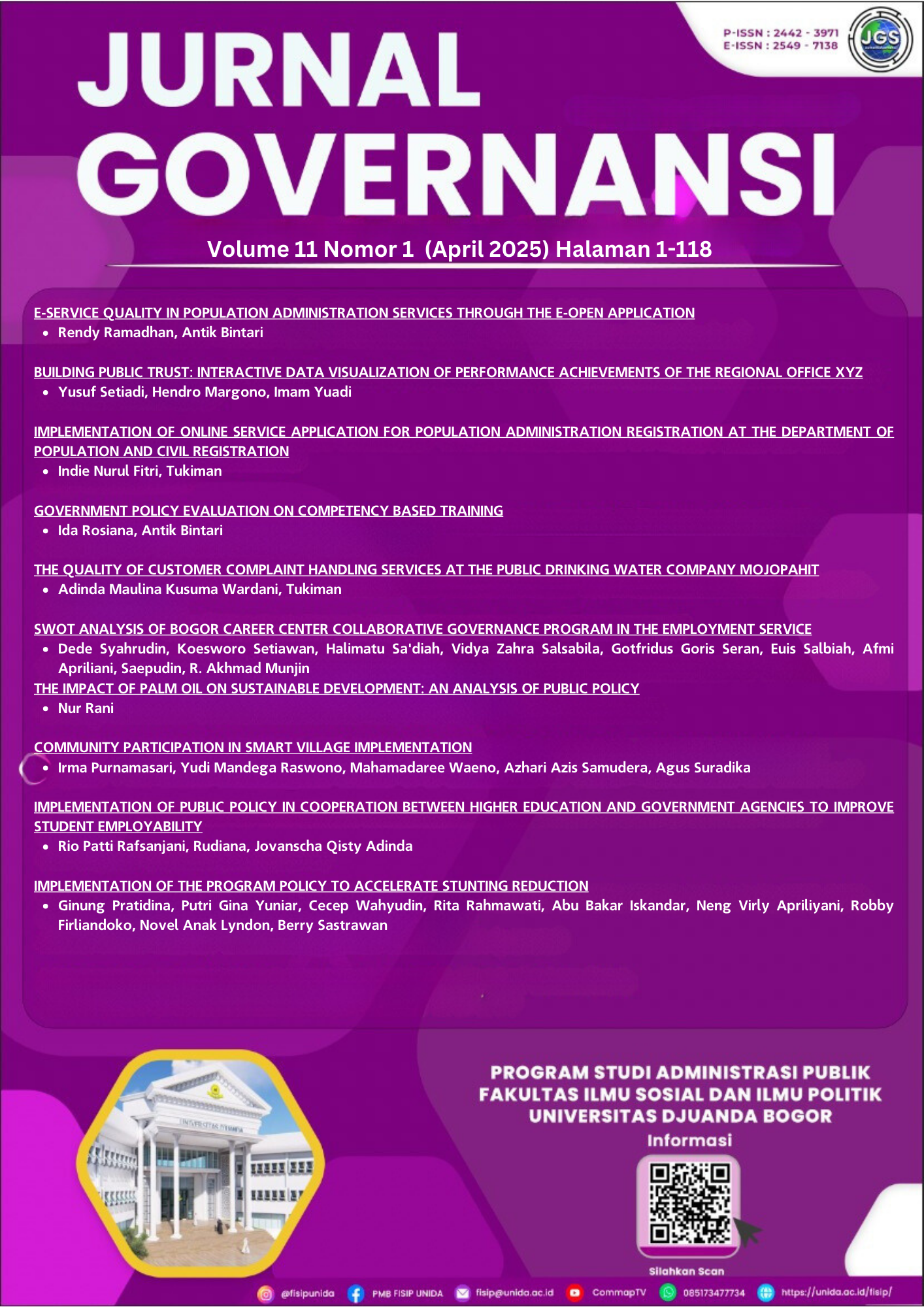
Downloads
Published
How to Cite
Issue
Section
License
Copyright (c) 2025 Ida Rosiana, Antik Bintari

This work is licensed under a Creative Commons Attribution-ShareAlike 4.0 International License.
Authors who publish with Jurnal Governansi agree to the following terms:
- Authors retain copyright and grant the journal right of first publication with the work simultaneously licensed under a Creative Commons Attribution 4.0 International License that allows others to share the work with an acknowledgement of the work's authorship and initial publication in Jurnal Governansi.
- Authors are able to enter into separate, additional contractual arrangements for the non-exclusive distribution of the journal's published version of the work (e.g., post it to an institutional repository or publish it in a book), with an acknowledgement of its initial publication in Jurnal Governansi.
- Authors are permitted and encouraged to post their work online (e.g., in institutional repositories or on their website) prior to and during the submission process, as it can lead to productive exchanges, as well as earlier and greater citation of published work.