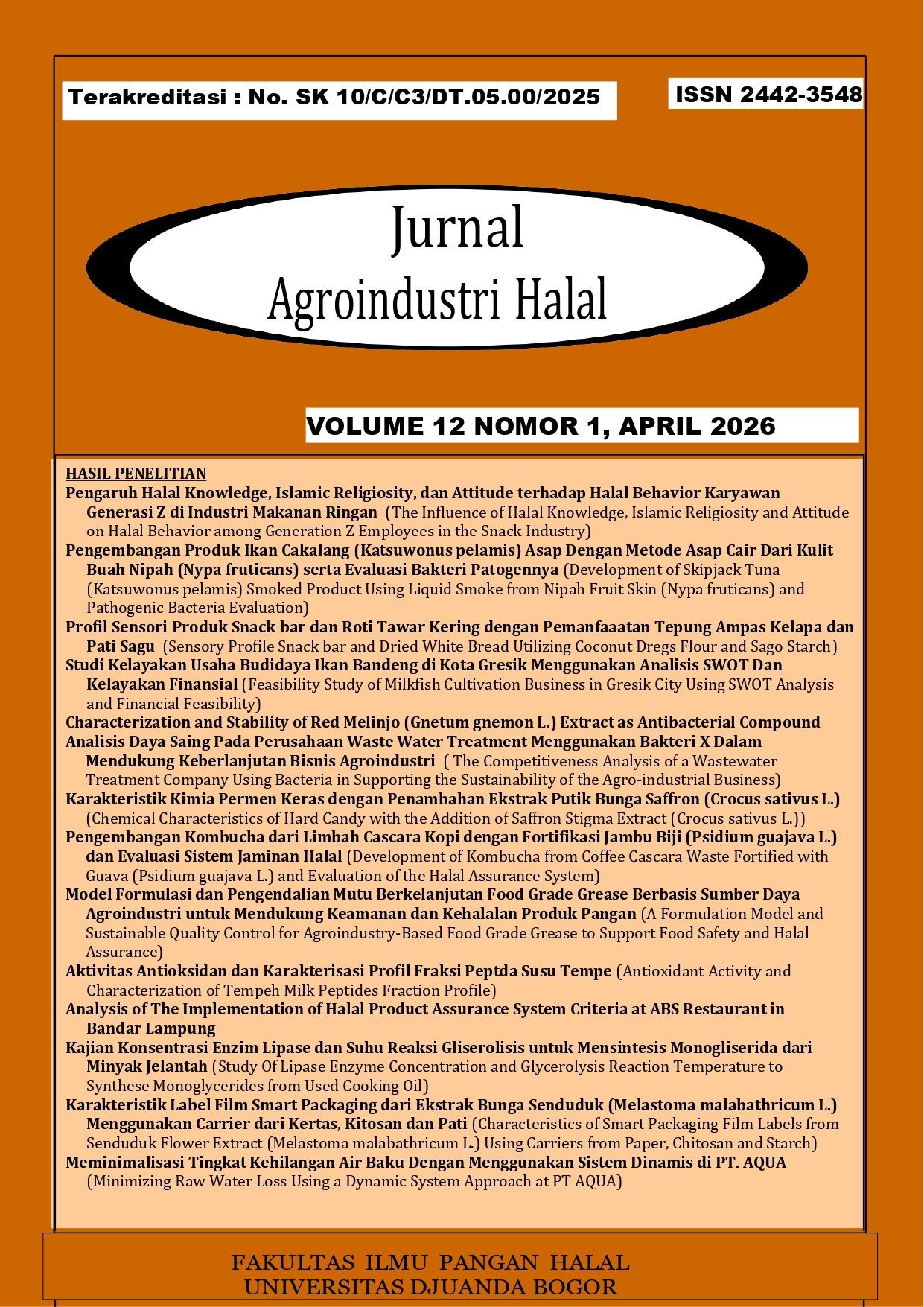
Model Formulasi dan Pengendalian Mutu Berkelanjutan Food Grade Grease Berbasis Sumber Daya Agroindustri untuk Mendukung Keamanan dan Kehalalan Produk Pangan
DOI:
https://doi.org/10.30997/jah.v12i1.24111Keywords:
food grade grease, critical quality characteristics, quality control, halal agroindustry, sustainabilityAbstract
Food safety and halal assurance of food products are influenced not only by the primary food ingredients but also by processing aids, one of which is food grade grease used in food processing equipment. Dependence on imported products and the lack of integration between formulation and process-based quality control highlight the need for the development of a sustainable scientific model based on local agroindustry resources. This study aims to develop a sustainable formulation and quality control model for agroindustry-based food grade grease to support food safety and halal assurance. The study employed a fundamental research approach, with food grade grease as a case study for model development. The research stages included the identification of Critical Quality Characteristics (CQC), selection and physicochemical characterization of agroindustry-based materials, formulation design using Design of Experiment (DOE), and the application of Statistical Quality Control (SQC) to analyze process stability and capability. The results indicate that the developed formulation model successfully identified quantitative relationships between material composition and critical quality parameters, with product quality consistency maintained within statistical control limits. The implementation of SQC demonstrated that the formulation process was stable, with process capability indices (Cp and Cpk) greater than 1.33 for key quality parameters. The integration of formulation and quality control models produced a conceptual framework capable of mapping critical quality points, process variability, and sustainability indicators, including resource-use efficiency and potential agroindustrial waste reduction. The proposed model is expected to serve as a scientific reference for the development and quality supervision of food processing aids that support food safety, halal assurance, and sustainable agroindustry principles.
References
Agustin, R., Hairiyah, N., Musthofa, I.,. (2025). Pengaruh Waktu Pengadukan Terhadap Stabilitas Dan Karakteristik Fisik Food Grade Grease Halal Dari CPO Tangki Timbun PT. ABC Effect of Stirring Time on the Stability and Physical Characteristics of Halal Food Grade Grease Form Storage Tank CPO of PT. ABC . Jurnal Agroindustri Halal, 11 (2) 351-358. https://doi.org/10.30997/jah.v11i3.21731
Asaad, M., Karo Sitepu, R. K., & Martial, T. (2022). Production Efficiency Analysis of Oil Palm Plantations: Stochastic Frontier Approach. International Journal of Research and Review, 9(12), 678–686. https://doi.org/10.52403/ijrr.20221278
Assrorudin, A., Ruhibnur, R., Rosmalinda, R., Kurniawan, T., & Susanto, A. (2020). Karakteristik Mutu Food Grade Grease Ramah Lingkungan Berbahan Baku Minyak Bekas Penggorengan. Jurnal Teknologi Agro-Industri, 7(2), 101–111. https://doi.org/10.34128/jtai.v7i2.93
Deuraseh, A., & Deuraseh, N. (2023). Halal Green from Plant-Based Product Perspective: Palm Oil as a Potential Source for Marine Engine Lubricant. Journal of Halal Science and Technology, 2(2), 41–59. https://doi.org/10.59202/jhst.v2i2.697
Florea, O., & Luca, M. (2010). Multipurpose lubricating greases for food-grade applications. Journal of the Balkan Tribological Association, 16(2).
Heng, Y. J., Yusof, N. F. M., Yen, L. A., Hamid, S. A., & Yusof, N. N. M. (2022). A Contact Characteristic of Roller Bearing with Palm Oil-based Grease Lubrication. Journal of Advanced Research in Fluid Mechanics and Thermal Sciences, 89(2). https://doi.org/10.37934/arfmts.89.2.139149
Indriani, M. R., Arrahman, N., Dini, V. M., Rahmawati, Y., & Darmawan, N. (2024). Challenges and opportunities for workforce skills in halal agri-food sector to meet global market demands through Halalink application. Halal Studies and Society, 2(1), 11–13. https://doi.org/10.29244/hass.2.1.11-13
Kurnia, J. C., Jangam, S. V., Akhtar, S., Sasmito, A. P., & Mujumdar, A. S. (2016). Advances in biofuel production from oil palm and palm oil processing wastes: A review. In Biofuel Research Journal (Vol. 3, Number 1, pp. 332–346). Green Wave Publishing of Canada. https://doi.org/10.18331/BRJ2016.3.1.3
Mayasari, E. J., Bakri, R., & Fibria, M. (2019). The effect of antioxidant additives on the characteristics of food-grade grease using castor oil (Ricinus communis L.) as the base oil. IOP Conference Series: Materials Science and Engineering, 496(1). https://doi.org/10.1088/1757-899X/496/1/012060
Mohd, K. N. (2022). Formulation of Food-Grade Grease Using Paraffin Oil, Fumed Silica, and Chitosan. Materials Science Forum, 1069, 211–218. https://doi.org/10.4028/p-yza5n0
Nasution, D. R., Hasibuan, A., & Sibuea, S. R. (2023). Pengendalian Kualitas CPO untuk Meminimumkan ALB Menggunakan Metode DMAIC. Blend Sains Jurnal Teknik, 1(4), 333–342. https://doi.org/10.56211/blendsains.v1i4.190
Odusote, J., Oni, H., Adeleke, A., Ikubanni, P., Omoniyi, P., Jen, T. C., & Akinlabi, E. (2023). Production and Performance Evaluation of Shea Butter-Based Lubricating Grease. E3S Web of Conferences, 430. https://doi.org/10.1051/e3sconf/202343001297
Săpunaru, O. V., Sterpu, A. E., Vodounon, C. A., Nasr, J., Duşescu-Vasile, C., Osman, S., & Koncsag, C. I. (2024). Lubricating Greases from Fried Vegetable Oil—Preparation and Characterization. Lubricants, 12(6). https://doi.org/10.3390/lubricants12060197
Tan, B. A., Nair, A., Zakaria, M. I. S., Low, J. Y. S., Kua, S. F., Koo, K. L., Wong, Y. C., Neoh, B. K., Lim, C. M., & Appleton, D. R. (2023). Free Fatty Acid Formation Points in Palm Oil Processing and the Impact on Oil Quality. Agriculture (Switzerland), 13(5). https://doi.org/10.3390/agriculture13050957
Downloads
Published
How to Cite
Issue
Section
License
Copyright (c) 2026 Nina Hairiyah, Nuryati, Raden Rizki Amalia, Fatimah, Imron Musthofa

This work is licensed under a Creative Commons Attribution-ShareAlike 4.0 International License.
Authors who publish with Jurnal Agroindustri Halal agree to the following terms:
- Authors retain copyright and grant the journal right of first publication with the work simultaneously licensed under a Creative Commons Attribution 4.0 International License that allows others to share the work with an acknowledgement of the work's authorship and initial publication in Jurnal Agroindustri Halal.
- Authors are able to enter into separate, additional contractual arrangements for the non-exclusive distribution of the journal's published version of the work (e.g., post it to an institutional repository or publish it in a book), with an acknowledgement of its initial publication in Jurnal Agroindustri Halal.
- Authors are permitted and encouraged to post their work online (e.g., in institutional repositories or on their website) prior to and during the submission process, as it can lead to productive exchanges, as well as earlier and greater citation of published work