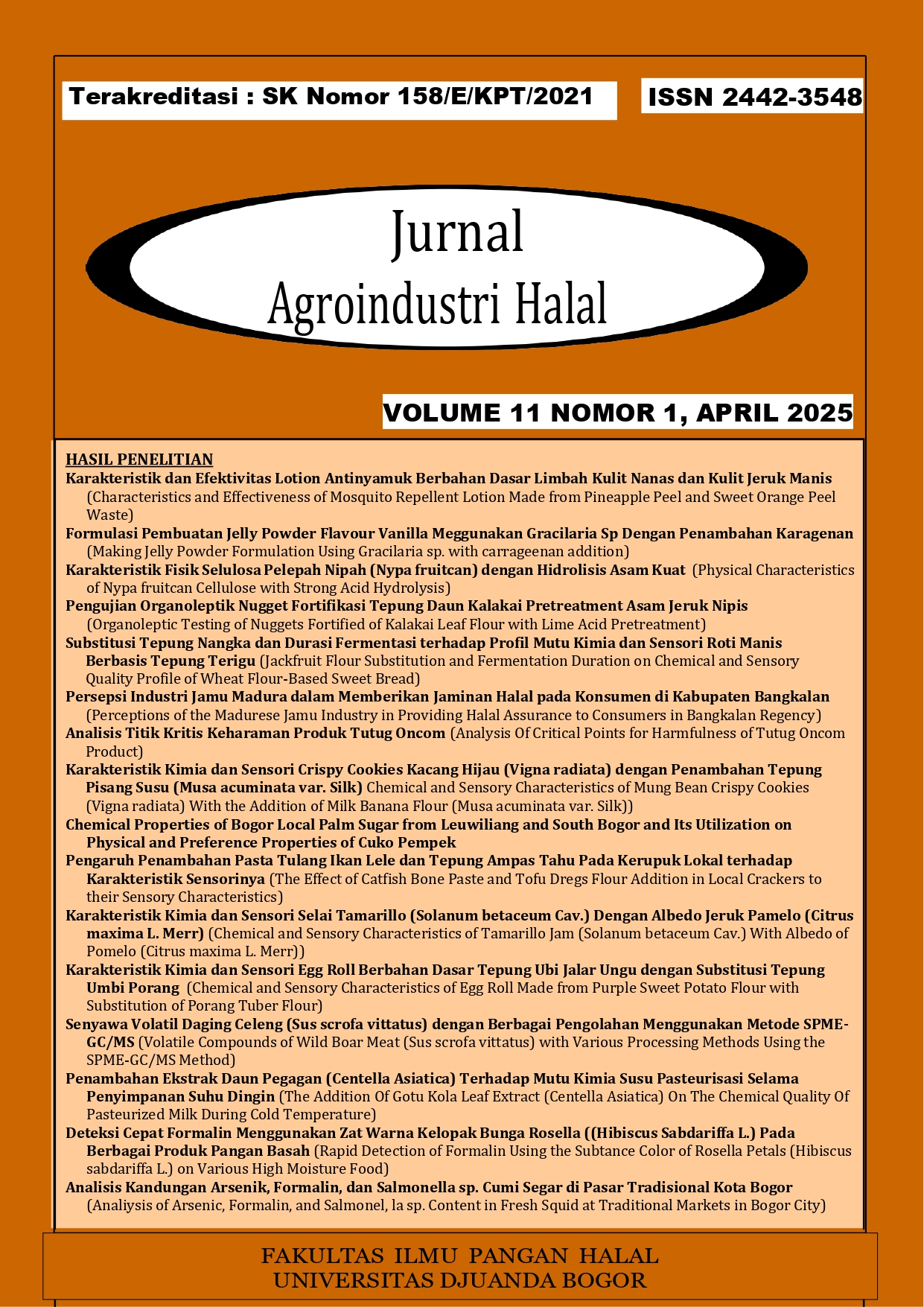
Senyawa Volatil Daging Celeng (Sus scrofa vittatus) dengan Berbagai Pengolahan Menggunakan Metode SPME-GC/MS
DOI:
https://doi.org/10.30997/jah.v11i1.18382Keywords:
halal, authentication, volatile, wild boarAbstract
Food adulteration involving the mixing of non-halal meat into halal products is a sensitive issue in Indonesia. Wild boar meat (Sus scrofa vittatus) is often found to be used in such practices, making it essential to identify its volatile compound profile. This study aims to identify volatile compounds in wild boar meat processed through boiling, frying, and roasting, using Solid-Phase Microextraction (SPME) combined with Gas Chromatography-Mass Spectrometry (GC-MS). The research was conducted qualitatively with three treatments and five replications for each cooking method. The analysis showed that boiled wild boar meat contained 156 volatile compounds, fried meat 142 compounds, and roasted meat 163 compounds, with total intensities of 779, 691, and 819, respectively. Principal Component Analysis (PCA) yielded an R²X value of 0.842 and a cumulative Q² of 0.747, indicating clear separation between samples. The main contributing volatile compounds were 2-Octenal (E)-, Longifolene, and Cyclopropyl carbinol.
References
Amalia, L., Yuliana, N. D., Sugita, P., Arofah, D., Syafitri, U. D., Windarsih, A., Rohman, A., Dachriyanus, Abu Bakar, N. K., & Kusnandar, F. (2022). Volatile compounds, texture, and color characterization of meatballs made from beef, rat, wild boar, and their mixtures. Heliyon, 8(10), e10882. https://doi.org/10.1016/j.heliyon.2022.e10882
Armengol, I., Villalba, D., Tor, M., Pérez-Santaescolástica, C., Purriños, L., Lorenzo, J. M., & Álvarez-Rodríguez, J. (2019). The extent to which genetics and lean grade affect fatty acid profiles and volatile compounds in organic pork. PeerJ, 7, e7322. https://doi.org/10.7717/peerj.7322
Ayseli, M. T., Filik, G., & Selli, S. (2014). Evaluation of volatile compounds in chicken breast meat using simultaneous distillation and extraction with odour activity value. Journal of Food and Nutrition Research, 53(2), 137–142.
Chen, G., Su, Y., He, L., Wu, H., & Shui, S. (2019). Analysis of volatile compounds in pork from four different pig breeds using headspace solid-phase micro-extraction/gas chromatography–mass spectrometry. Food Science and Nutrition, 7(4), 1261–1273. https://doi.org/10.1002/fsn3.955
Chen, Z. F., Lin, Q. B., Song, X. C., Chen, S., Zhong, H. N., & Nerin, C. (2020). Discrimination of virgin and recycled polyethylene based on volatile organic compounds using a headspace GC-MS coupled with chemometrics approach. Food Packaging and Shelf Life, 26, 100553. https://doi.org/10.1016/j.fpsl.2020.100553
Dashdorj, D., Amna, T., & Hwang, I. (2015). Influence of specific taste-active components on meat flavor as affected by intrinsic and extrinsic factors: An overview. European Food Research and Technology, 241(2), 157–171. https://doi.org/10.1007/s00217-015-2449-3
Ellis, D. I., Muhamadali, H., Allen, D. P., Elliott, C. T., & Goodacre, R. (2016). A flavour of omics approaches for the detection of food fraud. Current Opinion in Food Science, 10, 7–15. https://doi.org/10.1016/j.cofs.2016.07.002
Eriksson, L., Byrne, T., Johansson, E., Trygg, J., & Vikström, C. (2013). Multi- and megavariate data analysis: Basic principles and applications (3rd ed.). Umetrics Academy Press.
Fitriana, N., Sumartini, N., & Jayuska, A. (2014). Formulasi serbuk flavour makanan dari minyak atsiri tanaman kesum (Polygonum minus Huds) sebagai penyedap makanan. Jurnal Aplikasi Teknologi Pangan, 3(1), 12–15.
Garcia, A., & Barbas, C. (2011). Gas chromatography–mass spectrometry (GC–MS)-based metabolomics. In C. B. Oliveira (Ed.), Metabolic profiling: Methods and protocols (Vol. 708, pp. 191–204). Springer. https://doi.org/10.1007/978-1-61737-985-7_11
Jamilah, W. (2012). Sifat sensoris dan karakteristik flavor daging sapi PO dan kerbau rawa yang digemukkan dengan ransum disuplementasi minyak ikan lemuru terproteksi [Skripsi sarjana, Institut Pertanian Bogor].
Kamieniarz, R., Jankowiak, Ł., Frątczak, M., Panek, M., Wojtczak, J., & Tryjanowski, P. (2020). The relationship between hunting methods and the sex, age and body mass of wild boar (Sus scrofa). Animals, 10(12), 2345. https://doi.org/10.3390/ani10122345
Kosowska, M., Majcher, M. A., & Fortuna, T. (2017). Volatile compounds in meat and meat products. Journal of Food Science and Technology, 37(1), 1–7. https://doi.org/10.1590/1678-457X.08416
Lammers, M., Dietze, K., & Ternes, W. (2009). A comparison of the volatile profiles of frying European and Australian wild boar meat with industrial genotype pork by dynamic headspace-GC/MS analysis. Journal of Muscle Foods, 20(3), 255–274. https://doi.org/10.1111/j.1745-4573.2009.00146.x
Lytou, A. E., Panagou, E. Z., & Nychas, G. J. E. (2019). Volatilomics for food quality and authentication. Current Opinion in Food Science, 28, 88–95. https://doi.org/10.1016/j.cofs.2019.10.003
Mardiah, Amalia, L., & Trimelati, D. A. (2020). Analisis kehalalan daging sapi dengan metode pork detection kit. Jurnal Ilmiah Pangan Halal, 2(2), 53–60.
Nobeli, I., & Thornton, J. M. (2006). A bioinformatician’s view of the metabolome. BioEssays, 28(5), 534–545. https://doi.org/10.1002/bies.20414
Pavlidis, D. E., Mallouchos, A., Ercolini, D., Panagou, E. Z., & Nychas, G. J. E. (2019). A volatilomics approach for off-line discrimination of minced beef and pork meat and their admixture using HS-SPME GC/MS in tandem with multivariate data analysis. Meat Science, 151, 43–53. https://doi.org/10.1016/j.meatsci.2019.01.003
Pranata, A. W., Yuliana, N. D., Amalia, L., & Darmawan, N. (2021). Volatilomics for halal and non-halal meatball authentication using solid-phase microextraction–gas chromatography–mass spectrometry. Arabian Journal of Chemistry, 14(5), 103146. https://doi.org/10.1016/j.arabjc.2021.103146
Ramírez, M. R., Estévez, M., Morcuende, D., & Cava, R. (2004). Effect of the type of frying culinary fat on volatile compounds isolated in fried pork loin chops by using SPME-GC-MS. Journal of Agricultural and Food Chemistry, 52(25), 7637–7643. https://doi.org/10.1021/jf049207s
Salahudin, A., & Ramli, M. A. (2018). Penggunaan teknologi autentikasi halal dalam verifikasi produk makanan berasaskan daging. Al-Basirah, 8(1), 1–10.
Wang, Y., Bu, X., Yang, D., Deng, D., Lei, Z., Guo, Z., & Yu, Q. (2023). Effect of cooking method and doneness degree on volatile compounds and taste substance of Pingliang red beef. Foods, 12(3), 446. https://doi.org/10.3390/foods12030446
Yang, J., Zhao, X., Lu, X., Lin, X., & Xu, G. (2015). A data preprocessing strategy for metabolomics to reduce the mask effect in data analysis. Frontiers in Molecular Biosciences, 2, 4. https://doi.org/10.3389/fmolb.2015.00004
Downloads
Published
How to Cite
Issue
Section
License
Copyright (c) 2025 Lia Amalia, Noli Novidahlia, Intan Kusumaningrum, Sahnur Mulya, Mardiah, Aji Jumiono, Arshyla Eliska, Muhamad Fauzi Ramadhan, Nurfitri Lidiyani

This work is licensed under a Creative Commons Attribution-ShareAlike 4.0 International License.
Authors who publish with Jurnal Agroindustri Halal agree to the following terms:
- Authors retain copyright and grant the journal right of first publication with the work simultaneously licensed under a Creative Commons Attribution 4.0 International License that allows others to share the work with an acknowledgement of the work's authorship and initial publication in Jurnal Agroindustri Halal.
- Authors are able to enter into separate, additional contractual arrangements for the non-exclusive distribution of the journal's published version of the work (e.g., post it to an institutional repository or publish it in a book), with an acknowledgement of its initial publication in Jurnal Agroindustri Halal.
- Authors are permitted and encouraged to post their work online (e.g., in institutional repositories or on their website) prior to and during the submission process, as it can lead to productive exchanges, as well as earlier and greater citation of published work