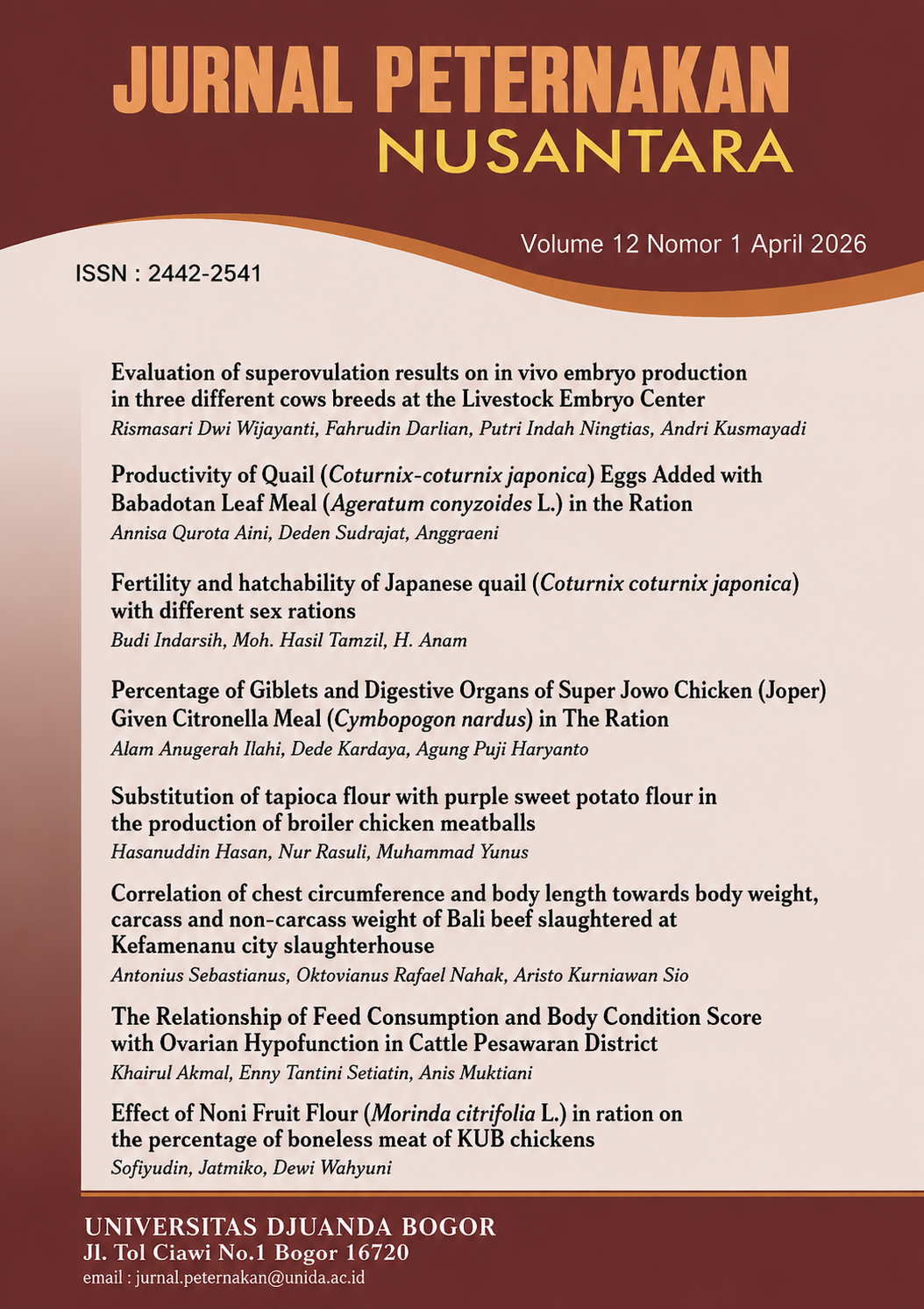
The Relationship of Feed Consumption And Body Condition Score With Ovarian Hypofunction In Cattle Pesawaran Distric
The Relationship of Feed Consumption And Body Condition Score With Ovarian Hypofunction In Cattle
DOI:
https://doi.org/10.30997/jpn.v12i1.21145Keywords:
Hypofunction; body condition score ; konsumsi pakanAbstract
Cases of ovarian hypofunction in beef cattle on smallholder farms greatly influence livestock reproductive activities, especially to achieve successful pregnancy in cattle with reproductive disorders. The material used in this research was 88 cattle belonging to breeders in Pesawaran Regency which were taken using the criteria of cattle having ovarian hypofunction reproductive disorders with a census of 68 breeders as respondents. Primary data was obtained directly in the field through interviews with each beef cattle farmer, while secondary data was obtained from related agencies. The results of research on feed consumption (X1) and Body Condition Score (X2) simultaneously have a very significant effect on the rate of recovery from hypofunction (Y). The partial T test of the feed consumption variable (X1) had no effect on the recovery rate, as shown by the significance value of 0.562 > 0.05. Meanwhile, Body Condition Score (X2) had a very significant effect on the recovery rate (Y). Meanwhile, the Body Condition Score variable (X2) has a very real influence on the recovery rate, as indicated by the significance value of 0.000<0.0. The research can be concluded that feed consumption and Body Condition Score have a relationship with the level of recovery from hypofunction
Downloads
References
Baker, J. J., (2014). Beef Cattle Production in Tropics. Florentina Publishing Co, Glassgow.
Anwar, R., Adi Wibowo, T., & Sasri Untari, D. (2021). Manajemen Pemberian Pakan Ternak Sapi PotongDi Kecamatan Pasir Sakti, Kabupaten Lampung Timur. Open Science and Technology, 01(02), 190–195.
BPS. (2019). Kabupaten Pesawaran Dalam Angka 2018. Pesawaran: Badan Pusat Statistik (BPS) Kabupaten Pesawaran.
Budiawan A., M. Ihsan dan S. Wajuhningsih. (2015). Hubungan Body Condition Score Terhadap Service Per Conception dan Calving Interval Sapi Potong Peranakan Ongole Di Kacamatan Babat Kabupaten Lamongan. Jurnal Ternak Tropika Vol.16, No.1: 34-40.
Gupta, D.(2015). Study on sterile and sub-sterile conditions in cow and buffalo in Mawana tehsil of district Meerut Ulttar Pradesh. J Anim Husb Dairy Sci 6(1): 83-84.
Hariadi M, Wurlina, Hermadi HA, Utomo B, Triana IN, Rimayanti, Ratnani H. (2011). Buku Ajar Ilmu Kemajiran. Penerbit Airlangga University Press. Surabaya. 1-26; 94-112.
Khadrawy, H.H.E., W.M. Ahmed, M.M. Zaabal and E.M. Hanafi. (2015). Lights on Drugs Used for Treatment of Ovarian Disorders in Farm Animals. Global Vet 14(3): 393-399.
Khalil, Andri dan U. Zaituni. (2019). Suplementasi Mineral Lokal Untuk Perbaikan Nutrisi Dan Reproduksi Sapi Peranakan Simmental Dara Pada Peternakan Rakyat Di Jorong Sibaladuang, Kabupaten Limapuluh Kota. Jurnal Ilmiah Pengabdian kepada Masyarakat : 5 (3): 202209.
McCosker, K. (2015) . Improving Beef Cattle Production in Free Range Systems: Implications for Indonesia. Proceeding International Seminar Improving Tropical Animal Production for Food Security. Unhalu Press., Kendari. Pp. 55-62.
Mulyanti, E., Keraf. (2021). Suplementasi Konsentrat untuk Memperbaiki Body Condition Score (BCS) Sapi Induk Menjelang Dikawinkan. Jurnal Sain Peternakan Indonesia, 16 (1): 85-92.
Sandi, S., M. Desiarni, & Asmak. (2018) . Manajemen Pakan Ternak Sapi Potong di Peternakan Rakyat di Desa Sejaro Sakti Kecamatan Indralaya Kabupaten Ogan Ilir. Jurnal Peternakan Sriwijaya Vol. 7(1). Pp. 21-29.
Purnamaningsih, H., Indarjulianto, S., & Nururrozi, A. (2017). Potensi jerami sebagai pakan ternak ruminansia. Jurnal Ilmu-Ilmu Peternakan, 27(1), 40-62.
Sabaruddin, Kholik, Dina Oktaviana, dan Maratun Jannah. (2022). Hubungan Body Condition Scoredengan Service Per Conceptionpada Induk Sapi Bali di Desa Kilang Kecamatan Montong Gading Kabupaten Lombok Timur. Jurnal Sains Peternakan 10(1).
Santosa U. (2008). Mengelola Peternakan Sapi Secara Profesional. Penebar swadaya. Jakarta.
Singarimbun, M dan Efendi. (1995). Metode Penelitian Survey. Jakarta : PT. Pustaka LP3SE
Soekartawi, A. Soeharjo, J. L. Dillon, dan J. B. Hardaker. (1984). Ilmu Usahatani dan Penelitian untuk Pengembangan Petani Kecil. Universitas Indonesia. Jakarta.
Suartini NK, TrilaksanaI GHB, Pemayun TGO. 2013. Kadar estrogen dan munculnya estrus setelah pemberian Buserelin (Agonis GnRH) pada sapi Bali yang mengalami anestrus postpartum akibat hipofungsi ovarium. Jurnal Ilmu dan Kesehatan Hewan
Yusuf M, D.P. Rahardja , A.L. Toleng, R. Haryani dan M.A. Asja. (2015). Body Condition Score of Bali Cows: Its Effect on Reproductive Status. Proceeding
International Seminar Improving Tropical Animal Production for Food Security, Kendari: Unhalu Press. Pp. 115-121.
Zainudin M, NurIhsan M, Suyadi. (2015). Efisiensi Reproduksi Sapi Perah PFH pada Berbagai Umur di CV. Milkindo Berka Abadi Desa Tegal sari Kecamatan Kepanjen Kabupaten Malang. Jurnal Ilmu-ilmu Peternakan 24(3): 32-37
Downloads
Published
How to Cite
Issue
Section
License
Copyright (c) 2026 Khairul Akmal, Enny Tantini Setiatin, Anis Muktiani

This work is licensed under a Creative Commons Attribution-ShareAlike 4.0 International License.
Authors who publish with Jurnal Peternakan Nusantara agree to the following terms:
- Authors retain copyright and grant the journal right of first publication with the work simultaneously licensed under a Creative Commons Attribution 4.0 International License that allows others to share the work with an acknowledgement of the work's authorship and initial publication in Jurnal Peternakan Nusantara.
- Authors are able to enter into separate, additional contractual arrangements for the non-exclusive distribution of the journal's published version of the work (e.g., post it to an institutional repository or publish it in a book), with an acknowledgement of its initial publication in Jurnal Peternakan Nusantara.
- Authors are permitted and encouraged to post their work online (e.g., in institutional repositories or on their website) prior to and during the submission process, as it can lead to productive exchanges, as well as earlier and greater citation of published work.