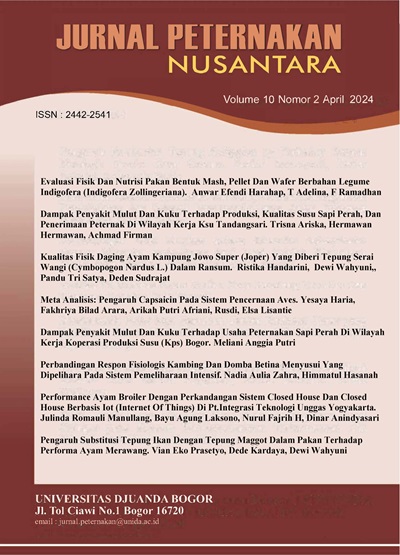
META ANALISIS: PENGARUH CAPSAICIN PADA SISTEM PENCERNAAN AVES
META ANALISIS: PENGARUH CAPSAICIN PADA SISTEM PENCERNAAN AVES
DOI:
https://doi.org/10.30997/jpn.v10i2.13891Keywords:
Aves, Capsaicin, Fitobiotik, PencernaanAbstract
The use of antibiotic growth promoters has been banned in various countries because of the risk of causing bacterial resistance to drugs and antibiotic residues, so phytobiotics are used as an alternative. One of the many commercial products known to have the potential to be used as a phytobiotic is the capsicum group. The characteristic of Capsicum is the high content of the capsaicin compound in it which is famous for its pharmacological abilities including increasing livestock production. This research is a meta-analysis research conducted to determine the effect of using capsaicin on poultry digestion. The data used in this research is secondary data extracted from previously collected journals. The data collected was then subjected to a statistical difference test to determine the differences between each treatment. The results of the analysis showed that in general the use of capsaicin supplementation increased digestive enzyme activity, feed intake, and chicken weight compared to treatment without the use of capsaicin. The statistical test results also showed that there were differences in the results of each treatment as indicated by a p value of 0.011 < 0.05 and there was a real and significant influence from the use of capsaicin on digestive assessment parameters with a p value of 0.011 < 0.05. These results show that capsaicin can be used as an alternative antibiotic for poultry to increase digestive enzyme activity, feed digestibility, increase feed intake, and increase bird body weight.
Downloads
References
Ahsan, U., Adabi, S.G., Ozdemir, S.O., Sevim, O., Onur, T., Kuter, E., & Cengiz, O. 2022. Growth performance, carcass yield and characteristics, meat quality, serum biochemistry, jejunal histomorphometry, oxidative stability of liver and breast muscle, and immune response of broiler chickens fed natural antioxidant alone or in combination with Bacillus licheniformis. Arch. Anim. Breed., 65, 183–197, https://doi.org/10.5194/aab-65-183-2022,
Al-Khalaifah, H., Al-Nasser, A., Al-Surrayai, T., Sultan, H., Al-Attal, D., Al-Kandari, R., Al-Saleem, H., Al-Holi, A., & Dashti, F. 2022. Effect of Ginger Powder on Production Performance, Antioxidant Status, Hematological Parameters, Digestibility, and Plasma Cholesterol Content in Broiler Chickens. Animals, 12(7), 901-915. https://doi.org/10.3390/ani12070901
Alem, W.T. 2024. Effect of herbal extracts in animal nutrition as feed additives. Heliyon, 10, 1-8. https://doi.org/10.1016/j.heliyon.2024.e24973
Azlan, A., Sultana, S., Huei, C.S., & Razman, M.R. (2022) Antioxidant, anti-obesity, nutritional and other beneficial effects of different chili pepper: a review. Molecules, 27(3), 898-909. https://doi.org/10.3390/molecules27030898
Dinbiso, T.D., Deressa, F.B., Legesse, D.T., Gebisa, E.S., Diko A.C., & Fulasa, T.T. 2022. Antimicrobial activity of selected ethnoveterinary medicinal plants of southern region, Ethiopia. Infect. Drug Resist, 106, 6225–6235.
Ding, X., Yang, C., Wang, P., Yang, Z., Ren, X. 2020. Effects of star anise (Illicium verum Hook. f) and its extractions on carcass traits, relative organ weight, intestinal development, and meat quality of broiler chickens. Poult Sci., 99(11):5673-5680. doi: 10.1016/j.psj.2020.07.009
El-Hack, A., El-Saadony, M.T., Elbestawy, A.R., Gado, A.R., Nader, M.M., Saad, A.M., El-Tahan, A.M., Taha, A.E., Salem, H.M., & El-Tarabily, K.A. 2022. Hot red pepper powder as a safe alternative to antibiotics in organic poultry feed: an updated review. Poultry Science, 10(4), 1-22. https://doi.org/10.1016/j.psj.2021.101684
Guo, Y., Balasubramanian, B., Zhao, Z.H., & Liu, W.C. 2021. Marine algal polysaccharides alleviate aflatoxin B1-induced bursa of Fabricius injury by regulating redox and apoptotic signaling pathway in broilers. Poult Sci. 100(8), 44–57. doi: 10.1016/j.psj.2020.10.050
Hernandez-Perez, T., Gomez-Garcia, M.D., & Valverde, M.E. Capsicum annuum (hot pepper): An ancient Latin-American crop with outstanding bioactive compounds and nutraceutical potential. A review. Compr. Rev. Food. Sci. Food. Safety., 19(6), 2972-2993. https://doi.org/10.1111/1541-4337.12634
Herrero-Encinas, J., Huerta, A., Blanch, M., Pastor, J.J., Morais, S., & Menoyo, D. 2023. Impact of Dietary Supplementation of Spice Extracts on Growth Performance, Nutrient Digestibility and Antioxidant Response in Broiler Chickens. Animals, 13(2), 250-265. https://doi.org/10.3390/ani13020250
Kang, Z., Hu, J., Chen, M., Mao, Y., Xie, L., Yang, N., Liu, T., Zhang, W., & Huang, W. 2022. Effects of Capsaicin on the Hypoglycemic Regulation of Metformin and Gut Microbiota Profiles in Type 2 Diabetic Rats. The American Journal of Chinese Medicine, 50(3), 839-861. https://doi.org/10.1142/S0192415X22500355
Kuralkar, P.S., & Kuralkar, S.V. 2021. Role of herbal products in animal production-an updated review. Journal Ethnopharmacol, 278, 1-11.
Li, Z., Zhang, J., Wang, T., Zhang, J., Zhang, L., & Wang T. 2022. Effects of Capsaicin on Growth Performance, Meat Quality, Digestive Enzyme Activities, Intestinal Morphology, and Organ Indexes of Broilers. Frontiers in Veterinary Science, 9, 1-16. https://doi.org/10.3389/fvets.2022.841231
Liu, H.S., Mahfuz, S.U., Wu, D., Shang, Q.H., Piao, X.S. 2020. Effect of chestnut wood extract on performance, meat quality, antioxidant status, immune function, and cholesterol metabolism in broilers. Poult. Sci., 99(8), 4488-4495. https://doi.org/10.2527/jas.2011-4304
Liu, J.G., Xia, W.G., Chen, W., Abouelezz, K.F.M., Ruan, D., Wang, S., Zhang, Y.N., Huang, X.B., Li, K.C., Zheng, C.T., & Deng, J.P. 2021. Effects of capsaicin on laying performance, follicle development, and ovarian antioxidant capacity in aged laying ducks. Poultry Science, 100(4), 68-77. https://doi.org/10.1016/j.psj.2020.11.070
Liu, S.J., Wang, J., He, T.F., Liu, H.S., Piao, X.S. 2021. Effects of natural capsicum extract on growth performance, nutrient utilization, antioxidant status, immune function, and meat quality in broilers. Poultry Science, 100(9), 1-18. https://doi.org/10.1016/j.psj.2021.101301
Long, S., Liu, S., Wang, J., Mahfuz, S., & Piao, X. (2021). Natural capsicum extract replacing chlortetracycline enhances performance via improving digestive enzyme activities, antioxidant capacity, anti-inflammatory function, and gut health in weaned pigs. Animal Nutrition, 7(2), 305-314. https://doi.org/10.1016/j.aninu.2020.12.004
Munglang, N.N. & Vidyarthi, V.K. 2020. Performance of Broiler Chicken on Diet Supplemented with Hot Red Pepper
Powder. Livestock Research International, 8(2), 59-65.
Ogbuewu, I.P., Okoro, V.M., & Mbajiorgu, C.A. 2020. Meta-analysis of the influence of phytobiotic (pepper) supplementation in broiler chicken performance. Trop. Anim. Health Prod, 52, 17-30. https://doi.org/10.1007/s11250-019-02118-3
Oliveira, H.C., Oliveira, M.C., Arantes, U.M., & Argyri, E.T.A. 2020. Paprika and/or marigold extracts improve productivity and yolk color in egg-laying quails. Ciência Animal Brasileira, 21, 1-18 https://doi.org/10.1590/1809-6891v21e-53048.
Orengo, & Megias, M.D. 2023. Penilaian Profitabilitas Dan Viabilitas Capsicum Frutescens Sebagai Tambahan Diet Bagi Ayam Broiler. International Journal of Interdisciplinary Research in Medical and Health Sciences, 10(1), 25-33. http://sadijournals.org/index.php/IJIRMHS/article/view/108
Parvari, S., Ebrahimi-Mahmoudabad, S.R., & Kianfar, R. 2022. Performance, Blood Parameters, and Immune Response of Japanese Quails fed Turmeric and Chili Pepper Powder. Animal Production Research, 11(1), 39-53. https://doi.org/10.22124/ar.2022.18651.1589
Shehata, A.A., Yalçın, S., Latorre, J.D., Basiouni, S., Attia, Y.A., Abd El-Wahab, A., Visscher, C., El-Seedi, H.R., Huber, C., Hafez, H.M., Eisenreich,W., & Tellez-Isaias, G. 2022. Probiotics, Prebiotics, and Phytogenic Substances for Optimizing Gut Health in Poultry. Microorganisms, 10(2), 395-418. https://doi.org/10.3390/microorganisms10020395
Sirotkin, A.V. 2023. Peppers and their constituents against obesity. Biologia Futura, 74, 247–252. https://doi.org/10.1007/s42977-023-00174-3
Sreshtaa, V. S., Leslie, R.S., Brundha, M.P., & Anjaneyulu, K. (2021). Dietary Capsaicin and Immune System. Annals of the Romanian Society for Cell Biology, 25(3), 5809–5822. https://annalsofrscb.ro/index.php/journal/article/view/2113
Tegegne, A., & Feye, G. 2020. Study of Selected Livestock Innovations in Ethiopia. Ethiopia: zef Center for Development Research University of Bonn.
Uarrota, V.G., Maraschin, M., de Bairros, A.F.M., & Pedreschi, R. (2021). Factors affecting the capsaicinoid profile of hot peppers and biological activity of their non-pungent analogs (Capsinoids) present in sweet peppers. Crit Rev Food Sci Nutr, 61(4), 649–665.
Wang, F., Xue, Y., Fu, L., Wang, Y., He, M., Zhao, L., & Liao, X. 2022. Extraction, purification, bioactivity and pharmacological effects of capsaicin: a review. Crit Rev Food Sci Nutr., 62(19), 5322-5348. doi: 10.1080/10408398.2021.1884840
Youssef, I. M., Manner, K., & Zentek, J. 2021. Effect of essential oils or saponins alone or in combination on productive performance intestinal morphology and digestive enzymes' activity of broiler chickens. J. Anim. Phys. Anim. Nutr., 105, 99–107.
Downloads
Published
How to Cite
Issue
Section
License
Copyright (c) 2024 Yesaya Haria, Fakhriya Bilad Arara, Arikah Putri Afriani, Rusdi, Elsa Lisantie

This work is licensed under a Creative Commons Attribution-ShareAlike 4.0 International License.
Authors who publish with Jurnal Peternakan Nusantara agree to the following terms:
- Authors retain copyright and grant the journal right of first publication with the work simultaneously licensed under a Creative Commons Attribution 4.0 International License that allows others to share the work with an acknowledgement of the work's authorship and initial publication in Jurnal Peternakan Nusantara.
- Authors are able to enter into separate, additional contractual arrangements for the non-exclusive distribution of the journal's published version of the work (e.g., post it to an institutional repository or publish it in a book), with an acknowledgement of its initial publication in Jurnal Peternakan Nusantara.
- Authors are permitted and encouraged to post their work online (e.g., in institutional repositories or on their website) prior to and during the submission process, as it can lead to productive exchanges, as well as earlier and greater citation of published work.