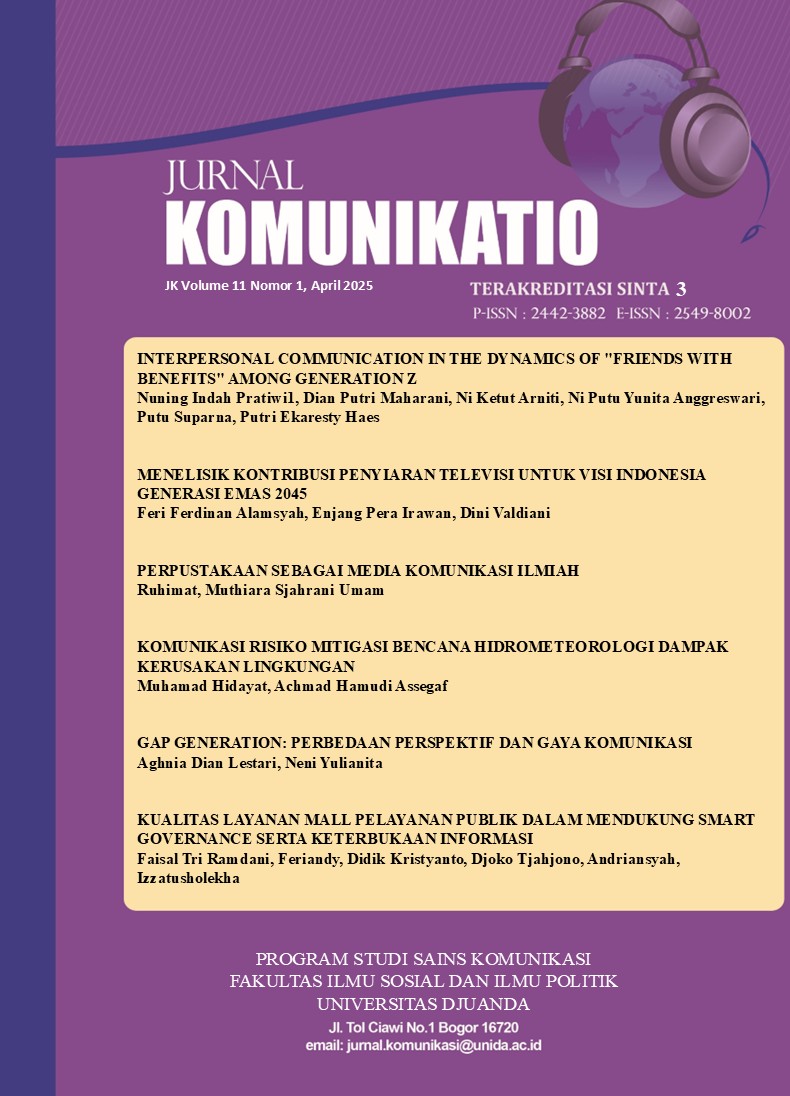
Menelisik Kontribusi Penyiaran Televisi untuk Visi Indonesia Generasi Emas 2045
DOI:
https://doi.org/10.30997/jk.v11i1.16367Keywords:
Broadcast television, Demographic dividend, Desk study, Generasi emas 2045, Mass mediaAbstract
A preventive idea for Indonesia's Generasi Emas 2 045 challenges in facing the demographic dividend in the future. This demographic dividend is a social threat that has tremendous impact, if not dealt with properly. All stakeholders, including television broadcasting industry, can contribute. Komisi Penyiaran Indonesia (KPI) stated that the television industry has great potential. This research aims to show the potential of the television industry in supporting this idea. The method used is a qualitative approach with descriptive analysis. Through the Desk study tradition, a research method that provides initial ideas on existing or secondary data. Data is obtained from references related to the reality of the study, such as government reports, previous research results, etc. The results of this research show: (1) Television has better advantages than new media in terms of credibility, (2) Television needs to expand into new media for wider distribution of content, (3) In the context of intervention, the government needs to strengthen the partnership system with television broadcasting industry, which is based on the principle of mutual benefit. This article can provide implications as one of the basics in developing television broadcasting culture after digitalization, which is part of mass communication.
References
Alamsyah, F. F., Karlinah, S., Sjuchro, D. W., & Agustin, H. (2021). Exploring the Different Opportunities For Information Diversity in the Digital Disruption Era. 11, 191–198.
Alamsyah, F. F., Reza, M., & Sariswara, V. (2023). Diseqluibrium Penggunaan Media pada Konteks Pencarian Informasi antara Generasi X dan Z. Jurnal Penelitian Sosial Ilmu Komunikasi, 7(2), 129–138.
Almubaroq, H. Z. (2023). Realize Gold Indonesia In 2045 Through 21st Century Proficiency Education. Journal of Namibian Studies, 36, 30–54.
Ardianti, V., Sumiatun, S., Mustiningsih, M., Rochmawati, R., & Camara, J. S. (2024). Optimizing Total Quality Management (TQM) Principles as a Strategy for Educational Transformation Towards the Golden Generation 2045. Journal of Education for Sustainability and Diversity, 3(1), 53–64. https://doi.org/10.57142/jesd.v3i1.604
Bappenas. (2019). Ringkasan Eksekutif Visi Indonesia 2045.
Bassot, B. (2022). Doing Qualitative Desk Based Research, A Practical Guide to Writing an Excellent Dissertation (1st ed.). Bristol University Press.
Belladonna, A. P., Hidayah, Y., & Tripuspita, N. (2023). Responding to The Challenges of The 2045 Golden Generation: Improving a Legal-Aware Golden Generation with a Cultural and Identity Education Approach. Edunesia: Jurnal Ilmiah Pendidikan, 4(2), 868–861.
Creswell, J. W. (2014). Research design: Qualitative, quantitative, and mixed methods approaches. 4th Edition. In SAGE Publication.
Danesvhara, A. D., & Zuhdi, S. (2014). Perubahan Orientasi TPI Sebagai Televisi Pendidikan Menjadi Televisi Komerisal (1991-1998).
Indonesia. (2002). Undang-undang nomor 32 tahun 2002 tentang penyiaran. Indonesia.
Kemkominfo, & Katadata. (2023). Media Sosial, Sumber Informasi Utama Masyarakat Indonesia. https://databoks.katadata.co.id/-/statistik/02948dc293fe4c9/media-sosial-sumber-informasi-utama-masyarakat-indonesia
McQuail, D. (2014). Mass Communication. In Mass Communication.
Moleong, L. J. Dr. M. A. (2019). Metodologi Penelitian Kualitatif (Edisi Revisi). PT. Remaja Rosda Karya.
Muneer, S., & Munir, S. (2020). impact of TV content on audience’ perception of materialism. International Journal of Linguistics, Literature and Culture, 6(4), 62–75.
Nielsen. (2024). Penggunaan TV meningkat di bulan Desember; video game mendorong keuntungan besar. The Nielsen Company. https://www.nielsen.com/id/insights/2024/tv-usage-rises-in-december-video-gaming-drives-big-gains/
Pramesthi, H. K., & Prasetyo, B. D. (2023). Pengaruh Terpaan Iklan Televisi Terhadap Brand Awarnes. In Jurnal Ilmu Komunikasi UHO : Jurnal Penelitian Kajian Ilmu Komunikasi dan Informasi (Vol. 8, Issue 1).
Solomin, Y. (2023). Television Broadcasting and Information Security: Analyzing Current Challenges and Future Prospects. Futurity of Social Sciences, 1(3), 33–46.
Sugiyono, Prof. Dr. (2016). Metode Penelitian Kuantitatif, Kualitatif, dan R&D. In Alfabeta, cv.
Sulistyanto, A., & Jamil, A. (2023). Trends of Agenda Setting Research: A Bibliometric and A Thematic Meta-Analysis. Komunikator, 15(1), 1–18.
Suyasa, I. M., Putri, P. I. D., & Suparna, P. (2022). The Tradition of Cultivation Theory And The Spiral of Silence Media. COMMUSTY Journal of Communication Studies and Society, 1(1), 17–21.
Downloads
Published
How to Cite
Issue
Section
License
Copyright (c) 2025 JURNAL KOMUNIKATIO

This work is licensed under a Creative Commons Attribution-ShareAlike 4.0 International License.
Authors who publish with Jurnal Komunikatio agree to the following terms:
- Authors retain copyright and grant the journal right of first publication with the work simultaneously licensed under a Creative Commons Attribution 4.0 International License that allows others to share the work with an acknowledgement of the work's authorship and initial publication in Jurnal Komunikatio.
- Authors are able to enter into separate, additional contractual arrangements for the non-exclusive distribution of the journal's published version of the work (e.g., post it to an institutional repository or publish it in a book), with an acknowledgement of its initial publication in Jurnal Komunikatio.
- Authors are permitted and encouraged to post their work online (e.g., in institutional repositories or on their website) prior to and during the submission process, as it can lead to productive exchanges, as well as earlier and greater citation of published work