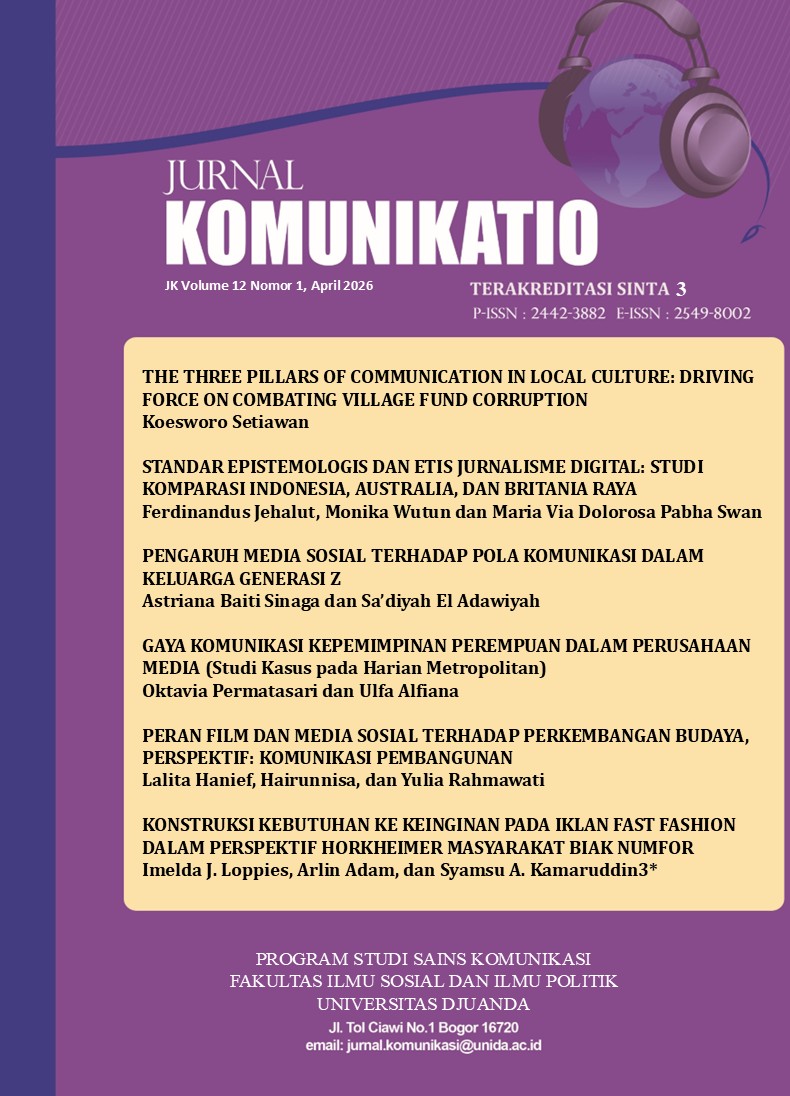
Standar Epistemologi dan Etika Jurnalisme Digital: Studi Komparasi Indonesia, Australia, dan Britania Raya
DOI:
https://doi.org/10.30997/jk.v12i1.22302Keywords:
Comparative study, Digital journalism, Epistemology, Ethics, Platform regulationAbstract
This study compares the ethical and epistemological standards of digital journalism as articulated in legal frameworks, professional codes, and public policies in Indonesia, Australia, and the United Kingdom. Using a descriptive qualitative approach within a constructivist paradigm, it conducts a comparative analysis of relevant legislation, online media guidelines, and journalist safety policies in the three countries. The findings identify three distinct models. Indonesia advances an editorial-ethics model emphasizing verification, correction, the right of reply, and the separation of news and advertising, yet largely neglecting algorithmic power. Australia develops a democracy-news economy model that defines news as essential to democratic participation and regulates bargaining relations between news organizations and platform companies. The United Kingdom establishes a regulatory-protection model that grants special status and procedural safeguards to journalistic content, while strengthening protections for journalists within an online safety regime. The study concludes that renewing the ethical and epistemological foundations of digital journalism requires closer alignment among professional ethics, public policy, and platform regulation to sustain journalism’s credibility as an epistemic authority. It calls for intensified collaboration among policymakers, media organizations, regulators, and journalism educators to address datafication, algorithmic opacity, and journalist safety in future regulatory reforms.
References
Abu-ayyash, S. (2025). Bridging the academia-industry gap : Insights from digital journalism education in Palestine. Journalism, 0(0), 1–19. https://doi.org/10.1177/14648849251320040.
Al-Zoubi, O., Ahmad, N., & Hamid, N. A. (2024). Artificial Intelligence in newsrooms: Ethical challenges facing journalists. Studies in Media and Communication, 12(1), 401–409. https://doi.org/10.11114/smc.v12i1.6587
Australian Press Council. (2021). General principles. APC.
Commonwealth of Australia. (2018). Australian Communications and Media Authority Act 2005. Canbera.
Commonwealth of Australia, The Treasury. (2022). News Media and Digital Platforms Mandatory Bargaining Code: The Code’s first year of operation. https://treasury.gov.au/publication/p2022-343549.
Australian Government. (2023). Communications and media in Australia: Trends and developments in viewing and listening 2022–2023. Australian Communications and Media Authority. https://www.acma.gov.au/publications/2023-12/report/communications-and-media-australia-trends-and-developments-viewing-and-listening-2022-2023.
Ayres, L. (2008). Thematic coding and analysis. In The SAGE encyclopedia of qualitative research methods (pp. 867–868). Sage. https://doi.org/10.4135/9781412963909.
Competition and Consumer Act 2010 (Cth). (2010). https://www.legislation.gov.au/C2004A00109/latest/downloads
Department for Digital Media & Sport, C., & Government, U. K. (2021). National Action Plan for the Safety of Journalists. HM Government.
Dewan Pers. (2008). Peraturan Dewan Pers Nomor 6/Peraturan-DP/V/2008 tentang Pengesahan Surat Keputusan Dewan Pers Nomor 03/SK-DP/III/2006 tentang Kode Etik Jurnalistik sebagai Peraturan Dewan Pers. Dewan Pers.
Dewan Pers. (2022). Keputusan Ketua Dewan Pers Nomor 20/SK-DP/IV/2022 tentang Penegasan Fungsi Dewan Pers dalam Standar Kompetensi Wartawan. Dewan Pers.
Dewan Pers (2012). Pedoman media siber. Dewan Pers.
Dewan Pers. (2022). Pedoman Pemberitaan Media Siber. Dewan Pers.
Díaz-Campo, J., & Segado-Boj, F. (2015). Journalism ethics in a digital environment: How journalistic codes of ethics have been adapted to the Internet and ICTs in countries around the world. Telematics and Informatics, 32(4), 735–744. https://doi.org/10.1016/j.tele.2015.03.004
Dolunay, et al. (2022). Unethical Practices and Effects of Digital Journalism in the COVID-19 Era: The Case of TRNC. SAGE Open, 12(2). https://doi.org/10.1177/21582440221085266.
Dörr, K. N., & Hollnbuchner, K. (2017). Ethical Challenges of Algorithmic Journalism. Digital Journalism, 5(4), 404–419. https://doi.org/10.1080/21670811.2016.1167612.
Ekström, M., Lewis, S. C., & Westlund, O. (2020). Epistemologies of digital journalism and the study of misinformation. New Media and Society, 22(2), 205–212. https://doi.org/10.1177/1461444819856914.
Humprecht, E. & Esser, F. (2018). Mapping digital journalism : Comparing 48 news websites from six countries. Journalism, 19(4), 500–518 https://doi.org/10.1177/1464884916667872.
Fahmy, N. & Attia, M. A. (2024). Egyptian Journalists ’ Perceptions of Digital Journalism Training Effectiveness. SAGE Open, 1–20. https://doi.org/10.1177/21582440241232756.
Forja-Peña, et al. (2024). The ethical revolution of digital journalism: AI and professional responsibility. Digital Journalism, 37(3), 237–254. https://doi.org/10.15581/003.37.3.237-254.
Garini, T., & Besman, A. (2018). Praktik Jurnalisme Kloning di Kalangan Wartawan Online. Mediator: Jurnal Komunikasi, 11(1), 1–9.
Given, L. M. (2008). The SAGE encyclopedia of qualitative research methods. Sage. https://doi.org/10.4135/9781412963909
Government of United Kingdom. (2023). Online Safety Act 2023. The Stationery Office.
Government of United Kingdom. (2023). National Action Plan for the Safety of Journalists: Updated Plan. HM Government.
Hendrickx, J., & Bulck, H. D. (2025). Rumor has it : Epistemology of celebrity journalism in the fl emish digital media ecology. Journalism, 26(7), 1391–1410. https://doi.org/10.1177/14648849241263328
Hidayat, Y. D. (2019). Clickbait on Indonesia Online Media. Jurnal Pekommas, 4(1), 1–10. https://doi.org/10.30818/jpkm.2019.2040101.
Holman, L., & Perreault, G. P. (2023). Diffusion of innovations in digital journalism : Technology , roles , and gender in modern newsrooms. 24(5), 938–957. https://doi.org/10.1177/14648849211073441.
Ireton, C., & Posetti, J. (2018). Journalism, fake news and disinformation: Handbook for journalism education and training. UNESCO.
Lestari, R. D. (2015). Jurnalisme Kloning, Praktik Plagiarisme Karya Jurnalistik di Kalangan Jurnalis (Studi Kasus di DIY). Universitas Gadjah Mada.
Lincoln, Y. S., & Guba, E. G. (1985). Naturalistic inquiry. Sage.
Pemerintah RI. (1999). UU Pers No 40 Tahun 1999.
Pereira, F. H. (2023). Media crisis and its effects on digital journalism careers in Canada. Journalism, 24(11), 2533–2550. https://doi.org/10.1177/14648849221116186.
Porlezza, C. (2024). The datafication of digital journalism : A history of everlasting challenges between ethical issues and regulation. Journalism, https://doi.org/10.1177/14648849231190232.
Püchel, L. (2024). Examining the digital renewal of news communication : A categorization of presentation modes in digital journalism, 25(5), 1167-1185. https://doi.org/10.1177/14614448211059488.
Salaverría, R. (2019). “Digital journalism: 25 years of research. Review article”. El profesional de la información, 28(1), 1-26. https://doi.org/10.3145/epi.2019.ene.01.
Salaverrıa & Martinez-Costa. (2024). Digital journalism in Spain : Technological , sociopolitical and economic factors as drivers of media evolution. Journalism, 25(5), 1050–1069. https://doi.org/10.1177/14648849231170519
Sang, et al. (2025). Looking back at journalism ethics research over the past decade : An analysis of research in digital journalism, journalism, journalism practice, and journalism studies 2013-2022. Journalism, 26(2), 365–386. https://doi.org/10.1177/14648849241244712.
Splichal, S., & Dahlgren, P. (2016). Journalism between de-professionalisation and democratisation. European Journal of Communication, 31(1), 5-18. https://doi.org/10.1177/0267323115614196
UK Government, & Department for Digital, Culture, Media & Sport. (2021). National action plan for the safety of journalists. UK Government. https://www.gov.uk/government/publications/national-action-plan-for-the-safety-of-journalists.
UK Government, & Department for Culture, Media & Sport. (2023). National action plan for the safety of journalists (2023). UK Government. https://www.gov.uk/government/publications/national-action-plan-for-the-safety-of-journalists/national-action-plan-for-the-safety-of-journalists-2023.
Ward, S. J. A. (2014). Radical Media Ethics: Ethics for a global digital world. Digital Journalism, 2(4), 455–471. https://doi.org/10.1080/21670811.2014.952985.
Ward, S. J. A. (2016). Digital Journalism Ethics. In The Routledge Companion to Digital Journalism Studies (pp. 56–64). Routledge.
Zviyita, I., & Mare, A. (2024). Ethical Issues Confronting Namibian Hybrid Media Organizations in the Digital Age. Journalism & Mass Communication Quarterly, Regular Issue, 1-28. https://doi.org/10.1177/10776990241240118.
Downloads
Published
How to Cite
Issue
Section
License
Copyright (c) 2026 JURNAL KOMUNIKATIO

This work is licensed under a Creative Commons Attribution-ShareAlike 4.0 International License.
Authors who publish with Jurnal Komunikatio agree to the following terms:
- Authors retain copyright and grant the journal right of first publication with the work simultaneously licensed under a Creative Commons Attribution 4.0 International License that allows others to share the work with an acknowledgement of the work's authorship and initial publication in Jurnal Komunikatio.
- Authors are able to enter into separate, additional contractual arrangements for the non-exclusive distribution of the journal's published version of the work (e.g., post it to an institutional repository or publish it in a book), with an acknowledgement of its initial publication in Jurnal Komunikatio.
- Authors are permitted and encouraged to post their work online (e.g., in institutional repositories or on their website) prior to and during the submission process, as it can lead to productive exchanges, as well as earlier and greater citation of published work