Inovasi Produk Cassava Japanese Cheesecake Terhadap Uji Organoleptik
Product Innovation of Cassava Japanese Cheesecake Based on Organoleptic Testing
DOI:
https://doi.org/10.30997/jiph.v8i1.23604Keywords:
Food innovation; local ingredients; economic value; Japanese cheesecake; gluten-free.Abstract
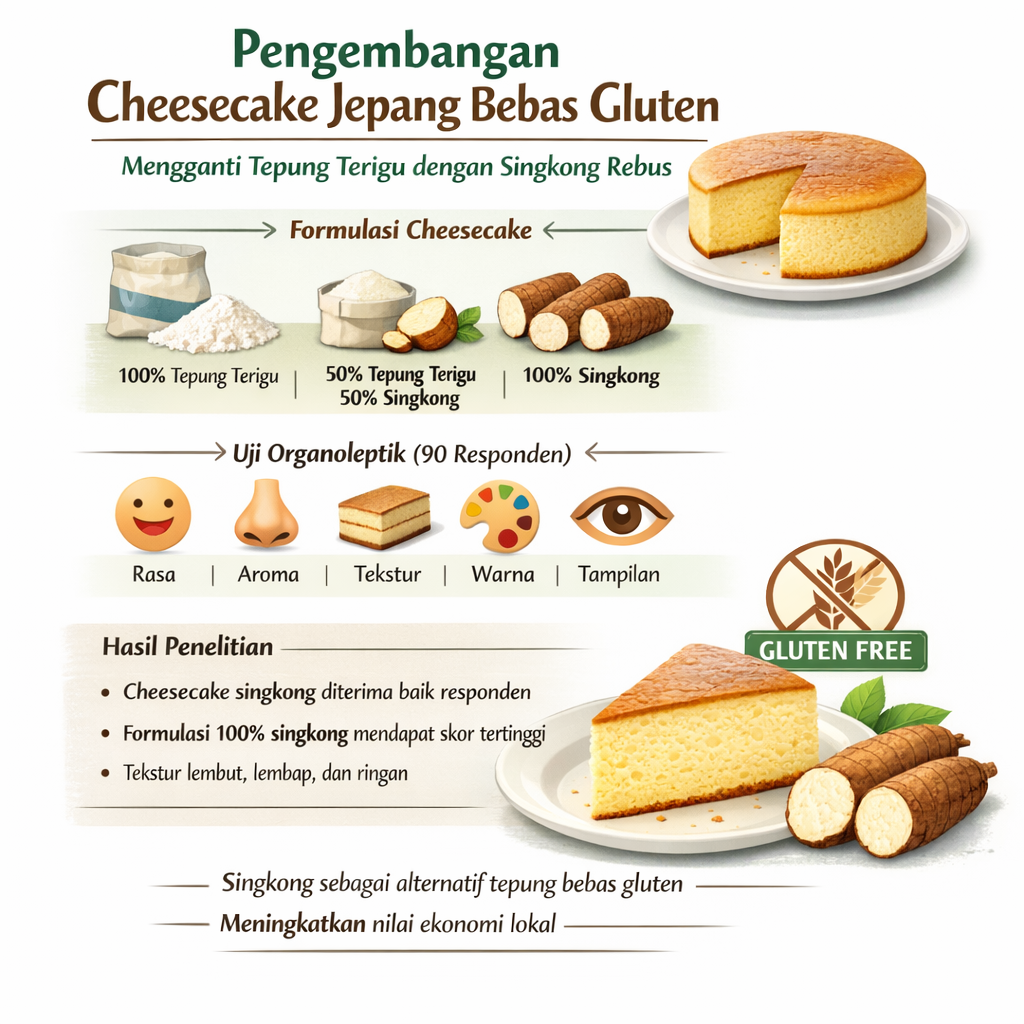
This study aims to develop a gluten-free Japanese cheesecake by substituting wheat flour with boiled cassava (Manihot esculenta Crantz) as a local food ingredient. The growing demand for gluten-free bakery products and Indonesia’s dependence on imported wheat flour encourage the utilization of cassava as an alternative raw material. This research employed a descriptive quantitative approach using three formulations: 100% wheat flour, 50% wheat flour–50% cassava, and 100% cassava. Organoleptic tests were conducted with 90 respondents to evaluate taste, aroma, texture, color, and overall appearance using a five-point hedonic scale. The results indicated that cassava-based Japanese cheesecake was well accepted by respondents, with the 100% cassava formulation obtaining the highest preference score. The substitution of wheat flour with cassava did not significantly alter the characteristic soft, moist, and fluffy texture of Japanese cheesecake. This product innovation demonstrates that cassava can be effectively utilized as a gluten-free alternative ingredient while increasing the economic value of local commodities and offering a healthier dessert option for consumers with gluten intolerance.
References
Ahmed, S., Zierk, J., & Codrich, D. (2021). Glans ischemia after circumcision in children: Two case reports. World Journal of Clinical Pediatrics, 10(4). https://www.wjgnet.com/bpg/gerinfo/240
Amnuaycheewa, P., Abdelmoteleb, M., Wise, J., Bohle, B., Ferreira, F., Tetteh, A. O., Taylor, S. L., & Goodman, R. E. (2022). Development of a sequence searchable database of celiac disease-associated peptides and proteins for risk assessment of novel food proteins. Frontiers in Allergy, 3. https://doi.org/10.3389/falgy.2022.900573
Ardyani, N. P., Gunawan, B., & Harahap, J. (2022). Ekologi politik budidaya singkong di Kecamatan Arjasari Kabupaten Bandung Provinsi Jawa Barat. Aceh Anthropological Journal, 6(2), 137. https://doi.org/10.29103/aaj.v6i2.8040
Agustina, A., & Muliadiasa, I. K. (2023). Dampak pariwisata terhadap kualitas air Danau Beratan berdasarkan parameter BOD dan COD. Jurnal Manajemen Kuliner, 2(1), 1–9. https://doi.org/10.59193/jmn.v2i1.111
Chamorro, A. F., Palencia, M., & Lerma, T. A. (2025). Physicochemical characterization and properties of cassava starch: A review. Polymers, 17(12). https://doi.org/10.3390/polym17121663
Ikhram, A., & Chotimah, I. (n.d.). Pemberdayaan masyarakat diversifikasi pangan melalui inovasi pangan lokal dari singkong. Retrieved from http://pkm.uika-bogor.ac.id/index.php/ABDIDOS/issue/archive
Indra Saraswati, T., Adawiyah, D. R., & Rungkat, F. Z. (2022). Pengaruh pengolahan pada sifat fisis dan kimia singkong goreng beku. Jurnal Ilmu Pertanian Indonesia, 27(4), 528–535. https://doi.org/10.18343/jipi.27.4.528
Kowalski, M. K., Domżał-Magrowska, D., & Małecka-Wojciesko, E. (2025). Celiac disease: Narrative review on progress in celiac disease. Foods, 14(6). https://doi.org/10.3390/foods14060959
Zenitha, C., Sukriadi, E. H., & Sekolah Tinggi Ilmu Ekonomi Pariwisata Yapari Bandung. (n.d.). Modification of traditional food (Klepon cheesecake).
Downloads
Published
How to Cite
Issue
Section
License
Copyright (c) 2026 Otje Herman Wibowo, Irra Chrisyanti Dewi, Fabiola Leoparjo, Hari Minantyo, Ham Sylvia Cindy Hartono, Patricia Alberta, Jeanette Magdalene Pekanto, Devi Ramadhani Hariyono

This work is licensed under a Creative Commons Attribution-NonCommercial-ShareAlike 4.0 International License.