Nano-Pektin sebagai Nanomaterial Pangan: Tinjauan Kritis tentang Preparasi dan Karakterisasinya
Nano‐Pectin as a Food Nanomaterial: A Critical Review of Its Preparation and Characterization
DOI:
https://doi.org/10.30997/jiph.v8i1.22768Keywords:
Functional food, pectin, Food Nanotechnology, Nano-pectinAbstract
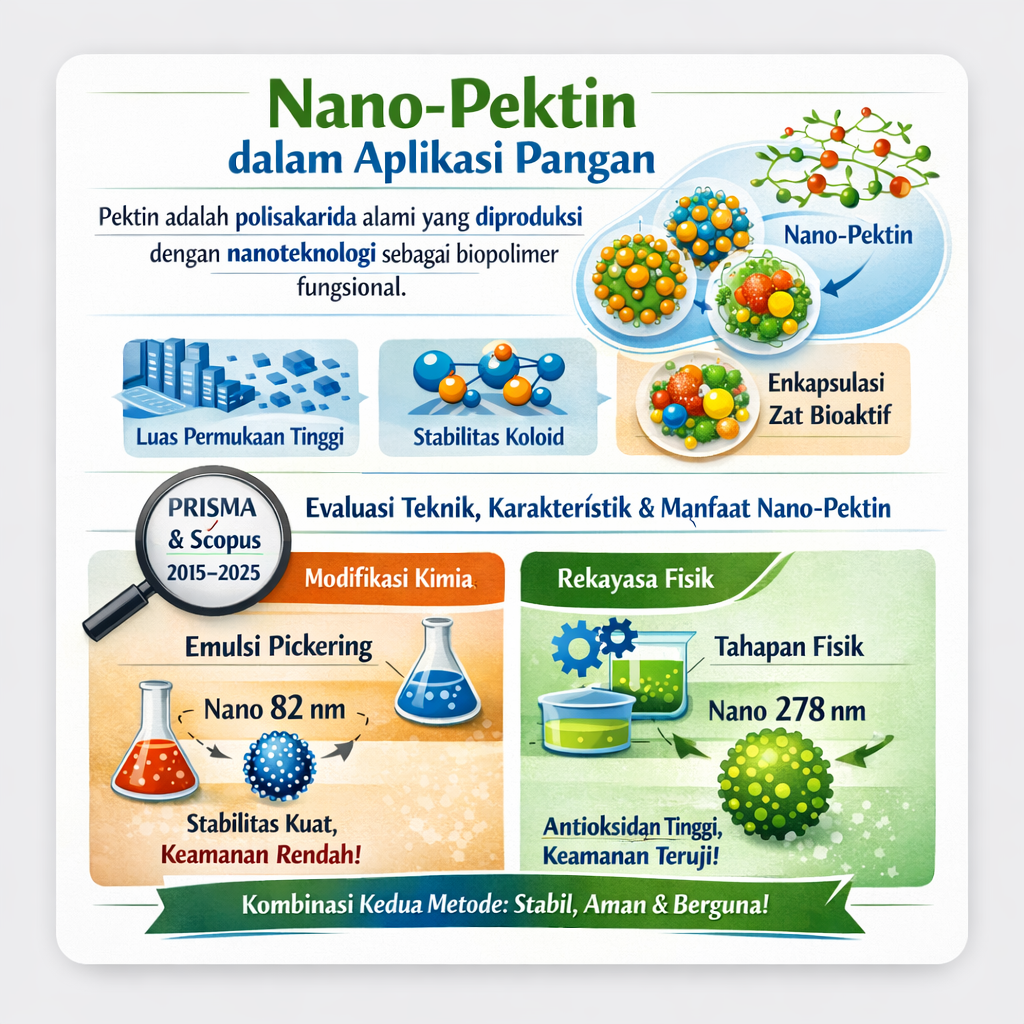
Pectin is a naturally occurring polysaccharide that could be produced, especially using nanotechnology techniques, as a functional biopolymer in food systems. The goal of converting pectin into nano-pectin is to increase its specific surface area, colloidal stability, and ability to encapsulate and transport bioactive substances. In order to assess the synthesis techniques, characteristics, benefits, and drawbacks of nanopectin for food applications, this paper provides a critical literature assessment. The study was carried out using the PRISMA standards and a Scopus literature search for the years 2015–2025. Chemical alteration and physical engineering were the two primary methods that were examined. For Pickering emulsions, the chemical method via polyelectrolyte complexation yields small nanoparticles (~82 nm) with strong interfacial stability, but it has drawbacks in terms of food safety. On the other hand, despite restricted molecular structural control, the stepwise physical approach yields bigger nano-pectin (~278 nm) with potent antioxidant bioactivity, proven safety, and successful direct application in functional food products. Combining the two methods could result in nano-pectin that is stable, safe, and useful for contemporary culinary applications.
References
Chen, H., Wang, Z., Guo, X., Yu, S., Zhang, T., Tang, X., Yang, Z., & Meng, H. (2022). Tannic Acid-Aminated Sugar Beet Pectin Nanoparticles as a Stabilizer of High-Internal-Phase Pickering Emulsions. Journal of Agricultural and Food Chemistry, 70(26), 8052–8063. https://doi.org/10.1021/ACS.JAFC.1C04865
de Rezende, S. C., Santamaria-Echart, A., Ribeiro, A., Dias, M. M., & Barreiro, M. F. (2025). Advancing Pickering emulsions with natural-based solid dispersion particles: Particle screening and design of pectin-based emulsions. Colloids and Surfaces A: Physicochemical and Engineering Aspects, 719, 137003. https://doi.org/10.1016/J.COLSURFA.2025.137003
Dib, T., Pan, H., & Chen, S. (2023). Recent Advances in Pectin-based Nanoencapsulation for Enhancing the Bioavailability of Bioactive Compounds: Curcumin Oral Bioavailability. Food Reviews International, 39(6), 3515–3533. https://doi.org/10.1080/87559129.2021.2012796
Elmizadeh, A., Goli, S. A. H., Mohammadifar, M. A., & Rahimmalek, M. (2024). Fabrication and characterization of pectin-zein nanoparticles containing tanshinone using anti-solvent precipitation method. International Journal of Biological Macromolecules, 260, 129463. https://doi.org/10.1016/J.IJBIOMAC.2024.129463
Fu, L., Tan, S., Si, R., Qiang, Y., Wei, H., Huang, B., Shi, M., Fang, L., Fu, J., & Zeng, S. (2023). Characterization, stability and antioxidant activity of curcumin nanocomplexes with soy protein isolate and pectin. Current Research in Food Science, 6, 100530. https://doi.org/10.1016/J.CRFS.2023.100530
Jacob, E. M., Borah, A., Jindal, A., Pillai, S. C., Yamamoto, Y., Maekawa, T., & Kumar, D. N. S. (2020). Synthesis and characterization of citrus-derived pectin nanoparticles based on their degree of esterification. Journal of Materials Research 2020 35:12, 35(12), 1514–1522. https://doi.org/10.1557/JMR.2020.108
Li, H., Wu, X., & Wu, W. (2024). Natural protein-polysaccharide-phenol complex particles from rice bran as novel food-grade Pickering emulsion stabilizers. International Journal of Biological Macromolecules, 277, 134314. https://doi.org/10.1016/J.IJBIOMAC.2024.134314
Li, Q., Wu, Y., Fang, R., Lei, C., Li, Y., Li, B., Pei, Y., Luo, X., & ShilinLiu. (2021). Application of Nanocellulose as particle stabilizer in food Pickering emulsion: Scope, Merits and challenges. Trends in Food Science & Technology, 110, 573–583. https://doi.org/10.1016/J.TIFS.2021.02.027
Mahmoud, M. H., Azab, D. E. S. H., Elbahnasawy, A. S., & Mahmoud, M. H. (2025). Impact of successive steps of nano-pectin preparation: characterization, role in combating increased oxidative stress in Wistar rats and its application in jam. Journal of the Saudi Society of Agricultural Sciences 2025 24:5, 24(5), 37-. https://doi.org/10.1007/S44447-025-00026-7
Moher, D., Liberati, A., Tetzlaff, J., Altman, D. G., Antes, G., Atkins, D., Barbour, V., Barrowman, N., Berlin, J. A., Clark, J., Clarke, M., Cook, D., D’Amico, R., Deeks, J. J., Devereaux, P. J., Dickersin, K., Egger, M., Ernst, E., Gøtzsche, P. C., … Tugwell, P. (2009). Preferred reporting items for systematic reviews and meta-analyses: the PRISMA statement. PLoS Medicine, 6(7). https://doi.org/10.1371/JOURNAL.PMED.1000097
Naji-Tabasi, S., Shakeri, M. sadat, Modiri-Dovom, A., & Shahbazizadeh, S. (2024). Investigating Baneh (Pistacia atlantica) gum properties and applying its particles for stabilizing Pickering emulsions. Food Chemistry: X, 21, 101111. https://doi.org/10.1016/J.FOCHX.2023.101111
Nie, C., Bu, X., Ma, S., Zhang, J., Ma, Q., Li, W., Zhang, X., Wu, H., Hu, S., Fan, G., & Wang, J. (2022). Pickering emulsions synergistically stabilized by cellulose nanocrystals and peanut protein isolate. LWT, 167, 113884. https://doi.org/10.1016/J.LWT.2022.113884
Phosanam, A., Moreira, J., Adhikari, B., Adhikari, A., & Losso, J. N. (2023). Stabilization of ginger essential oil Pickering emulsions by pineapple cellulose nanocrystals. Current Research in Food Science, 7, 100575. https://doi.org/10.1016/J.CRFS.2023.100575
Rosales, T. K. O., & Fabi, J. P. (2023). Pectin-based nanoencapsulation strategy to improve the bioavailability of bioactive compounds. International Journal of Biological Macromolecules, 229, 11–21. https://doi.org/10.1016/J.IJBIOMAC.2022.12.292
Siles-Sánchez, M. de las N., García-Ponsoda, P., Fernandez-Jalao, I., Jaime, L., Santoyo, S., Siles-Sánchez, M. de las N., García-Ponsoda, P., Fernandez-Jalao, I., Jaime, L., & Santoyo, S. (2024). Development of Pectin Particles as a Colon-Targeted Marjoram Phenolic Compound Delivery System. Foods 2024, Vol. 13, 13(2). https://doi.org/10.3390/FOODS13020188
Tanaka, Y., Li, Q., Hatakeyama, M., & Kitaoka, T. (2024). Synthesis and structural design of microspheres comprising cellulose nanofibers and artificial lignin polymer by enzyme-mediated Pickering emulsion templating. RSC Sustainability, 2(5), 1580–1589. https://doi.org/10.1039/d4su00067f
Downloads
Published
How to Cite
Issue
Section
License
Copyright (c) 2026 Yoedi Wicaksono, Yohan Ariesto, Prima Yaumil Fajri, Nazwa Nurhaliza

This work is licensed under a Creative Commons Attribution-NonCommercial-ShareAlike 4.0 International License.