Substitusi Emulsifier Non-Halal dengan Ekstrak Berbasis Polifenol dan Protein Nabati
Substitution of Non-Halal Emulsifiers with Polyphenol- and Plant Protein-Based Extracts
DOI:
https://doi.org/10.30997/jiph.v8i1.22297Keywords:
emulsifier, halal, polifenol, protein nabati, makananAbstract
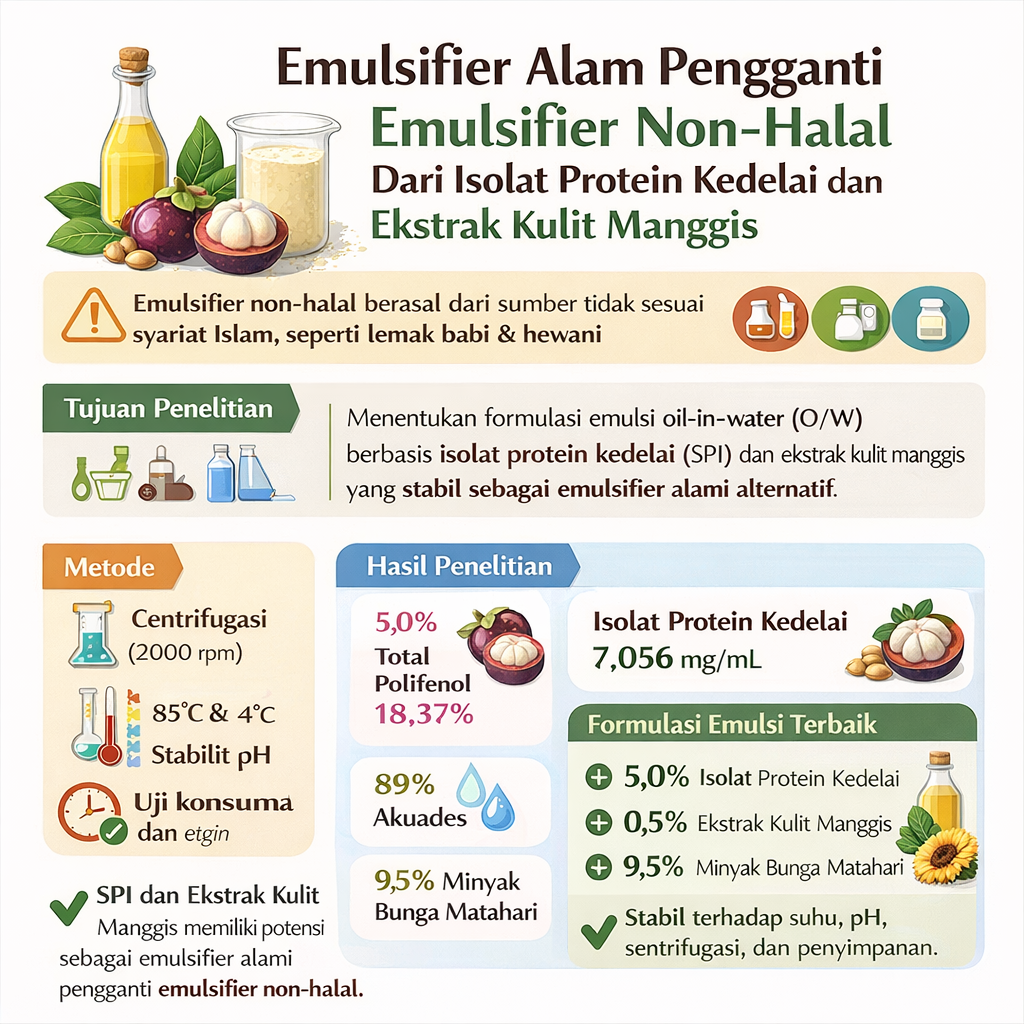
Emulsifiers are crucial for ensuring product stability in the food, cosmetics, and pharmaceutical sectors. Many emulsifiers, however, are sourced from non-halal origins, such as lard or other animal products that contravene Islamic law. Moreover, certain synthetic emulsifiers may provoke apprehensions related to health and environmental sustainability. This study aims to determine the most stable oil-in-water (O/W) emulsion formulation utilizing soy protein isolate (SPI) and mangosteen peel extract, evaluated through centrifugation tests, thermal treatments, pH tests, and storage stability, as a potential natural emulsifier to substitute non-halal emulsifiers. This study used a laboratory-based experimental methodology. The findings indicated that the polyphenol extract comprised 18.37% polyphenols, whereas the soy protein isolate had a concentration of 7.056 mg/mL. Four emulsions were formulated with varying concentrations of soy protein isolate: 1.0%, 2.5%, 5.0%, and 10.0%. The study revealed that polyphenols from mangosteen peel and vegetable protein from soybeans exhibit potential as emulsifiers. The optimal formulation for creating an emulsion consisted of 5.0% soy protein isolate, 0.5% mangosteen peel extract, 89% distilled water, and 9.5% sunflower oil. The emulsion with the optimal formulation exhibited excellent stability, as evidenced by its stability parameters concerning temperature, pH, centrifugation, and storage.
References
Adeola, A., Smith, A., Conway, B. R., Nep, E. I., & Kemas, U. C. (2020). Influence of Grewia polysaccharides on the stability of oil-in-water emulsions. British Journal of Pharmacy, 5(1). https://doi.org/10.5920/bjpharm.699
Bustani, N. I., Mustapa, A., Sultan, I., Ali, S., & Darussalam, B. (2024). Exploring the knowledge and awareness of emulsifiers in food and non-food products among the community in Brunei Darussalam. Journal of Halal Product and Research, 7(1), 16–29. https://doi.org/10.20473/jhpr.vol.7-issue.1.16-29
Colucci, G., Santamaria-Echart, A., Silva, S. C., Fernandes, I. P. M., Sipoli, C. C., & Barreiro, M. F. (2020). Development of Water-in-Oil Emulsions as Delivery Vehicles and Testing with a Natural Antimicrobial Extract. Molecules, 25(9), 2105. https://doi.org/10.3390/molecules25092105
Dammak, I., Sobral, P. J. do A., Aquino, A., Neves, M. A. das, & Conte-Junior, C. A. (2020). Nanoemulsions: Using emulsifiers from natural sources replacing synthetic ones - A review. Comprehensive Reviews in Food Science and Food Safety, 19(5), 2721–2746. https://doi.org/10.1111/1541-4337.12606
Hien, N. T., Hoa, H. D., Hoa, N. Q., Tram, P. T., & Tu, N. T. M. (2018). Study on extraction of tannins from the garcinia mangostana linn peel in Vietnam. Vietnam Journal of Science and Technology, 56(4A), 113. https://doi.org/10.15625/2525-2518/56/4A/13118
Javaid, I., & Barabas, D. (2024). Consumers willing to pay 9.7% sustainability premium, even as cost-of-living and inflationary concerns weigh: PwC 2024 Voice of the Consumer Survey. Press Release. https://www.pwc.com/gx/en/news-room/press-releases/2024/pwc-2024-voice-of-consumer-survey.html
Jumiono, A., Mardiah, M., Amalia, L., & Puspasari, E. (2023). Identifikasi Titik Kritis Kehalalan Bahan Nabati Dan Produk Turunan Bahan Nabati. Jurnal Ilmiah Pangan Halal, 5(1), 21–29. https://doi.org/10.30997/jiph.v5i1.9998
Karaca, A. C., Tan, C., Assadpour, E., & Jafari, S. M. (2025). Recent advances in the plant protein-polyphenol interactions for the stabilization of emulsions. Advances in Colloid and Interface Science, 335, 103339. https://doi.org/10.1016/j.cis.2024.103339
Kim, W., Wang, Y., & Selomulya, C. (2020). Dairy and plant proteins as natural food emulsifiers. Trends in Food Science and Technology, 105, 261–272. https://doi.org/10.1016/j.tifs.2020.09.012
Li, M., Ritzoulis, C., Du, Q., Liu, Y., Ding, Y., Liu, W., & Liu, J. (2021). Recent Progress on Protein-Polyphenol Complexes: Effect on Stability and Nutrients Delivery of Oil-in-Water Emulsion System. Frontiers in Nutrition, 8. https://doi.org/10.3389/fnut.2021.765589
McClements, D. J., Bai, L., & Chung, C. (2017). Recent Advances in the Utilization of Natural Emulsifiers to Form and Stabilize Emulsions. Annual Review of Food Science and Technology, 8, 205–236. https://doi.org/10.1146/annurev-food-030216-030154
Nguyen, M.-T., Shin, J.-A., & Lee, K.-T. (2023). Oxidation stability of oil-in-water emulsion prepared from perilla seed oil and soy sauce with high salt concentration using OSA-starch. Food Science and Biotechnology, 32(13), 1883–1891. https://doi.org/10.1007/s10068-023-01296-z
Ozturk, B., & McClements, D. J. (2016). Progress in natural emulsifiers for utilization in food emulsions. Current Opinion in Food Science, 7, 1–6. https://doi.org/10.1016/j.cofs.2015.07.008
Partridge, D., Lloyd, K. A., Rhodes, J. M., Walker, A. W., Johnstone, A. M., & Campbell, B. J. (2019). Food additives: Assessing the impact of exposure to permitted emulsifiers on bowel and metabolic health - Introducing the FADiets study. Nutrition Bulletin, 44(4), 329–349. https://doi.org/10.1111/nbu.12408
Snapcart. (2024). Indonesian Consumers’ Interest Toward Sustainable Products: Part 2. https://snapcart.global/indonesian-consumers-interest-toward-sustainable-products-part-2
Southney, F. (2021). What do consumers think about food additives? Survey. Food Navigator Europe. https://www.foodnavigator.com/Article/2021/09/22/What-do-consumers-think-about-food-additives/
Tian, L., Kejing, Y., Zhang, S., Yi, J., Zhu, Z., Decker, E. A., & McClements, D. J. (2021). Impact of tea polyphenols on the stability of oil-in-water emulsions coated by whey proteins. Food Chemistry, 343. https://doi.org/10.1016/j.foodchem.2020.128448
Downloads
Published
How to Cite
Issue
Section
License
Copyright (c) 2026 Robby Nur Hidayat, Adi Muhamad Nurdiansyah, Neneng Windayani, Tri Cahyanto

This work is licensed under a Creative Commons Attribution-NonCommercial-ShareAlike 4.0 International License.