Pengaruh Penambahan Ampas Kopi Terhadap Uji Organoleptik Cookies Berbahan Dasar Tepung Ubi Jalar Ungu
The Effect of Spent Coffee Grounds Addition on the Organoleptic Test of Cookies Made from Purple Sweet Potato Flour
DOI:
https://doi.org/10.30997/jiph.v7i3.21306Keywords:
coffee grounds, cookies, organoleptic, functional food, purple sweet potato flourAbstract
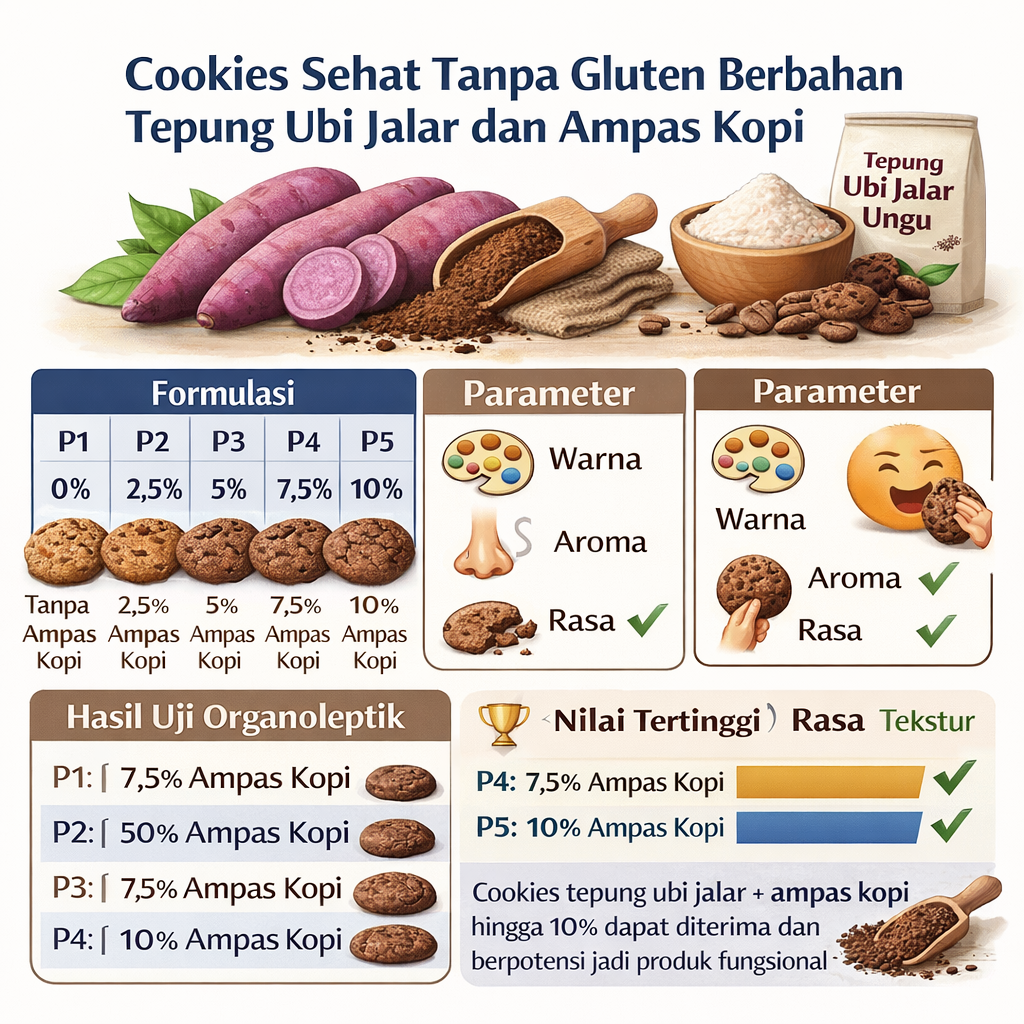
Cookies are commonly made from wheat flour, which contains gluten and relies on imports. As an alternative, this study utilizes purple sweet potato flour and coffee grounds to produce healthier and more environmentally friendly cookies. The research aims to examine the effect of coffee grounds addition on the organoleptic characteristics of cookies and determine the most preferred formulation by consumers. The study used a Randomized Block Design (RBD) with five treatments: without coffee grounds (P1), and with 2.5% (P2), 5% (P3), 7.5% (P4), and 10% (P5) coffee grounds. Organoleptic testing was conducted by 30 panelists. The results showed that the addition of coffee grounds had a significant effect (p<0.05) on texture and taste parameters, but no significant effect on color, aroma, and overall acceptance. The best treatments were P4 (7.5%) and P5 (10%), which received the highest scores in taste and texture. In conclusion, cookies made from purple sweet potato flour with up to 10% coffee grounds are acceptable to consumers and have the potential to become a functional food product based on local ingredients.
References
Aguilar‐Raymundo, V. G., Sánchez‐Páez, R., Gutiérrez‐Salomón, A. L., & Barajas‐Ramírez, J. A. (2019). Spent coffee grounds cookies: Sensory and texture characteristics, proximate composition, antioxidant activity, and total phenolic content. Journal of Food Processing and Preservation, 43(12), e14223.
Ahanchi, M., Sugianto, E. C., Chau, A., & Khoddami, A. (2024). Quality properties of bakery products and pasta containing spent coffee grounds (SCGs): A review. Foods, 13(22), 3576.
Ali, F. Y., Nugroho, S. A., Fatimah, T., Asmono, S. L., Rosdiana, E., Pratita, D. G., & Firgiyanto, R. (2025). Pengembangan Produk Kopi Herbal Berbasis Rempah Lokal Sebagai Strategi Peningkatan Daya Saing Usaha Mikro di Kabupaten Jember. Jurnal Hasil Pengabdian Masyarakat (JURIBMAS), 4(1), 122-130.
Ali, F. Y., Pratita, D. G., Suwardi, S., Prasetyo, H., Rosdiana, E., & Suharjono, S. (2023). Pemasaran E-Commerce Produk Inovasi Di Kelompok Tani Tirto Wangi Kabupaten Jember. Agrimas: Jurnal Pengabdian Masyarakat Bidang Pertanian, 2(1), 30-37.
Arista, G. M., Hapsari, D. R. ., & Nurlaela, R. S. . (2023). Karakteristik Kimia dan Sensori Permen Jelly Kopi Robusta (Coffea canephora P.) dengan Proporsi Sukrosa dan Isomalt. Jurnal Ilmiah Pangan Halal, 5(2), 81–90.
Azuan, A. A., Mohd, Z. Z., Hasmadi, M., ND, R., & Zainol, M. K. (2020). Physicochemical, antioxidant and sensory characteristics of cookies supplemented with different levels of spent coffee ground extract. Food Research.
Diningrat, D. S., Sari Harahap, N., Maulana, B., Nirmala Sari, A., & Dewi, G. (2021). Pemanfaatan Limbah Ampas Kopi Untuk Pembuatan Parfum. In Jurnal Pengabdian kepada Masyakarat (Vol. 2).
Elfariyanti, Zarwinda, I., & Jannah, M. (2023). Formulation, Physicochemical, And Acceptance Test Of Cookies From Purple Sweet Potato Flour (Ipomeae batatas L.) and Aceh Forest Honey. 25 Serambi Journal of Agricultural Technology, 5(1). http://ojs.serambimekkah.ac.id/index.php/sjat
Elwin, Shalihy, W., Pratiwi, I., & Masriani. (2022). Kajian Substitusi Sebagian Tepung Terigu dengan Tepung Ubi Jalar dalam Pembuatan Mie Kering untuk Mendukung Diversifikasi Pangan Lokal. JURNAL TRITON, 13(1), 43–51. https://doi.org/10.47687/jt.v13i1.228
Fefbrilla, E., Yulia, A., & Lisani. (2022). Pengaruh Perbandingan Ampas Kopi (Coffea sp) dan Tepung Terigu terhadap Kualitas Cookies.
Gafar, P. A. (2020). Pengembangan Cookies Dengan Penambahan Kopi Robusta Bubuk (Coffea canephora L.) Dan Ekstrak Kunyit Putih (Curcuma zedoaria [Berg.] Roscoe). In Jurnal Dinamika Penelitian Industri (Vol. 31, Issue 2).
Hadistio, A., & Siti Irma Rahmawati. (2021). TITIK KRITIS HALAL & NILAI TAMBAH KOPI JAHE TERIPANG HALAL CRITICAL POINT & ADDED VALUE GINGER BEAM COFFEE . Jurnal Ilmiah Pangan Halal, 2(2), 49–52.
Hantiono, G. M. L., Maestra, I., Dewi, C., Zakia Az-Zahra, C., Priyanti, E., Kesejahteraan, A., Ibu, S., & Semarang, K. (2025). Biskuit Ampas Kopi (Bis’Kop) sebagai Alternatif Snack dengan Konsep Zero Waste. 90–98. https://doi.org/10.69697/garina.v17i1.275
Hapsari, D. R. ., Puspasari, E., & Fachriani, F. (2024). Karakteristik Kimia dan Sensori Minuman Susu Kopi Liberika (Coffea Liberica) . Jurnal Ilmiah Pangan Halal, 6(1), 116–125.
Mudalal, S., Sawafta, K., Zaqdah, M., Jaayssa, R., Saidi, S., Rahhal, B., ... & Abu-Khalaf, N. (2025). Sustainable Cookies Enriched With Spent Coffee Grounds: A Study on Nutritional, Textural, and Sensory Properties. Journal of Food Processing and Preservation, 2025(1), 7439017.
Mutiara, D., Gusnita, W., Holinesti, R., & Andriani, C. (2024). Uji Organoleptik Penggunaan Tepung Ubi Jalar Ungu Terhadap Kualitas Cookies. Jurnal Pendidikan Tata Boga Dan Teknologi, 5(1), 39. https://doi.org/10.24036/jptbt.v5i1.12258
Ramadhan, I., & Murtini, E. S. (2022). Kualitas Muffin Mengandung Ampas Kopi: Studi Pengaruh Konsentrasi dan Perbedaan Metode Ekstraksi Ampas Kopi. In Jurnal Teknologi Pertanian (Vol. 23, Issue 3).
Rosdiana, E., Erliana, J., Ali, F. Y., Setyoko, U., & Anindita, D. C. (2024). Test of Level of Likes on Fermentation Length and Physical Quality Characteristics of Robusta Coffee After Storage. Jurnal Riset Perkebunan, 5(2), 88-93.
Salama, N., Ariani, F., & Harun, H. (2023). Ekstraksi Pigmen Antosianin dari Ubi Jalar Ungu dengan Menggunakan Metode Maserasi. Jurnal SAINTIS, 17, 33.
Santoso, J., & Minantyo, H. (2022). Pemanfaatan tepung ampas kopi arabika (Coffea arabica) sebagai substitusi tepung terigu (Triticum compactum) dalam pembuatan bolu klemben. AGROMIX, 13(2), 187–193. https://doi.org/10.35891/agx.v13i2.3063
Suladra, Ir. M. (2020). Pengaruh Penambahan Ubi Jalar Ungu (Ipomea batatas L.) Terhadap Sifat Organoleptik dan Aktivitas Antioksidan pada Kue Yangko. Jurnal Ilmiah Teknologi Pertanian.
Widiantara, T., Arief, D. Z., & Yuniar, E. (2018). Kajian Perbandingan Tepung Kacang Koro Pedang (Canavalia ensiformis) Dengan Tepung Tapioka Dan Konsentrasi Kuning Telur Terhadap Karakteristik Cookies Koro. In Pasundan.
Downloads
Published
How to Cite
Issue
Section
License
Copyright (c) 2025 Fandyka Yufriza Ali, Hasanah Hasanah, Rizky Nirmala Kusumaningtyas , Sepdian Luri Asmono

This work is licensed under a Creative Commons Attribution-NonCommercial-ShareAlike 4.0 International License.