TRANSFORMASI DIGITAL DALAM REKAPITULASI FORUM KONSULTASI PUBLIK
DOI:
https://doi.org/10.30997/jgs.v11i2.20601Kata Kunci:
Digital Transformation, Public Governance, Public ServiceAbstrak
Transformasi digital merupakan kebutuhan mendesak dalam tata kelola pelayanan publik untuk mengurangi beban administratif, meningkatkan akurasi, dan memperkuat akuntabilitas. Penelitian ini mengkaji proses rekapitulasi Forum Konsultasi Publik (FKP) pada Kementerian Pendayagunaan Aparatur Negara dan Reformasi Birokrasi, dengan unit analisis Asisten Deputi Pemberdayaan Partisipasi Masyarakat (Asdep PPM). Tujuan penelitian adalah menganalisis mekanisme rekapitulasi FKP, mengidentifikasi hambatan digitalisasi, serta merumuskan model strategis yang selaras dengan prinsip Sistem Pemerintahan Berbasis Elektronik (SPBE). Metode yang digunakan adalah pendekatan kualitatif dengan desain studi kasus melalui wawancara mendalam, observasi, dan analisis dokumen. Hasil penelitian menunjukkan bahwa sistem digital berbasis formulir daring, spreadsheet otomatis, dan penyimpanan terpusat mampu meningkatkan efisiensi, akurasi, dan keterlacakan data, sekaligus memperkuat transparansi dan akuntabilitas. Hambatan yang muncul meliputi keterbatasan infrastruktur, kesiapan SDM, sinkronisasi regulasi, resistensi budaya kerja, serta keamanan data. Analisis teori manajemen perubahan Kurt Lewin mengungkap bahwa keberhasilan transformasi digital bergantung pada proses unfreeze–change–refreeze yang konsisten dalam birokrasi. Dampaknya, digitalisasi rekapitulasi FKP tidak hanya mempercepat respons pemerintah terhadap masukan masyarakat, tetapi juga memperkuat legitimasi kebijakan publik berbasis data, meningkatkan partisipasi, serta membangun budaya kerja birokrasi yang adaptif. Model strategis ini berpotensi direplikasi di sektor pelayanan publik lainnya untuk mempercepat penerapan SPBE di Indonesia.
Referensi
Afiyah, S. (2024). The Impact of E-Government Services, Citizen Participation, and Transparency on Public Trust in Government. Global International Journal of Innovative Research, 2(6), 1246–1261. https://doi.org/10.59613/global.v2i6.200
Amaliah, W. A. R., Haliah, H., & Nirwana, N. (2025). Comparative Study on E-Government Implementation: Lessons from Developed and Developing Countries. DIJMS: Dinasti International Journal of Management Science, 6(4), 1063–1073. https://doi.org/https://doi.org/10.38035/dijms.v6i4.4570
Araby, M. A. A. Al. (2024). Transforming Citizen Engagement In E- Governance Framework: A Conceptual Analysis. JAKPP: Jurnal Analisis Kebijakan Dan Pelayanan Publik, 10(2), 213–236.
Arkaan, G. A., Indira, M., & Suhendar, P. (2024). Building Public Trust Through E-Governance Strategy : A Case Study in DKI Jakarta , Indonesia. Social Impact Journal, 3(2), 32–41.
Avianti, I., & Syahrir, S. (2020). Digital Governance. Inovasi dengan etika dan integritas. PT. Kaptain Komunikasi Indonesia.
Benlahcene, A., Awang, H., Mansor, N. S., Nadzir, M. M., Yamin, F. M., & Haruna, I. U. (2024). Citizens’ E-participation through E-government services: a systematic literature review. Cogent Social Sciences, 10(1). https://doi.org/10.1080/23311886.2024.2415526
data.worldbank.org. (2023). World Bank Open Data.
Djatmiko, G. H., Sinaga, O., & Pawirosumarto, S. (2025). Digital Transformation and Social Inclusion in Public Services: A Qualitative Analysis of E-Government Adoption for Marginalized Communities in Sustainable Governance. Sustainability (Switzerland), 17(7), 1–28. https://doi.org/10.3390/su17072908
Fadrial, R., Simanjuntak, H. T. R. F., Wirman, W., & Wibowo, W. S. (2024). FOSTERING TRUST THROUGH BYTES: UNRAVELLING THE IMPACT OF E-GOVERNMENT ON PUBLIC TRUST IN INDONESIAN. Interdisciplinary Journal of Information, Knowledge, and Management, 19(15).
Hussain, S. T., Lei, S., Akram, T., Haider, M. J., Hussain, S. H., & Ali, M. (2018). Kurt Lewin’s change model: A critical review of the role of leadership and employee involvement in organizational change. Journal of Innovation and Knowledge, 3(3), 123–127. https://doi.org/10.1016/j.jik.2016.07.002
International Bank for Reconstruction and Development / The World Bank. (2022). EQUITABLE GROWTH, FINANCE & INSTITUTIONS INSIGHT. Interoperability: Towards a Data-Driven Public Sector. In www.worldbank.org. https://doi.org/10.1596/38520
Lo, O., Buchanan, W. J., Chrysoulas, C., Sayeed, S., Papadopoulos, P., & Pitropakis, N. (2022). GLASS: A Citizen-Centric Distributed Data-Sharing Model within an e-Governance Architecture. Sensors (Basel, Switzerland). https://doi.org/https://doi.org/ 10.3390/s22062291 Academic
Maharani, D., Rahmawati, A., Putri, V. F. D., & Fauzy, M. R. (2024). Implementasi Pelayanan Publik Berbasis Digital. Karimah Tauhid, 3(11), 12143–12155. https://doi.org/10.30997/karimahtauhid.v3i11.15337
Maureira, S. T., Mayor, U., Olivares, A., & Mayor, U. (2024). The Missing Link : Identifying Digital Intermediaries in E-. General Economics Cornell University, 1–29. https://doi.org/https://doi.org/10.48550/arXiv.2501.10846
Niet, I. A., Dekker, R., & van Est, R. (2022). Seeking Public Values of Digital Energy Platforms. Science Technology and Human Values, 47(3), 380–403. https://doi.org/10.1177/01622439211054430
Nurhidayat, Nurmandi, A., & Congge, U. (2024). Bridging the digital divide: analyzing public participation in Indonesia’ s e-government through the e-participation index. Otoritas: Jurnal Ilmu Pemerintahan, 14(2), 481–498. https://doi.org/https://doi.org/10.26618/ojip.v14i2.14435
OECD. (2025a). Effectively Managing Investments in Digital Government An OECD Policy Framework (Issue 76).
OECD. (2025b). Government at a Glance. In OECD. https://doi.org/10.1093/oso/9780190645410.003.0002
Praratya, A., Sukmayadi, V., & Kamil, D. N. G. (2024). Fostering Digital Dialogue: A Case Study of Government Social Media Initiatives in Advocating Social Participation. Jurnal Komunikasi: Malaysian Journal of Communication, 40(2), 362–379. https://doi.org/10.17576/JKMJC-2024-4002-21
Rychwalska, A., Goodell, G., & Roszczynska-Kurasinska, M. (2021). Data management for platform-mediated public services: Challenges and best practices. Surveillance and Society, 19(1), 22–36. https://doi.org/10.24908/ss.v19i1.13986
Saeed, S. (2025). Digital Transformation in Governmental Public Service Provision and Usable Security Perception in Saudi Arabia. Information (Switzerland), 16(3). https://doi.org/10.3390/info16030247
Setyarto, D. B., Alimuddin, Mulyaningsih, & Judijanto, L. (2025). The role of e-government in increasing transparency and accountability of public administration in the digital era. Edelweiss Applied Science and Technology, 9(2), 1771–1783. https://doi.org/10.55214/25768484.v9i2.4908
Setyawati, D. N., & Fitriati, R. (2023). Digital Governance Dalam Keterbukaan Informasi Publik. Jurnal Kebijakan Publik, 14(1), 48. https://doi.org/10.31258/jkp.v14i1.8217
Shin, B., Floch, J., Rask, M., Bæck, P., Edgar, C., Berditchevskaia, A., Mesure, P., & Branlat, M. (2024). A systematic analysis of digital tools for citizen participation. Government Information Quarterly, 41(3), 101954. https://doi.org/10.1016/j.giq.2024.101954
Susaningsih, C., Gibran, A. S., & Ardiansyah, A. (2024). Implementasi e-government pada sektor pelayanan publik sebagai upaya pencegahan kejahatan kerah biru “implementation of e-government in the public service sector as a strategy for preventing blue-collar crime.” JAID: Journal of Administration and International Development, 4(2), 29–39.
Waliyondi, G., Maruapey, M. H., & Saprudin, S. (2025). Implementasi Teknologi Informasi dalam Meningkatkan Transparansi dan Akuntabilitas Administrasi Publik di Rumah Tahanan Kelas I Depok. Ranah Research: Journal of Multidisciplinary Research and Development, 7(4), 2545–2555. https://doi.org/10.38035/rrj.v7i4.1532
Widiatmoko, C., Simarmata, R. P., Gunadi, G. A., Amazihono, M., & Watimena, J. S. (2023). E-Government as A Tool to Increase Public Participation in Public Decision Making. ARRUS Journal of Social Sciences and Humanities, 3(3), 272–278. https://doi.org/10.35877/soshum1809
Zulmasyhur, Setiawan, H. D., & L. W., N. P. (2024). Peningkatan Tata Kelola Melalui Transformasi Digital. Jurnal Governansi, 10(1), 127–136. https://doi.org/10.30997/jgs.v10i1.11544
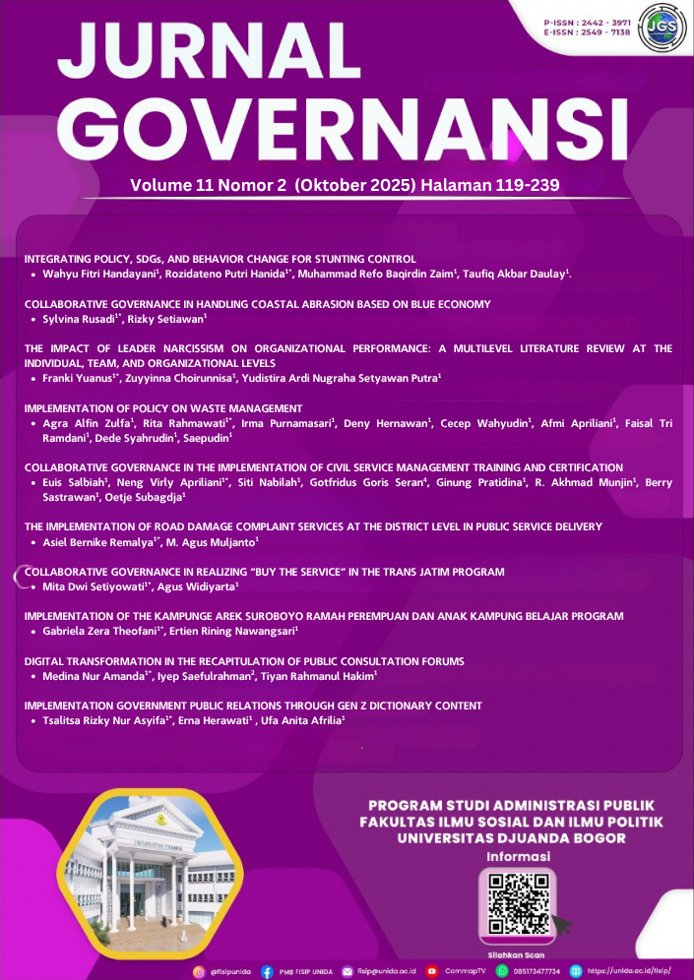
Unduhan
Diterbitkan
Cara Mengutip
Terbitan
Bagian
Lisensi
Hak Cipta (c) 2025 Medina Nur Amanda, Iyep Saefulrahman, Tiyan Rahmanul Hakim

Artikel ini berlisensiCreative Commons Attribution-ShareAlike 4.0 International License.
Authors who publish with Jurnal Governansi agree to the following terms:
- Authors retain copyright and grant the journal right of first publication with the work simultaneously licensed under a Creative Commons Attribution 4.0 International License that allows others to share the work with an acknowledgement of the work's authorship and initial publication in Jurnal Governansi.
- Authors are able to enter into separate, additional contractual arrangements for the non-exclusive distribution of the journal's published version of the work (e.g., post it to an institutional repository or publish it in a book), with an acknowledgement of its initial publication in Jurnal Governansi.
- Authors are permitted and encouraged to post their work online (e.g., in institutional repositories or on their website) prior to and during the submission process, as it can lead to productive exchanges, as well as earlier and greater citation of published work.