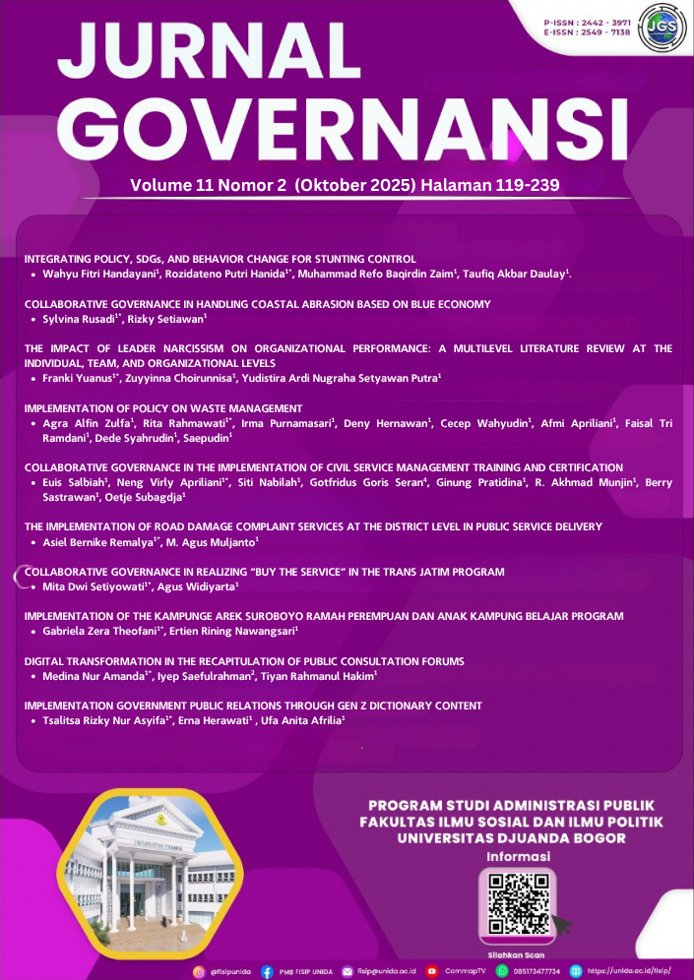
INTEGRATING POLICY, SDGs, AND BEHAVIOR CHANGE FOR STUNTING CONTROL
DOI:
https://doi.org/10.30997/jgs.v11i2.17296Kata Kunci:
Behavior Change, Health and Nutrition, Stunting, Sustainable Development Goals (SDGs), West SumatraAbstrak
Indonesia is committed to achieving Sustainable Development Goals (SDGs), especially the second and third goals, child health and nutrition are very important. Stunting is a problem that often occurs in Indonesia. The prevalence of stunting in West Sumatra in 2022 still touched 25.2%, still high from Indonesia's target of 14%. This scientific paper analyzes various relevant literature with descriptive qualitative methods. The AGIL Framework approach by Talcott Parsons found that policy success depends on adaptation to community conditions, achieving clear targets, cross-sector integration, and long-term behavior change. Policies or programs in reducing the prevalence of stunting affect people's attitudes, awareness, and parenting of health and nutrition in children. Based on the analysis conducted, efforts to prevent and manage stunting in West Sumatra have shown changes in community behavior. Programs that are in line with policy directions, such as routine posyandu programs, actions to report children indicated as stunted, Supplementary Food Provision (PMT), and the establishment of Healthy Village Houses (RDS), behavior change communication policies, and specific nutrition interventions, in children aged 0-23 months and pregnant women, have proven effective in influencing changes in community behavior. Therefore, it is hoped that the government can provide support and collaboration between stakeholders, and help increase community participation in controlling the prevalence of stunting in West Sumatra.
Referensi
Agustina, N. (2022, September 13). Apa itu Stunting? Kemenkes Ditjen Yankes. https://yankes.kemkes.go.id/view_artikel/1516/apa-itu-stunting
Darmansyah, E., & Yusran, R. (2024). Implementasi Kebijakan Kampanye Perubahan Perilaku dalam Upaya Penurunan Stunting di Puskesmas Danau Kerinci Barat. Jurnal Administrasi Pemerintahan Desa, 5(1), 10. https://doi.org/10.47134/villages.v5i1.87
Febrian, F., & Yusran, R. (2021). KOORDINASI DALAM IMPLEMENTASI KEBIJAKAN PENCEGAHAN STUNTING DI KOTA PADANG. Jurnal Manajemen Dan Ilmu Administrasi Publik (JMIAP), 3(1), 11–21. https://doi.org/10.24036/jmiap.v3i1.214
Gusdiva, N., Koeswara, H., & Putera, R. E. (2024). IMPLEMENTASI KEBIJAKAN PENURUNAN STUNTING DI KABUPATEN SOLOK. GEMA PUBLICA, 9(1), 32–49. https://doi.org/10.14710/gp.9.1.2024.32-49
Indah, S., & Yusran, R. (2022). Upaya Pencegahan Stunting di Nagari Inderapura Barat Kecamatan Pancung Soal Kabupaten Pesisir Selatan. Jurnal Pendidikan Tambusai, 6(2), 16511–16516. https://doi.org/https://doi.org/10.31004/jptam.v6i2.5114
Iqbal, M., & Yusran, R. (2021). UPAYA KONVERGENSI KEBIJAKAN PENCEGAHAN STUNTING DI KOTA PADANG. Jurnal Manajemen Dan Ilmu Administrasi Publik (JMIAP), 3(2), 109–116. https://doi.org/10.24036/jmiap.v3i2.245
Kementerian Kesehatan Republik Indonesia. (2023). Hasil Survei Status Gizi Indonesia (SSGI) 2022. https://ayosehat.kemenkes.go.id
Manggala, R. A., & Suryapuspita, M. (2024). Implementasi Kebijakan Aksi Konvergensi Percepatan Penurunan Stunting Di Kecamatan Sasak Ranah Pasisie Kabupaten Pasaman Barat [Disertasi]. Institut Pemerintahan Dalam Negeri (IPDN).
Media, Y., & Elfemi, N. (2021). PERMASALAHAN SOSIAL BUDAYA DAN ALTERNATIF KEBIJAKAN DALAM UPAYA PENANGGULANGAN STUNTING PADA BALITA DI KABUPATEN SOLOK, PROVINSI SUMATERA BARAT. JURNAL EKOLOGI KESEHATAN, 20(1), 56–68. https://doi.org/10.22435/jek.v20i1.4130
Nirmalasari, N. O. (2020). Stunting pada anak: Penyebab dan faktor risiko stunting di Indonesia. Qawwam, 14(1), 19–28.
Nurdin, A., & Muhammad, Z. (2022). Analysis of Government Policy in Reducing Stunting Rate at Aceh Jaya, Indonesia. International Journal of Advances in Social Sciences and Humanities, 1(4), 187–196. https://doi.org/10.56225/ijassh.v1i4.95
Oktavilantika, D. M., Suzana, D., & Damhuri, T. A. (2023). Literature Review: Promosi Kesehatan dan Model Teori Perubahan Perilaku Kesehatan. Jurnal Pendidikan Tambusai, 7(1), 1480–1494.
Peraturan Daerah Provinsi Sumatera Barat Nomor 6 Tahun 2021 Tentang Rencana Pembangunan Jangka Menengah Daerah Tahun 2021-2026., Sumbarprov II.70 (2021). https://bappeda.sumbarprov.go.id/home/news/246-rpjmd-prov-sumatera-barat-tahun-2021-2026.html
Peraturan Gubernur Sumatera Barat Nomor 31 Tahun 2023 Tentang Rencana Aksi Daerah Tujuan Pembangunan Berkelanjutan Tahun 2023–2026. Retrieved July 1, 2025, from https://peraturan.infoasn.id/provinsi/peraturan-gubernur-sumatera-barat-nomor-31-tahun-2023/
Pratidina, G., Wahyudin, C., Rahmawati, R., Zakiah, R. U., Handayani, Y., & Putri, R. N. A. (2023, December). Implementation of the Accelerated Stunting Handling Program. In Iapa Proceedings Conference (pp. 20-28).
Prochaska, J. Q., & Diclemente, C. C. (1983). Stages and Processes of Self-Change of Smoking: Toward An Integrative Model of Change. Journal of Consulting and Clinical Psychology, 51(3), 390–395. https://doi.org/https://doi.org/10.1037/0022-006X.51.3.390
Rahmanindar, N., & Harnawati, R. A. (2020). PENGARUH PENYULUHAN PROGRAM ISI PIRINGKU TERHADAP PENINGKATAN SIKAP DAN PERILAKU IBU DALAM MANANGANI BALITA GIZI BURUK. Jurnal Medikes (Media Informasi Kesehatan), 7(2), 259–270. https://doi.org/10.36743/medikes.v7i2.235
Roediger, R., Hendrixson, D. T., & Manary, M. J. (2020). A roadmap to reduce stunting. The American Journal of Clinical Nutrition, 112, 773S-776S. https://doi.org/10.1093/ajcn/nqaa205
Sari, D. P., & Yusran, R. (2022). Evaluasi Kebijakan Pencegahan Stunting di Nagari Pulakek Koto Baru Kecamatan Sungai Pagu Kabupaten Solok Selatan. Journal of Civic Education, 5(1), 90–100. https://doi.org/10.24036/jce.v5i1.661
Septivani, R. I., Arshita, D. A., & Permana, A. A. (2023). Kebijakan dalam Upaya Penanggulangan Stunting pada Balita di Kabupaten Solok, Provinsi Sumatera Barat Effort to Manage Stunting In Children in Solok Regency, West Sumatera Province. Jurnal Ilmiah Riset Dan Pengembangan, 8(5), 1–9.
Talcott Parsons. (1964). The Social System. The Free Press of Glencoe.
Vaivada, T., Akseer, N., Akseer, S., Somaskandan, A., Stefopulos, M., & Bhutta, Z. A. (2020). Stunting in childhood: an overview of global burden, trends, determinants, and drivers of decline. The American Journal of Clinical Nutrition, 112, 777S-791S. https://doi.org/10.1093/ajcn/nqaa159
Wahyuningsih, W., Bukhari, A., Juliaty, A., Erika, K. A., Pamungkas, R. A., Siokal, B., Saharuddin, S., & Amir, S. (2022). Stunting Prevention and Control Program to Reduce the Prevalence of Stunting: Systematic Review Study. Open Access Macedonian Journal of Medical Sciences, 10(F), 190–200. https://doi.org/10.3889/oamjms.2022.8562
Yasri, A., & Yusran, R. (2022). Implementasi Program Laskar Nagari Peduli Pangan dan Gizi (LNPPG) dalam Pencegahan Stunting di Kabupaten Padang Pariaman. PUBLICNESS: Journal of Public Administration Studies, 1(1), 30–35. https://doi.org/10.24036/publicness.v1i1.4
Unduhan
Diterbitkan
Cara Mengutip
Terbitan
Bagian
Lisensi
Hak Cipta (c) 2025 Wahyu Fitri Handayani, Rozidateno Putri Hanida, Muhammad Refo Baqirdin Zaim, Taufiq Akbar Daulay

Artikel ini berlisensiCreative Commons Attribution-ShareAlike 4.0 International License.
Authors who publish with Jurnal Governansi agree to the following terms:
- Authors retain copyright and grant the journal right of first publication with the work simultaneously licensed under a Creative Commons Attribution 4.0 International License that allows others to share the work with an acknowledgement of the work's authorship and initial publication in Jurnal Governansi.
- Authors are able to enter into separate, additional contractual arrangements for the non-exclusive distribution of the journal's published version of the work (e.g., post it to an institutional repository or publish it in a book), with an acknowledgement of its initial publication in Jurnal Governansi.
- Authors are permitted and encouraged to post their work online (e.g., in institutional repositories or on their website) prior to and during the submission process, as it can lead to productive exchanges, as well as earlier and greater citation of published work.