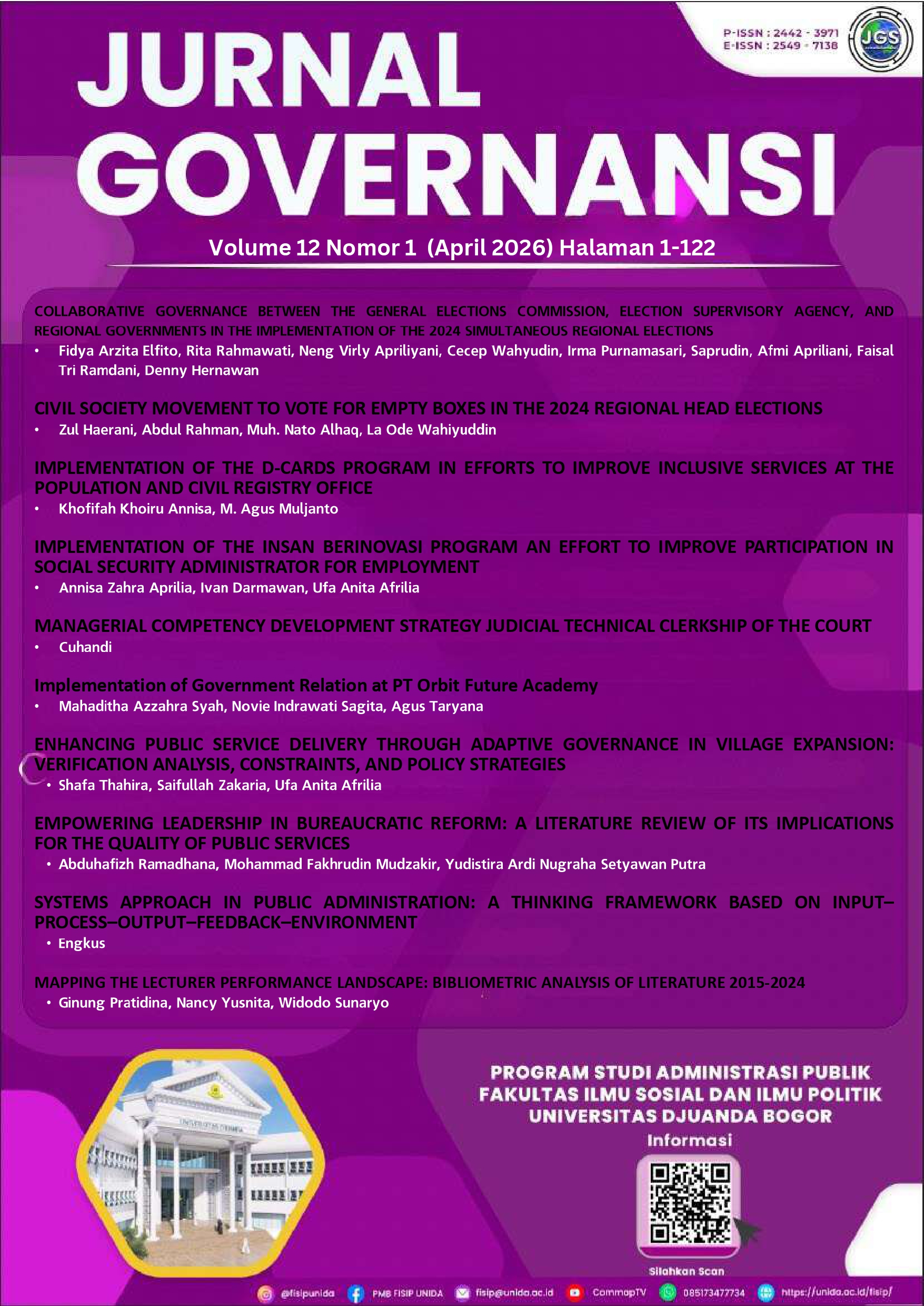
MAPPING THE LECTURER PERFORMANCE LANDSCAPE: BIBLIOMETRIC ANALYSIS OF LITERATURE 2015-2024
DOI:
https://doi.org/10.30997/jgs.v12i1.24294Keywords:
Bibliometric Analysis, Lecturer Performance, Private UniversityAbstract
The objective of this study is to map the research landscape of lecturer performance for the 2015-2024 period. The research method uses a bibliometric approach to 199 Scopus documents with the keyword "Performance Lecturer". Descriptive analysis of annual and country trends and co-occurrence mapping using VOSviewer (network, density, and overlay) was conducted. The results show an increasing trend in publications, with a spike in 2020 of 32 documents and in 2024 of 35 papers published in Scopus. The geographic distribution shows Indonesia's dominance as the largest contributor, followed by Malaysia and other countries; therefore, this topic appears to be accelerating in Southeast Asia. Thematic mapping displays two main interconnected clusters. First, the managerial-organizational cluster includes leadership, motivation, organizational culture, commitment, path analysis, and private universities. Second, the pedagogical-technological cluster encompasses students, learning, teaching, systems, processes, evaluation/assessment, technology, implementation, and the pandemic, with connecting methodological terms such as variable, respondent, role, time, and software/data collection. These findings imply the need for integrated lecturer performance indicators that balance organizational and pedagogical dimensions, standardised measurement for cross-study comparability, expanded cross-country collaboration to reduce regional bias, and the use of learning technology to encourage measurable lecturer performance improvements at the individual and institutional levels. The mapping results provide an empirical basis for higher education leaders and policymakers to design interventions and further research agendas on lecturer performance.
References
Asikin, N., Suwono, H., Sumitro, S. B., Dharmawan, A., & Tanjung, A. Q. (2023). Trends in ocean literacy research in Indonesia: A bibliometric analysis. BIO Web of Conferences, 79, 13002. https://doi.org/10.1051/bioconf/20237913002
Arshad, Z. M., Azman, M. N. A., Kenzhaliyev, O. B., & Kassimov, F. R. (2024). Educational Enhancement Through Augmented Reality Simulation: A Bibliometric Analysis. International Journal of Advanced Computer Science and Applications, 15(7). https://doi.org/10.14569/ijacsa.2024.0150769
Bahrom, B., Pahrudin, A., & Rahmi, S. (2025). Model, Konsep, Desain, Pendekatan Dan Model Pengembangan Kurikulum.
Farhat, M., Novaria, E., Sutalhis, & Yusuf, A. (2024). Blended Learning: Suatu Tinjauan Perspektif Dunia Pendidikan Dan Pelatihan.
Filho, W. L., Sálvia, A. L., Abubakar, I. R., Mifsud, M., Azadi, H., Sharifi, A., LeVasseur, T., Luetz, J. M., Velázquez, L., Singh, P., Pretorius, R., Akib, N. A. M., Savelyeva, T., Brandli, L., Muthu, N., & Lombardi, P. (2022). Impacts of the COVID-19 Pandemic on Routines of Higher Education Institutions: A Global Perspective. Sustainability, 14(21), 14105. https://doi.org/10.3390/su142114105
Gao, W., & Zhang, L. (2025). Intuitive and analytical identification of landscape locality: a dual-process approach to historic and imitation heritage districts in Jiangnan water towns. npj Heritage Science, 13(1), 318.
Gassanova, A., & Kozhakhmet, S. (2024). Mapping the landscape of HRM research in higher education: a 40-year review and directions for future research. International Journal of Educational Management, 38(1), 158-177.
Guibrunet, L., González-Jiménez, D., Arroyo-Robles, G., Cantú-Fernández, M., Contreras, V., Mendez, D. F., ... & Balvanera, P. (2024). Geographic and epistemic pluralism in the sources of evidence informing international environmental science–policy platforms: lessons learnt from the IPBES values assessment. Global Sustainability, 7, e36.
Hamilaturroyya, H., & Adibah, I. Z. (2025). Dinamika Pengembangan Kurikulum Di Era Digital Dalam Menjawab Kesenjangan Konsep Dan Praktik. Learning Jurnal Inovasi Penelitian Pendidikan Dan Pembelajaran, 5(3), 1245. https://doi.org/10.51878/learning.v5i3.6631
Handayani, L. T., Pandin, M. G. R., & Nursalam, N. (2023). Perioperative Pressure Injury: Bibliometric Analysis. medRxiv (Cold Spring Harbor Laboratory). https://doi.org/10.1101/2023.12.04.23299418
Hidayah, F. F., Indriyanti, D. R., & Madnasri, S. (2024). What is the Image of Microscale Chemistry Research for Chemistry Teaching in 2013-2023? Jurnal Inovasi Pendidikan IPA, 10(1), 10. https://doi.org/10.21831/jipi.v10i1.68835
Husaeni, D. F. A., & Nandiyanto, A. B. D. (2021). Bibliometric Using Vosviewer with Publish or Perish (using Google Scholar data): From Step-by-step Processing for Users to the Practical Examples in the Analysis of Digital Learning Articles in Pre and Post Covid-19 Pandemic. ASEAN Journal of Science and Engineering, 2(1), 19. https://doi.org/10.17509/ajse.v2i1.37368
Istichomah, I., Sansuwito, T. B., & Situmorang, B. (2024). Bibliomatric Study on Digital Education of Knowledge and Skill using VOS Viewer. International Journal of Educational Qualitative Quantitative Research, 3(1), 1. https://doi.org/10.58418/ijeqqr.v3i1.58
Klaser, K., Casari, P., & Cuel, R. (2024). Are second-level literature reviews reliable? An assessment through bibliometric and network analysis. Research Square (Research Square). https://doi.org/10.21203/rs.3.rs-4755616/v1
Martins, J., Gonçalves, R., & Branco, F. (2022). A bibliometric analysis and visualization of e-learning adoption using VOSviewer. Universal Access in the Information Society, 23(3), 1177. https://doi.org/10.1007/s10209-022-00953-0
Ma, K., & Hui, B.-H. (2023). A Bibliometric Analysis Of Literature On Attitudes In Stem Education In 2008-2022. Journal of Baltic Science Education, 22(6), 1038. https://doi.org/10.33225/jbse/23.22.1038
Murni, A. W., Suryanti, S., & Suprapto, N. (2023). Use of bibliometric software to explore the relationship between scientific literacy and socio-scientific issues. E3S Web of Conferences, 450, 3009. https://doi.org/10.1051/e3sconf/202345003009
Nandiyanto, A. B. D., & Husaeni, D. F. A. (2021). A bibliometric analysis of materials research in Indonesian journal using VOSviewer. Journal of Engineering Research. https://doi.org/10.36909/jer.asseee.16037
Patty, E. N. S., Iriyani, S. A., Marlina, M., Ria, R. R. P., & Ardiyati, S. M. (2023). Analisis Bibliometrik Kinerja Dosen Penelitian Menggunakan Aplikasi Vosviewer. Edu Cendikia Jurnal Ilmiah Kependidikan, 3(1), 41. https://doi.org/10.47709/educendikia.v3i01.2238
Patty, E. N. S., Yorman, Y., Miswaty, T. C., Syahid, A., & Muti’ah, M. (2024). Bibliometric analysis of the use of VOSviewer in educational research: Trends and implications. Cypriot Journal of Educational Sciences, 19(1), 61. https://doi.org/10.18844/cjes.v19i1.9376
Rahmawati, D., Fanisyah, E., Chaeruman, U. A., Suwarno, S., & Wicaksono, D. (2022). Research Trends of Branding In The Context of Eduation: A Bibliometric Analysis. AL-ISHLAH Jurnal Pendidikan, 14(4), 5933. https://doi.org/10.35445/alishlah.v14i4.2101
Rishi, M., Dwivedi, P., & Ghosal, A. (2022). Application of RBV Theory in Business Management - A Bibliometric Analysis. Acta Universitatis Bohemiae Meridionalis, 25(2), 138. https://doi.org/10.32725/acta.2022.015
Samala, A. D., Rawas, S., Criollo-C, S., Bondarenko, O., Samala, A. G., & Novaliendry, D. (2024). Harmony in Education: An In-Depth Exploration of Indonesian Academic Landscape, Challenges, and Prospects Towards the Golden Generation 2045 Vision. TEM Journal, 2436. https://doi.org/10.18421/tem133-71
Sendika, M., & Frinaldi, A. (2025). Transformasi Budaya Organisasi di Sektor Publik: Inovasi Menuju Pelayanan Publik Yang Lebih Responsif. Social Jurnal Inovasi Pendidikan IPS, 5(2), 371. https://doi.org/10.51878/social.v5i2.5376
Soegoto, H., Soegoto, E. S., Luckyardi, S., & Rafdhi, A. A. (2021). A Bibliometric Analysis of Management Bioenergy Research Using Vosviewer Application. Indonesian Journal of Science and Technology, 7(1), 89. https://doi.org/10.17509/ijost.v7i1.43328.
Wahyudin, C. E. C. E. P., Apriliani, A. F. M. I., Ramdani, F. T., Pratidina, G. I. N. U. N. G., & Seran, G. G. (2023). A bibliometric analysis collaborative governance of plastic reduction through the transformation industry. Journal of Engineering Science and Technology, 18(4), 85-93.
Yan, L., & Zhiping, W. (2023). Mapping the Literature on Academic Publishing: A Bibliometric Analysis on WOS. SAGE Open, 13(1). https://doi.org/10.1177/21582440231158562
Yakob, M., Sahudra, T. M., & Sukirno, S. (2025). Transformational Leadership of Principals: Driving Excellence in Education Quality. Al-Ishlah: Jurnal Pendidikan, 17(1), 1658-1667.
Yogi, A. S., Pahriyah, S., Ani, S. I., Japar, M., & Kardiman, Y. (2025). Inovasi Pembelajaran Pkn Di Era Digital Dengan Pemanfaatan Teknologi Dalam Meningkatkan Motivasi Dan Minat Belajar Siswa. Social Jurnal Inovasi Pendidikan IPS, 5(2), 484. https://doi.org/10.51878/social.v5i2.5725
Zhang, Y., Ong, T. S., & Kamarudin, F. (2024). Environmental regulation and corporate environmental performance: A bibliometric analysis. Journal of Infrastructure Policy and Development, 8(4). https://doi.org/10.24294/jipd.v8i4.3149
Downloads
Published
How to Cite
Issue
Section
License
Copyright (c) 2026 Ginung Pratidina, Nancy Yusnita, Widodo Sunaryo

This work is licensed under a Creative Commons Attribution-ShareAlike 4.0 International License.
Authors who publish with Jurnal Governansi agree to the following terms:
- Authors retain copyright and grant the journal right of first publication with the work simultaneously licensed under a Creative Commons Attribution 4.0 International License that allows others to share the work with an acknowledgement of the work's authorship and initial publication in Jurnal Governansi.
- Authors are able to enter into separate, additional contractual arrangements for the non-exclusive distribution of the journal's published version of the work (e.g., post it to an institutional repository or publish it in a book), with an acknowledgement of its initial publication in Jurnal Governansi.
- Authors are permitted and encouraged to post their work online (e.g., in institutional repositories or on their website) prior to and during the submission process, as it can lead to productive exchanges, as well as earlier and greater citation of published work.