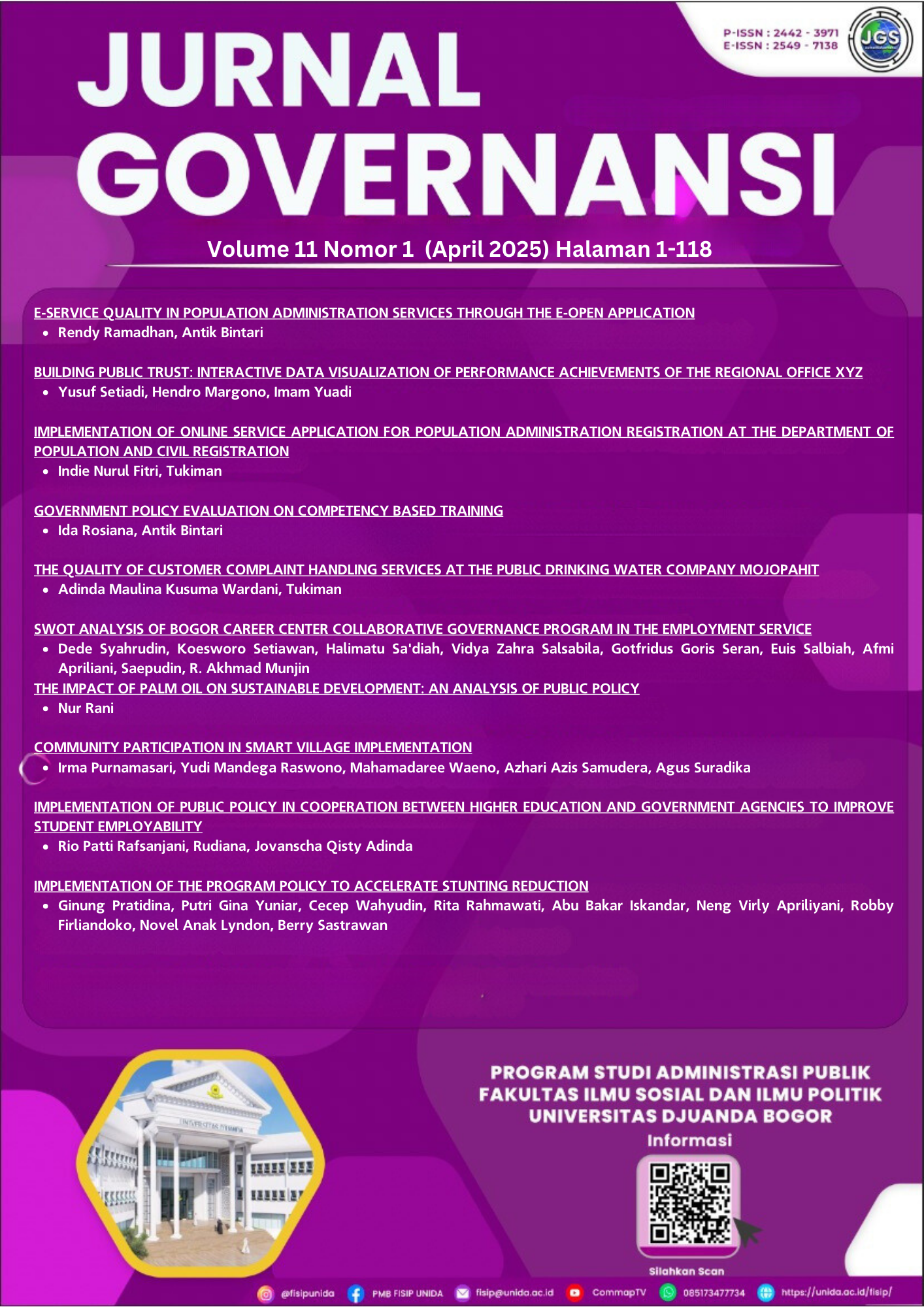
BUILDING PUBLIC TRUST: INTERACTIVE DATA VISUALIZATION OF PERFORMANCE ACHIEVEMENTS OF THE REGIONAL OFFICE XYZ
DOI:
https://doi.org/10.30997/jgs.v11i1.15091Keywords:
Data Visualization, Staffing, Power BI, Transparency, Kanreg IX BKNAbstract
This research aims to build public trust in the performance of XYZ Regional Office through interactive data visualization using Power BI. Public trust in government agencies is often influenced by transparency and openness in delivering performance information. In this context, interactive and easy-to-understand data visualization is important to improve public understanding of agency performance achievements. The urgency of this research lies in the need for transparency and public accountability, which can encourage active public participation in monitoring and supporting government performance. This research uses a descriptive method with a quantitative approach. The data used is the performance data of XYZ Regional Office, which is then processed and visualized using Power BI. Interactive data visualization is designed to facilitate users in exploring relevant performance information, with a focus on key indicators of agency achievement. By interpreting data findings, this research identifies factors that influence staffing dynamics, such as the total number of civil servants, retirement proposals, and promotion proposals. The implications of the findings are also discussed to provide relevant recommendations for stakeholders related to strategic staffing decision-making. The results showed that the interactive data visualization created was able to increase public understanding and positive perception of the performance of XYZ Regional Office. The novelty of this research lies in the use of Power BI as an interactive visualization tool in the context of government agencies, which has not been widely applied. This research is expected to be a reference for other government agencies to increase public trust through a data-driven approach and performance transparency.
References
Ali, S. M., Gupta, N., Nayak, G. K., & Lenka, R. K. (2016, December). Big data visualization: Tools and challenges. In 2016 2nd International conference on contemporary computing and informatics (IC3I) (pp. 656-660). IEEE.
Alsallakh, B., Micallef, L., Aigner, W., Hauser, H., Miksch, S., & Rodgers, P. (2014). Visualizing sets and set-typed data: State-of-the-art and future challenges.
Aspin, A. (2016). Pro Power BI Desktop. Apress.
Becker, L. T., & Gould, E. M. (2019). Microsoft power BI: extending excel to manipulate, analyze, and visualize diverse data. Serials Review, 45(3), 184-188.
Dilla, W. N., & Steinbart, P. J. (2005). The effects of alternative supplementary display formats on balanced scorecard judgments. International Journal of Accounting Information Systems, 6(3), 159-176.
Debiasi, A. (2016). Study of visual clutter in geographic node-link diagrams.
Husin, N. D. I., & Abdullah, N. A. S. (2019). Overlapping issues and solutions in data visualization techniques. Indonesian Journal of Electrical Engineering and Computer Science, 16(3), 1600-1608.
Keim, D. A., Mansmann, F., Schneidewind, J., & Ziegler, H. (2006, July). Challenges in visual data analysis. In Tenth International Conference on Information Visualisation (IV'06) (pp. 9-16). IEEE.
Keim, D. A., & Ward, M. O. (2002). Visual data mining techniques.
Knight, D., Knight, B., Pearson, M., Quintana, M., & Powell, B. (2018). Microsoft Power BI Complete Reference: Bring your data to life with the powerful features of Microsoft Power BI. Packt Publishing Ltd.
Knaflic, C. N. (2015). Storytelling with data: A data visualization guide for business professionals. John Wiley & Sons.
Lipe, M. G., & Salterio, S. (2002). A note on the judgmental effects of the balanced scorecard's information organization. Accounting, organizations and society, 27(6), 531-540.
Liu, J., Tang, T., Wang, W., Xu, B., Kong, X., & Xia, F. (2018). A survey of scholarly data visualization. Ieee Access, 6, 19205-19221.
Provost, F., & Fawcett, T. (2013). Data Science for Business: What you need to know about data mining and data-analytic thinking. " O'Reilly Media, Inc.".
Maccarthaigh, M., & Boyle, R. (2014). Civil service accountability: Challenge and change. Research Paper, (12).
Powell, B. (2018). Mastering Microsoft Power BI: Expert techniques for effective data analytics and business intelligence. Packt Publishing Ltd.
Provost, F., & Fawcett, T. (2013). Data science and its relationship to big data and data-driven decision making. Big data, 1(1), 51-59.
Singh, G., Kumar, A., Singh, J., & Kaur, J. (2023, March). Data visualization for developing effective performance dashboard with Power BI. In 2023 International Conference on Innovative Data Communication Technologies and Application (ICIDCA) (pp. 968-973). IEEE.
Stefanovic, N. (2015). Collaborative predictive business intelligence model for spare parts inventory replenishment. Computer Science and Information Systems, 12(3), 911-930.
Susanto, A., Wahid, O., Hazriani, Y., & Yuyun, Y. (2021). Decision support system on quality assessment of the prospective civil servant’s education and training using fuzzy method. Indonesian Journal of Electrical Engineering and Computer Science, 24(1), 519-529.
Swires-Hennessy, E. (2014). Presenting data: How to communicate your message effectively. John Wiley & Sons.
Uskov, V. L., Bakken, J. P., Ganapathi, K. S., Gayke, K., Galloway, B., & Fatima, J. (2020). Data cleaning and data visualization systems for learning analytics. In Smart Education and e-Learning 2020 (pp. 183-197). Springer Singapore.
Van den Elzen, S., & Van Wijk, J. J. (2014). Multivariate network exploration and presentation: From detail to overview via selections and aggregations. IEEE Transactions on Visualization and Computer Graphics, 20(12), 2310-2319.
Wahyudin, C. E. C. E. P., Apriliani, A. F. M. I., Ramdani, F. T., Pratidina, G. I. N. U. N. G., & Seran, G. G. (2023). a Bibliometric Analysis Collaborative Governance of Plastic Reduction Through the Transformation Industry. Journal of Engineering Science and Technology, 18(4), 85-93.
Widjaja, S., & Mauritsius, T. (2019). The development of performance dashboard visualization with power BI as platform. International Journal of Mechanical Engineering and Technology (IJMET), 10(5), 235-249.
Wijaya, A., Subagyo, A., Pramono, P., & Pujiatun, P. (2022). Penerapan Prinsip-Prinsip Service Excellence dalam Pelayanan Publik. JIIP-Jurnal Ilmiah Ilmu Pendidikan, 5(12), 5485-5492.
Xia, F., Su, X., Wang, W., Zhang, C., Ning, Z., & Lee, I. (2016). Bibliographic analysis of nature based on Twitter and Facebook altmetrics data. PloS one, 11(12), e0165997.
Yigitbasioglu, O. M., & Velcu, O. (2012). A review of dashboards in performance management: Implications for design and research. International journal of accounting information systems, 13(1), 41-59.
Downloads
Published
How to Cite
Issue
Section
License
Copyright (c) 2025 Yusuf Setiadi, Hendro Margono, Imam Yuadi

This work is licensed under a Creative Commons Attribution-ShareAlike 4.0 International License.
Authors who publish with Jurnal Governansi agree to the following terms:
- Authors retain copyright and grant the journal right of first publication with the work simultaneously licensed under a Creative Commons Attribution 4.0 International License that allows others to share the work with an acknowledgement of the work's authorship and initial publication in Jurnal Governansi.
- Authors are able to enter into separate, additional contractual arrangements for the non-exclusive distribution of the journal's published version of the work (e.g., post it to an institutional repository or publish it in a book), with an acknowledgement of its initial publication in Jurnal Governansi.
- Authors are permitted and encouraged to post their work online (e.g., in institutional repositories or on their website) prior to and during the submission process, as it can lead to productive exchanges, as well as earlier and greater citation of published work.