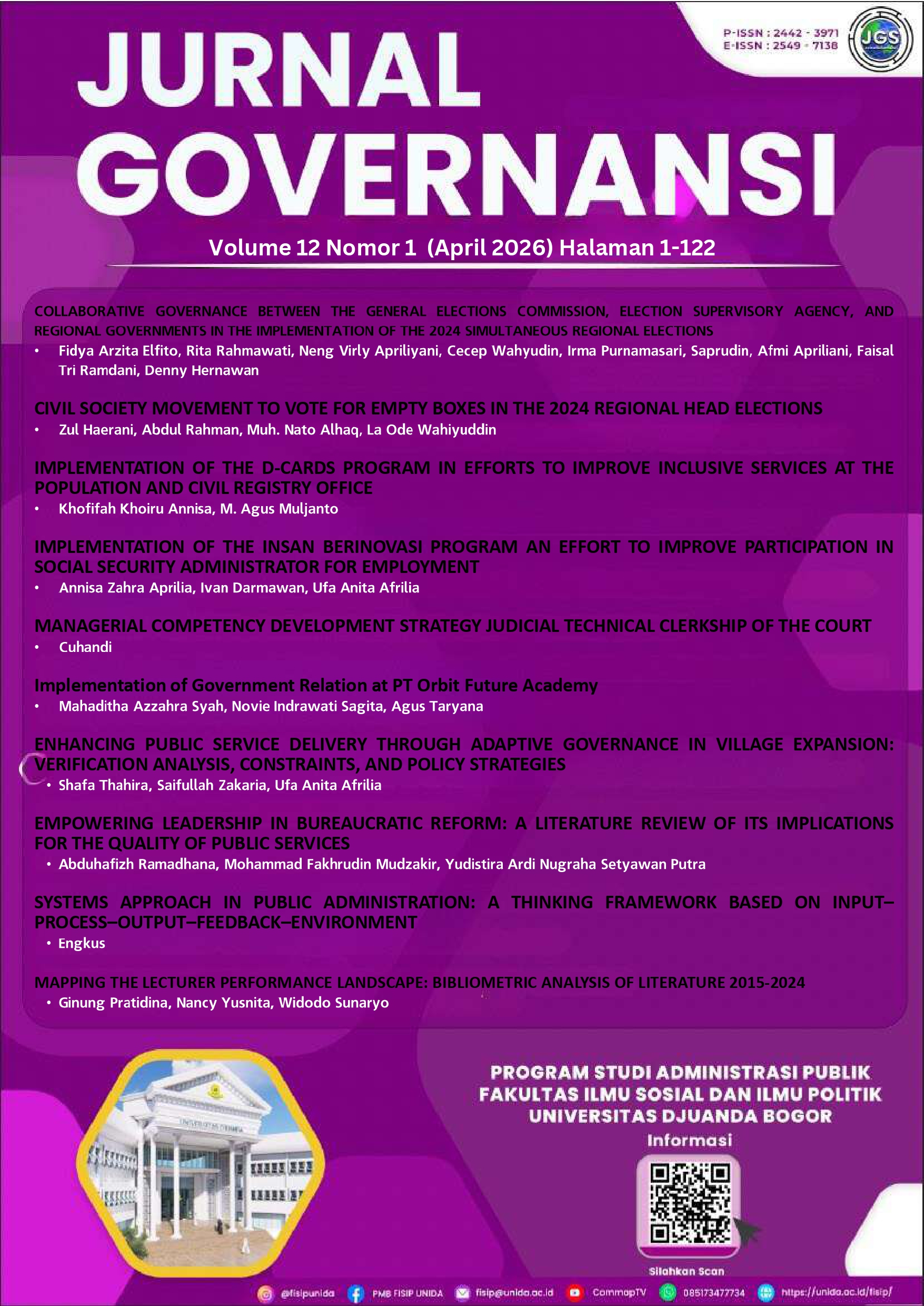
CIVIL SOCIETY MOVEMENT TO VOTE FOR EMPTY BOXES IN THE 2024 REGIONAL HEAD ELECTIONS
DOI:
https://doi.org/10.30997/jgs.v12i1.19763Keywords:
Single Candidate, Civil Society Movement, Empty Box, Pilkada 2024Abstract
The 2024 simultaneous Regional Head Elections in several regions in Indonesia have shown interesting political phenomena, one of which is the emergence of a civil society movement to vote for the empty box. This phenomenon occurs primarily in regions with only one candidate pair, which indirectly limits democratic choices for voters. This study aims to analyze the civil society movement to vote for the empty box as an alternative form of political participation. The method used is descriptive qualitative with a phenomenological approach. Primary data were collected through in-depth interviews with 10 informants selected purposively consisting of movement activists, community leaders, and active voters, supported by participant observation and visual documentation. Secondary data were obtained from official documents of the Maros Election Commission (KPUD), mass media coverage, legal regulations, and academic literature for the 2020-2024 period. Data analysis used thematic analysis with triangulation validation. The results of the study indicate that the civil society movement supporting the empty box is a form of reflective political participation driven by dissatisfaction with public services, rejection of single candidates, and a desire for democratic alternatives. By obtaining 35% (68,527 votes) of the total valid votes, this movement put real pressure on the local political process and demonstrated active resistance by citizens to political monopoly.
References
Abdullah. (2024). Calon Tunggal Dalam Politik Kotak Kosong Dan Kekuasaan Partai Pada Pilkada. Jurnal Kolaboratif Sains, 7(8), 2992–3005. https://doi.org/10.56338/jks.v7i8.5945
Cohen, J. L., & Arato, A. (2016). Civil society and political theory. In Democracy: A reader (pp. 370–374). Columbia University Press.
Diamond, L. (1999). Developing democracy: Toward consolidation. JHU press.
Diani, M., & Bison, I. (2004). Organizations, coalitions, and movements. Theory and Society, 33(3), 281–309.
Erniyanti, E. (2018). Kajian Kritis Pemilihan Kepala Daerah Calon Tunggal Pasca Putusan Mahkamah Konstitusi Nomor 100/Puu-Xiii/2015. Jurnal Hukum Samudra Keadilan, 13(2), 250–258.
Firmansyah, J., Apriansyah, A., & ... (2023). Analisis Penyebab Kemunculan Kotak Kosong Pada Pemilihan Kepala Daerah Di Kabupaten Sumbawa Barat Tahun 2020. JIP: SAMOTA (Jurnal Ilmu …, 01(September), 1–8. http://www.jurnal.uts.ac.id/index.php/samota/article/view/2175%0Ahttps://www.jurnal.uts.ac.id/index.php/samota/article/download/2175/1251
Jenkins, J. C. (1983). Resource mobilization theory and the study of social movements. Annual Review of Sociology, 9(1), 527–553.
McCarthy, J. D., & Zald, M. N. (2017). Resource mobilization and social movements: A partial theory. In Social Movements in an Organizational Society: Collected Essays (pp. 15–46). https://doi.org/10.4324/9781315129648
Mulyadi, D., Claudia, C., Ratu, N., & Januwati, P. (2024). Fenomena kotak kosong dalam pilkada tahun 2024. https://doi.org/10.55551/jip.v5i2.185
Republik Indonesia. (2016). Undang-Undang Republik Indonesia Nomor 10 Tahun 2016 Tentang Perubahan Kedua Atas Undang-Undang Nomor 1 Tahun 2015 Tentang Penetapan Peraturan Pemerintah Pengganti Undang-Undang Nomor 1 Tahun 2014 Tentang Pemilihan Gubernur, Bupati, Dan Walikota Menjadi U. 1–90. https://doi.org/10.1017/CBO9781107415324.004
Rizal, A. (2022). Pemilukada Serentak 2024: Dinamika, Urgensi dan Tantangan. Proceedings of the 1st Conference on Social, Politics, and Culture (IACS-CSPC) 2022, 1, 136–140.
Syahid, I., Adnan, M., & Alfirdaus, L. K. (2024). Membuka Jalan Baru: Jaringan Kotak Kosong (JKK) dalam Pemilihan Umum Kepala Daerah Kota Balikpapan. NeoRespublica: Jurnal …, 5(2), 531–544. http://neorespublica.uho.ac.id/index.php/journal/article/view/207%0Ahttp://neorespublica.uho.ac.id/index.php/journal/article/download/207/89
Tarrow, S. (2022). Power in movement. Cambridge university press.
Tilly, C., & Tarrow, S. G. (2015). Contentious politics. Oxford University Press.
Widyasari, A., Anggia Dewi, R., & Mayasari Sri Rengganis, V. (2022). Gerakan Politik Pendukung Kotak Kosong: Keterlibatan Civil Society dalam Pilkada Kabupaten Pati Tahun 2017. Jurnal PolGov, 1(1), 89–119. https://doi.org/10.22146/polgov.v1i1.5053
Downloads
Published
How to Cite
Issue
Section
License
Copyright (c) 2026 Zul Haerani, Rahman Abdul, Alhaq Muh. Nato, Wahiyuddin La Ode

This work is licensed under a Creative Commons Attribution-ShareAlike 4.0 International License.
Authors who publish with Jurnal Governansi agree to the following terms:
- Authors retain copyright and grant the journal right of first publication with the work simultaneously licensed under a Creative Commons Attribution 4.0 International License that allows others to share the work with an acknowledgement of the work's authorship and initial publication in Jurnal Governansi.
- Authors are able to enter into separate, additional contractual arrangements for the non-exclusive distribution of the journal's published version of the work (e.g., post it to an institutional repository or publish it in a book), with an acknowledgement of its initial publication in Jurnal Governansi.
- Authors are permitted and encouraged to post their work online (e.g., in institutional repositories or on their website) prior to and during the submission process, as it can lead to productive exchanges, as well as earlier and greater citation of published work.