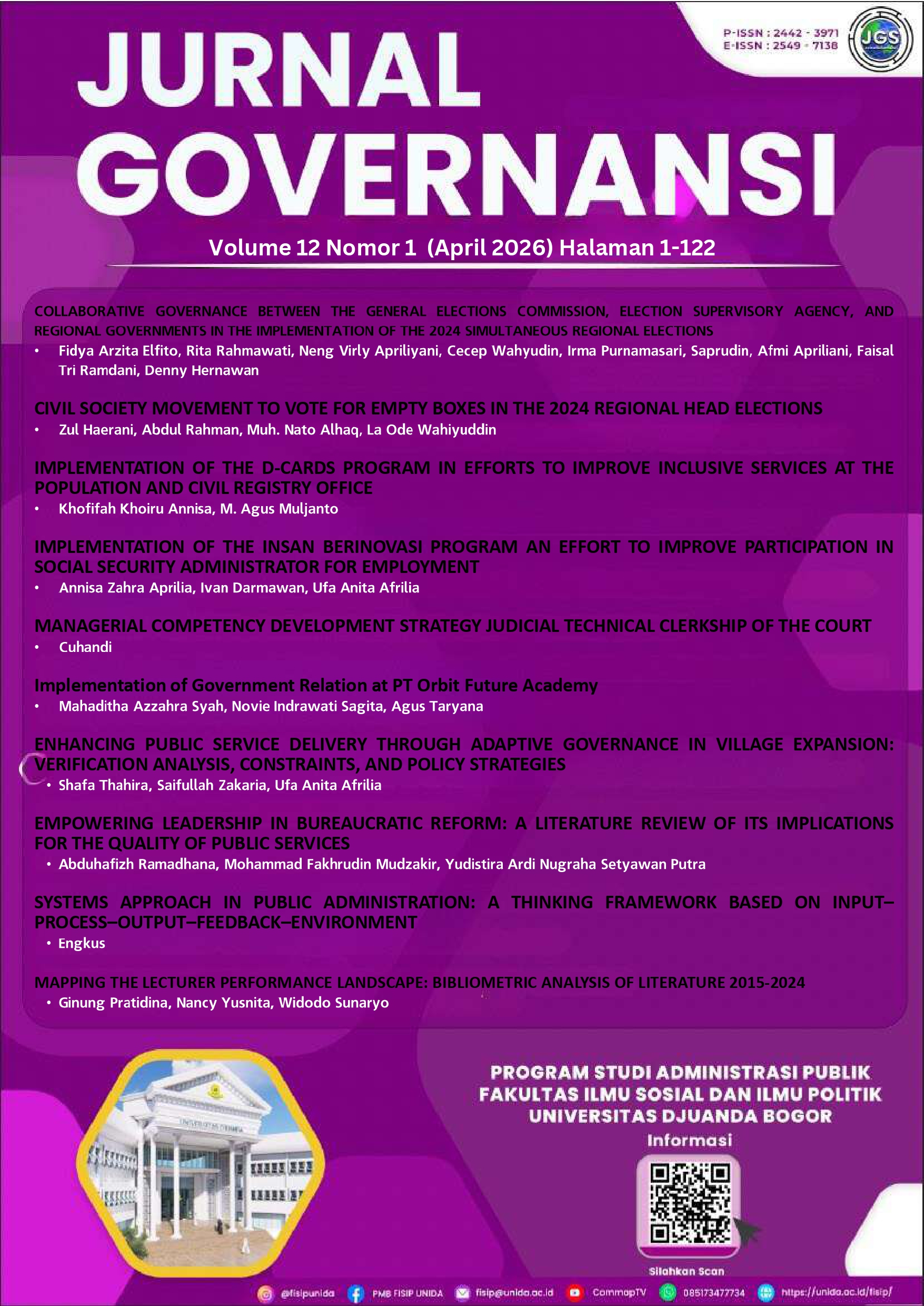
COLLABORATIVE GOVERNANCE BETWEEN THE GENERAL ELECTIONS COMMISSION, ELECTION SUPERVISORY AGENCY, AND REGIONAL GOVERNMENTS IN THE IMPLEMENTATION OF THE 2024 SIMULTANEOUS REGIONAL ELECTIONS
DOI:
https://doi.org/10.30997/jgs.v12i1.19651Keywords:
Actor Synergy, Collaborative Governance, Participation, Regional ElectionsAbstract
The 2024 Simultaneous Regional Elections serve as a crucial momentum for the consolidation of democracy at the local level, including in Bogor Regency, one of the regions with the highest number of voters in West Java. Additionally, Bogor Regency is categorized as a medium-risk area in the Election Vulnerability Index according to Bawaslu reports, thus posing potential risks of horizontal conflict and technical challenges in the election process. This complexity requires collaborative governance across institutions to ensure a democratic, inclusive, and peaceful electoral process. This study aims to examine the forms, challenges, and efforts of collaboration among key actors such as the General Elections Commission (KPU), the Election Supervisory Board (Bawaslu), the National Unity and Politics Agency, the police, the media, and the community in organizing the Pilkada in Bogor Regency. A descriptive quantitative approach was employed, involving 145 respondents from institutions and the public using disproportionate stratified random sampling and simple random sampling techniques. Data were collected through observation, interviews, documentation, and Likert-scale questionnaires, and analyzed using the Weight Mean Score (WMS) method. The findings indicate that inter-agency collaboration has been running well, with an average score of 4.13 (institutional respondents) and 3.80 (community respondents). The dimensions of facilitative leadership and institutional design demonstrated the strongest performance, while the starting condition dimension was the weakest. These findings underscore the importance of strengthening initial capacity and developing clear collaborative Standard Operating Procedures (SOPs). The novelty of this research lies in the empirical application of the Collaborative Governance approach (Ansell & Gash, 2008) in the context of regional elections in a conflict-prone area, along with a structured analysis based on four main dimensions. This study implies the need for a sustainable collaboration system at every stage of the electoral process to establish a participatory, secure, and accountable government.
References
Ansell, C., & Gash, A. (2008). Collaborative governance in theory and practice. Journal of Public Administration Research and Theory, 18(4), 543–571. https://doi.org/10.1093/jopart/mum032
Apriliani, A., Wahyudin, C., Hastuti, A., Ramdani, F. T., Andani, H., & Irli, S. S. (2024). Collaborative Governance dalam Pengembangan Usaha Mikro Kecil dan Menengah Melalui Pelatihan dan Pendampingan. Qardhul Hasan; Media Pengabdian Kepada Masyarakat, 10(3), 275–286.
Dewi, S. M., Nabilah, S., Hermawan, D., & Ramdani, F. T. (2024). Implementasi Good Governance dalam Pelayanan Publik di Desa Pandansari. Karimah Tauhid, 3(7), 8237–8246. http://www.samarinda.lan.go.id/jba/index.php/jba/article/view/45%0Ahttp://www.samarinda.lan.go.id/jba/index.php/jba/article/download/45/56
Habibah, E. N. (2021). Collaborative Governance: Konsep & Praktik dalam Pengelolaan Bank Sampah (T. A. Wahyuningtyas, D. O. Putra, & Freepik.com (eds.)). Penerbit Pustaka Rumah Cinta.
Indira Arundinasari. (2022). Kolaborasi Tata Kelola Kampung Pelangi Kota Surabaya. Journal Publicuho, 5(3), 713–721. https://doi.org/10.35817/publicuho.v5i3.14
Katon, B. C., Sulistiowati, R., & Meiliyana. (2022). Identifikasi Starting Condition dalam Praktik Collaborative Governance Mengatasi Mitigasi Konflik Satwa Liar dengan Masyarakat di Sekitar Taman Nasional Way Kambas Kabupaten Lampung Timur. Administrativa: Jurnal Birokrasi, Kebijakan Dan Pelayanan Publik, 4(2), 321–335. https://administrativa.fisip.unila.ac.id/index.php/1/article/view/194
Kurniadi. (2020). Collaborative Governance dalam Penyediaan Infrastruktur (H. Rahmadhani, T. Yuliyanti, & A. Y. Wati (eds.)). Penerbit Deepublish.
Muhammad, F. (2024). Teori Governance: Transparansi, Akuntabilitas dan Pencegahan Korupsi (I. Bisri (ed.); Cetakan 1). Selaras Media Kreasindo.
Nuraini, R., & Nugroho, H. (2022). Collaborative Governance dalam Penyelenggaraan Pemilu di Indonesia: Analisis Konteks Lokal. Jurnal Ilmu Pemerintahan, 13(1), 45–60.
Nurhidayat, I. (2023). Prinsip-Prinsip Good Governance Di Indonesia. Journal E-Gov Wiyata : Education and Government, 1(1), 40–52. https://journal.wiyatapublisher.or.id/index.php/e-govHalaman40
Ohorella, Z., & Fitriati, R. (2024). Peran Kepemimpinan Fasilitatif Dalam Tata Kelola Kolaboratif Pada Kebijakan Pariwisata Bahari, Studi Wisata Selam Di Kota Tidore Kepulauan Maluku Utara. COSTING: Journal of Economic, Business and Accounting, 7(6), 9295–9310.
Qoyimah, D., Wardana, M. R., Susi, N., Nooresa, A. F., Muttaqin, M. I., & Wijaya, S. R. (2023). Collaborative Governance: Model Pengawasan Partisipatif Berbasis Gerakan Perempuan Mengawasi [Collaborative Governance: A Model of Participatory Surveillance Based on The Gerakan Perempuan Mengawasi]. Jurnal Politica Dinamika Masalah Politik Dalam Negeri Dan Hubungan Internasional, 13(2), 182–202. https://doi.org/10.22212/jp.v13i2.3317
Rahmawati, R., Hernawan, D., Darusman, D., & Sektiono, D. (2019). Kinerja Implementasi Tata Kelola Hutan Taman Nasional Gunung Halimun Salak. Sosiohumaniora, 21(3), 305–315. https://doi.org/10.24198/sosiohumaniora.v21i3.7328
Ridwanullah, M., Rahmawati, R., & Hernawan, D. (2021). Pemetaan Tata Kelola Pengembangan Pariwisata. Jurnal Governansi, 7(1), 9–18. https://doi.org/10.30997/jgs.v7i1.3106
Sanjaya, S., Rahmawati, R., & Sudarsa, A. S. (2022). Tata Kelola dan Pengembangan Pariwisata Geopark Pongkor Kabupaten Bogor Terhadap Peningkatan Ekonomi Masyarakat. Administratie Jurnal Administrasi Publik, 5(April), 23–32.
Saputra, A., & Astuti, S. J. W. (2022). Collaborative Governance Dalam Penanganan Pandemi Covid 19 (Study Kasus Di Kelurahan Kandangan). JISP (Jurnal Inovasi Sektor Publik), 2(1), 1–15. https://doi.org/10.38156/jisp.v2i1.113
Setiawan, A., & Handala, H. (2020). Jejaring Bawaslu dalam Penanganan Pelanggaran Pemilihan Umum Serentak. Jurnal Academia Praja, 3(2), 322–340.
Sihombing, P. (2020). Demokrasi Lokal dan Tantangan Pilkada Serentak. Jurnal Politik Lokal, 5(2), 103–117.
Sugiyono. (2019). Metode Penelitian Kuantitatif, Kualitatif, dan R&D (Sutopo (ed.); Cetakan ke). ALFABETA, cv.
Sukmajati, M., & Farhan, A. (2023). Kualitas Demokrasi dalam Pilkada Serentak: Evaluasi dan Rekomendasi. Pustaka Pemilu.
Teka, S. Si. (2021). Urgensi Desain Collaborative Governance dalam Pemilu dan Pilkada (Studi Kasus Malpraktik Elektoral Tahapan Pencalonan Pemilu DPRD Provinsi NTT dan Pilkada Sabu Raijua). Adhyasta Pemilu, 4(1), 1–27.
Wahyudin, C., Firliandoko, R., Amalia, N., & Zulfa, A. A. (2024). Model Tatakelola Pariwisata Berbasis Kolaboratif dalam Pengembangan Pariwisata Berkelanjutan. Jurnal Governansi, 10(2), 147–164.
Wahyudin, C., Subagdja, O., & Iskandar, A. (2023). Desain Model Collaborative Governance Dalam Penanganan Pengurangan Penggunaan Plastik. Jurnal Governansi, 9(2), 151–162. https://doi.org/10.30997/jgs.v9i2.8004
Yuliati, R., & Aziz, M. (2021). Mitigasi Konflik dan Kolaborasi Antar-Lembaga dalam Penyelenggaraan Pemilu. Jurnal Kebijakan Publik, 12(2), 89–101.
Downloads
Published
How to Cite
Issue
Section
License
Copyright (c) 2026 Fidya Arzita Elfito, Rita Rahmawati, Neng Virly Apriliyani, Cecep Wahyudin, Irma Purnamasari, Saprudin, Afmi Apriliani, Faisal Tri Ramdani, Denny Hernawan

This work is licensed under a Creative Commons Attribution-ShareAlike 4.0 International License.
Authors who publish with Jurnal Governansi agree to the following terms:
- Authors retain copyright and grant the journal right of first publication with the work simultaneously licensed under a Creative Commons Attribution 4.0 International License that allows others to share the work with an acknowledgement of the work's authorship and initial publication in Jurnal Governansi.
- Authors are able to enter into separate, additional contractual arrangements for the non-exclusive distribution of the journal's published version of the work (e.g., post it to an institutional repository or publish it in a book), with an acknowledgement of its initial publication in Jurnal Governansi.
- Authors are permitted and encouraged to post their work online (e.g., in institutional repositories or on their website) prior to and during the submission process, as it can lead to productive exchanges, as well as earlier and greater citation of published work.