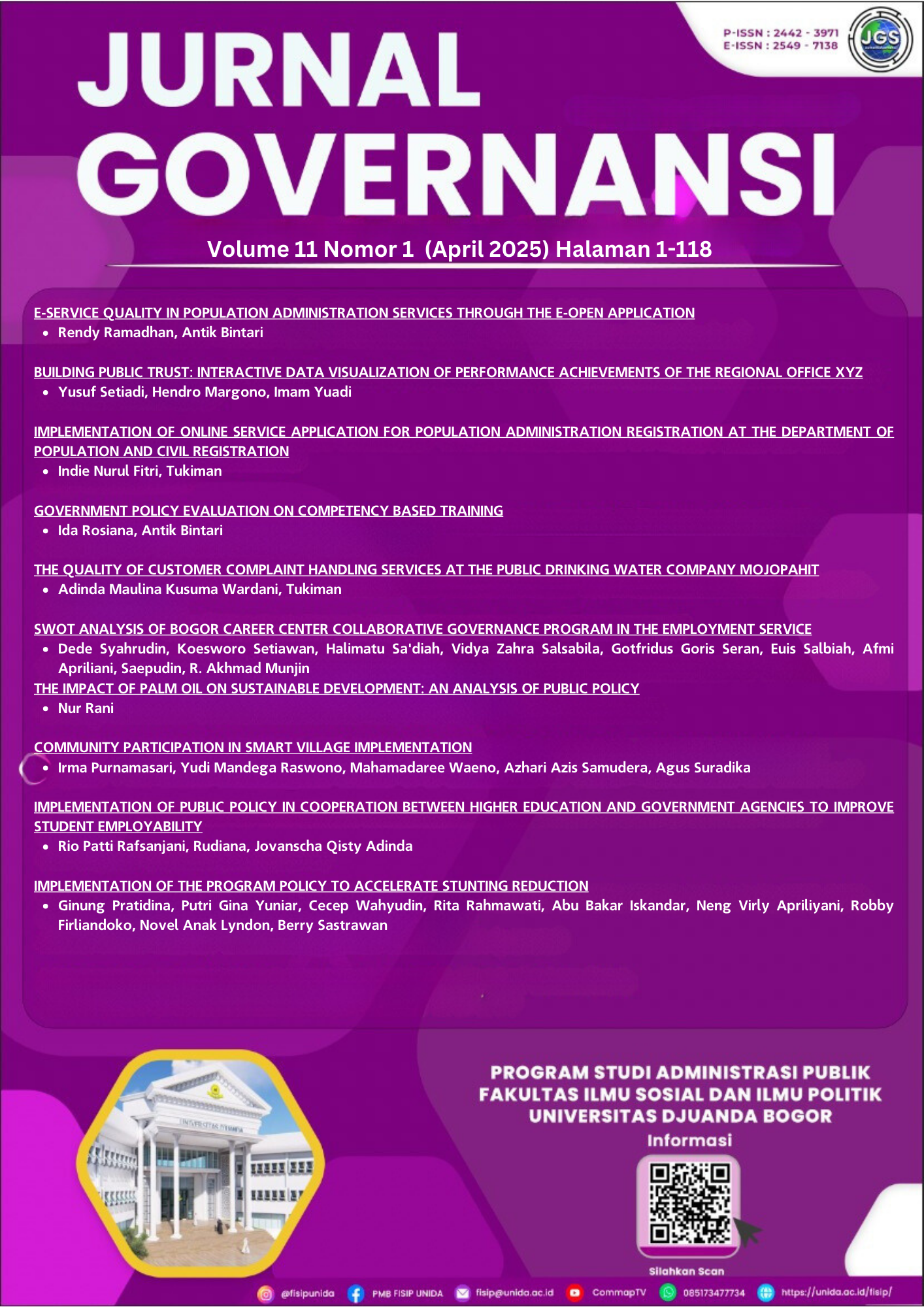
SWOT ANALYSIS OF BOGOR CAREER CENTER COLLABORATIVE GOVERNANCE PROGRAM IN THE EMPLOYMENT SERVICE
DOI:
https://doi.org/10.30997/jgs.v11i1.16403Keywords:
BCC Programs, Collaborative Governance, Employment Service, SWOT Analysis, Regional DevelopmentAbstract
Bogor Career Center (BCC) is a program from the Bogor Regency Manpower Office to improve job opportunities and workforce skills. However, the effectiveness of this program still faces challenges, such as synergy between stakeholders, limited resources, and workforce readiness in facing industrial competition. This study aims to analyze the SWOT factors in the implementation of collaborative governance in the BCC program and measure its effectiveness which emphasizes trust, communication, and implementation capacity, as well as analysis that includes program success, target achievement, user satisfaction, input-output levels, and overall goal achievement. This study uses qualitative methods with interview techniques, documentation studies, and observations. The results of the study indicate that BCC has strengths in policy support and partnership networks, but still faces coordination constraints and resource limitations. The opportunities for this program lie in the utilization of technology and industry collaboration, while the threats include labor market dynamics and budget constraints. The analysis shows that trust and communication between stakeholders still need to be strengthened, and implementation capacity is not optimal. In terms of effectiveness, target achievement and user satisfaction still need to be improved to ensure the sustainability of the program. In conclusion, the success of collaborative governance in the BCC program depends on strengthening trust, communication, and implementation capacity, as well as the effectiveness of the program in achieving targets and user satisfaction.
References
Ansell, C., & Gash, A. (2008). Collaborative Governance in Theory and Practice. Journal of Public Administration Research and Theory, 18(4), 543–571. https://doi.org/10.1093/jopart/mum032
Caissy Rahmadhani Hasibuan, & Herman. (2024). Collaborative Governance dalam Mengurangi Pengangguran di Kabupaten Bengkalis. Jurnal Kemunting, 5(1), 43–104.
Dian Feradiah, & Agus Prianto. (2024). Penguatan Peran Pemerintahan Melalui Collaborative Governance dalam Menyediakan Lapangan Kerja Inklusi di Kabupaten Pasuruan. Journal Publicuho, 7(3), 1077–1093. https://doi.org/10.35817/publicuho.v7i3.459
E. Halimatu, S., & Syahrudin, D. (2024). Implementasi Program Bogor Career Center (BCC) dalam Memberikan Peluang Masyarakat Kabupaten Bogor Mendapatkan Pekerjaan. Karimah Tauhid, 3(12), 13807–13812.
Enggareti, Viskarani Bertys, Nina Widowati, & Maesaroh. (2022). Efektivitas program puskesmas tanpa antrian kota semarang (pustaka) pada pendaftaran online di puskesmas srondol banyumanik semarang. Journal of Public Policy and Management Review, 11(2), 131–145.
Irfan, M., Firamadhina, F. I. R., & Akmalia, N. N. (2022). Analisis Kemitraan Plan International Indonesia Menggunakan Strategi Community Relations. Jurnal Kolaborasi Resolusi Konflik, 4(1), 59. https://doi.org/10.24198/jkrk.v4i1.38086
Jasrani, J., Arafat, A., & Firdaus, F. (2023). Evaluasi Program Corporate Social Responsibility PT Gasing Sulawesi. Tolis Ilmiah: Jurnal Penelitian, 5(1), 1. https://doi.org/10.56630/jti.v5i1.283
Kurniawan, F. E., & Aruan, N. L. (2021). Digitalisasi dan Pola Kerja Baru: Dampak Bagi Industrialisasi dan Respons Kebijakan Ketenagakerjaan. Jurnal Sosioteknologi, 20(3), 395–409. https://doi.org/10.5614/sostek.itbj.2021.20.3.11
Kusnadi, I. H. (2020). Efektifitas Program Pelatihan Berbasis Kompetensi Pada Unit Pelaksana Teknis Daerah Balai Latihan Kerja di Kabupaten Subang. The World of Public Administration Journal, 103–124. https://doi.org/10.37950/wpaj.v1i2.739
Miller, L., Bolton, M., Boulton, J., Mintrom, M., Nicholson, A., Rudiger, C., Skinner, R., Raven, R., & Webb, G. I. (2020). AI for monitoring the Sustainable Development Goals and supporting and promoting action and policy development. 2020 IEEE / ITU International Conference on Artificial Intelligence for Good (AI4G), 180–185. https://doi.org/10.1109/AI4G50087.2020.9311014
Morse, R. S., & Stephens, J. B. (2012). Teaching Collaborative Governance: Phases, Competencies, and Case-Based Learning. Journal of Public Affairs Education, 18(3), 565–583. https://doi.org/10.1080/15236803.2012.12001700
Palifiana, D. A., Khadijah, S., Dewi, D. P., & Salamahu, L. (2024). Pemberdayaan Perempuan Penyandang Disabilitas Sebagai Upaya Meningkatkan Kualitas Hidup. GERVASI: Jurnal Pengabdian Kepada Masyarakat, 7(3), 1393–1403. https://doi.org/10.31571/gervasi.v7i3.6614
Pangesti, E. N., Resmi, S., & Utami, A. M. (2024). Pengaruh Kualitas Layanan dan Kepuasan Pelanggan terhadap Loyalitas Pelanggan pada Badan Penyelenggaraan Jaminan Sosial Ketenagakerjaan Gunungkidul. Cakrawangsa Bisnis: Jurnal Ilmiah Mahasiswa, 5(1), 16. https://doi.org/10.35917/cb.v5i1.481
Sakty, I. (2023). Governance of the National Development Planning and Budgeting Synchronization Network. Journal La Sociale, 4(5), 363–371. https://doi.org/10.37899/journal-la-sociale.v4i5.915
Wahyudin, C., Firliandoko, R., Amalia, N., & Alfin Zulfa, A. (2024). Collaborative Based Tourism Governance Model in Sustainable Tourism Development. Jurnal Governansi, 10(2), 147–164. https://doi.org/10.30997/jgs.v10i2.12974
Wood, D. J., & Gray, B. (1991). Toward a Comprehensive Theory of Collaboration. The Journal of Applied Behavioral Science, 27(2), 139–162. https://doi.org/10.1177/0021886391272001
Xiao, Y., Parker, S. H., & Manser, T. (2013). Teamwork and Collaboration. Reviews of Human Factors and Ergonomics, 8(1), 55–102. https://doi.org/10.1177/1557234X13495181
Yasintha, P. N. (2020). Collaborative Governance dalam Kebijakan Pembangunan Pariwisata di Kabupaten Gianyar. Jurnal Ilmiah Dinamika Sosial, 4(1), 1. https://doi.org/10.38043/jids.v4i1.2219
Yulindawati, & Editia Ari Putra. (2024). Peran Balai Latihan Kerja (BLK) dalam Mengurangi Pengangguran di Kota Banda Aceh. Jurnal Ilmiah Basis Ekonomi Dan Bisnis, 3, 71–86.
Downloads
Published
How to Cite
Issue
Section
License
Copyright (c) 2025 Dede Syahrudin, Koesworo Setiawan, Halimatu Sa'diah, Vidya Zahra Salsabila, Gotfridus Goris Seran, Euis Salbiah, Afmi Apriliani, Saepudin, R. Akhmad Munjin

This work is licensed under a Creative Commons Attribution-ShareAlike 4.0 International License.
Authors who publish with Jurnal Governansi agree to the following terms:
- Authors retain copyright and grant the journal right of first publication with the work simultaneously licensed under a Creative Commons Attribution 4.0 International License that allows others to share the work with an acknowledgement of the work's authorship and initial publication in Jurnal Governansi.
- Authors are able to enter into separate, additional contractual arrangements for the non-exclusive distribution of the journal's published version of the work (e.g., post it to an institutional repository or publish it in a book), with an acknowledgement of its initial publication in Jurnal Governansi.
- Authors are permitted and encouraged to post their work online (e.g., in institutional repositories or on their website) prior to and during the submission process, as it can lead to productive exchanges, as well as earlier and greater citation of published work.