
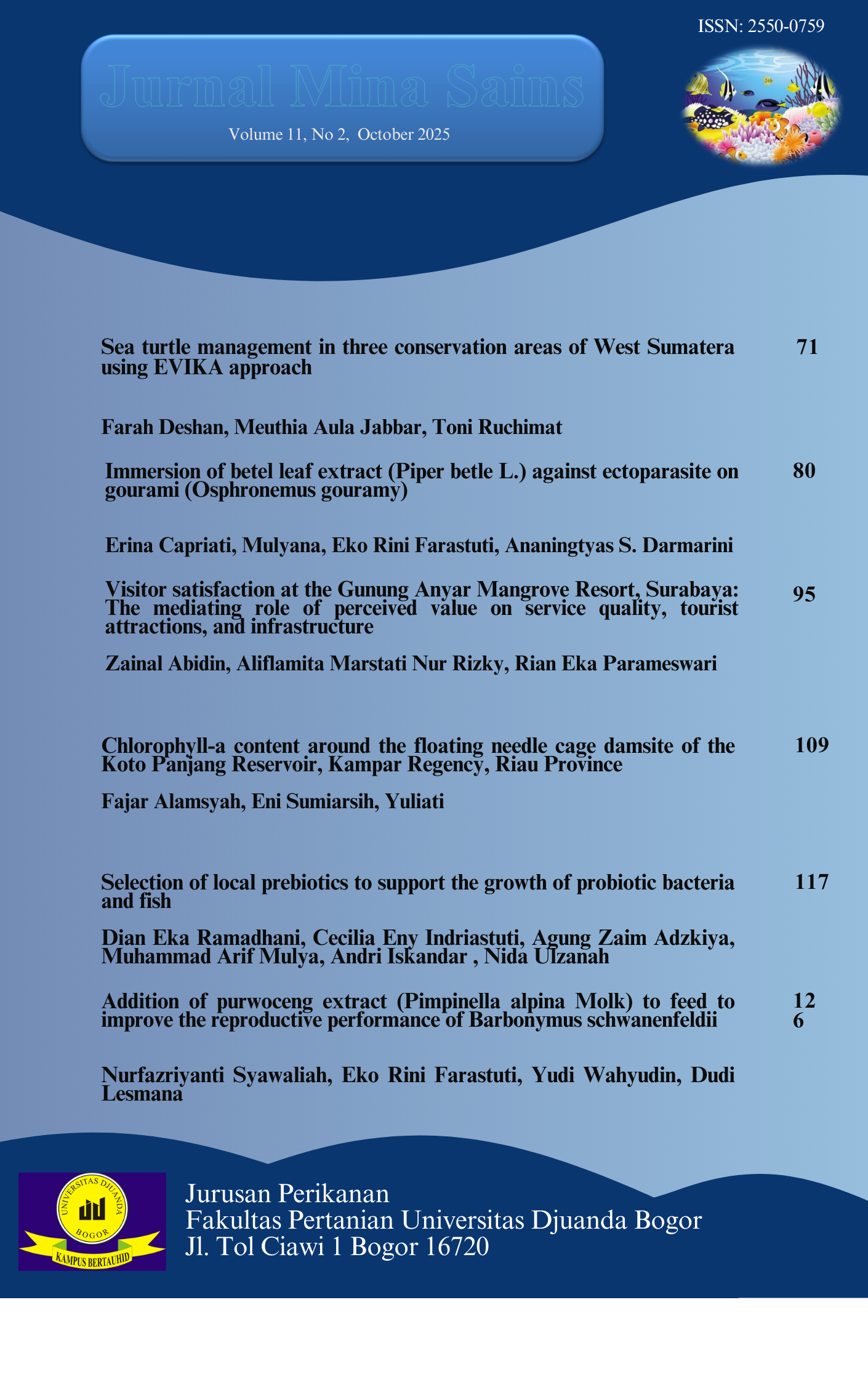
Sea turtle management in three conservation areas of West Sumatera using EVIKA approach
DOI:
https://doi.org/10.30997/jmss.v11i2.19910Keywords:
Conservation area, effectiveness, EVIKA, Marine Protected Area, Sea turtleAbstract
Sea turtles are keystone species in coastal ecosystems, playing an essential role in maintaining ecological balance by regulating the population of certain marine organisms and sustaining the quality of critical habitats such as seagrass beds and coral reefs. Their presence not only reflects the health of marine ecosystems but also serves as a key indicator of the success of marine conservation initiatives. This study evaluates the effectiveness of conservation area management in three sites in West Sumatera Province using the Evaluation of Marine Protected Area Management Effectiveness (EVIKA) framework, namely the Pieh Marine Protected Area on Pandan Island, Karabak Ketek Island, and the Ampiang Parak Conservation Area. A descriptive analysis was applied to assess the performance of each EVIKA criterion and indicator. The results show that the Pieh Conservation Area achieved a sustainable management status with the highest score in the input component, while Karabak Ketek
Island and Ampiang Parak were categorized as optimally managed. The effectiveness of management across these areas is influenced by several key factors, including the strength of legal frameworks, the availability and competence of human resources, institutional capacity, and the level of community participation. This study recommends enhancing multi-stakeholder collaboration, strengthening the role of community-based monitoring groups (pokmaswas), and implementing participatory monitoring systems that are community-driven and adaptive to the dynamic changes of coastal environments.
References
Aprilia, M., & Rajab, M. A. (2025). Analisis Kesesuaian Habitat Sarang Semi Alami Peneluran Penyu Lekang (Lepidochelys olivacea) di UPTD KPSDKP Sumatera Barat. Jurnal Pesisir dan Laut Tropis, 13(1), 40-51.
Falih, N. Z., Inayah, N.F., Indirayani, S.L., Saputri, S.A. (2025). Upaya Konservasi Penyu di Indonesia Sebagai Penyelamat Dari Ancaman Kepunahan. ENVIRO: Journal of Tropical Environmental Research (2025) 27 (1): 51–58. DOI: https://doi.org/10.20961/enviro.v27i1.101223
Firdaus, F., Damanhuri, H., Putra, A., Suparno, S., & Arlius, A. (2024). Environmental Sustainability Based on Natural Heritage Conservation and Resource Management in Tourist Objects in the Ampiang Parak Conservation Area. Science and Environmental Journal for Postgraduate, 6(2), 331-338. https://doi.org/10.24036/senjop.v6i2.255
Fitriani, D., Zurba, N., Edwarsyah, E., Marlian, N., Munandar, R. A., & Febrina, C. D. (2021). Kajian Kondisi Lingkungan Tempat Peneluran Penyu di Desa Pasie Lembang, Aceh Selatan. Journal of Aceh Aquatic Sciences, 5(1), 35-45.
Hanif, A., Damanhuri, H., Suparno, S., & Rusli, M. U. (2022). Tingkat Penetasan Penyu Hijau di Pulau Pandan Kawasan Konservasi Pulau Pieh, Sumatera Barat. Jurnal Akuatik Lestari, 6(1), 1-9.
Harnino, T., Parawangsa, I. N. Y., Sari, L. A., & Arsad, S. (2021). Efektifitas Pengelolaan Konservasi Penyu di Turtle Conservation and Education Center Serangan, Denpasar Bali. Journal of Marine and Coastal Science Vol, 10(1), 242-255. https://e-journal.unair.ac.id/JMCS
Himpson, K., Dixon, S., & Le Berre, T. (2023). Evaluation of Sea Turtle Morbidity and Mortality Within the Indian Ocean from 12 Years of Data Shows High Prevalence of Ghost Net Entanglement. Plos One, 18(8), e0289167. https://doi.org/10.1371/journal.pone.0289167
HS, D. S., & Lubis, S. B. (2018). Terumbu Karang Taman Wisata Perairan Pulau Pieh Sumatera Barat. Jurnal Airaha, 7(2). https://doi.org/10.15578/ja.v7i02.93
Jemarut, W., & Sari, D. P. (2021). Kajian Yuridis Perlindungan Penyu. Jurnal Ilmiah Dunia Hukum, 6(1), 1-10.
Le Gouvello, D.Z.M., Girondot, M., Bachoo, S. et al. The good and bad news of long-term monitoring: an increase in abundance but decreased body size suggests reduced potential fitness in nesting sea turtles. Mar Biol 167, 112 (2020). https://doi.org/10.1007/s00227-020-03736-4
Lumbantoruan, L. H., Noviyanti, R., & Gigentika, S. (2023). Kondisi Pengelolaan Kawasan Konservasi Perairan Bintan Provinsi Kepulauan Riau. Jurnal Akuatiklestari, 7(1), 8-22. https://doi.org/10.31629/akuatiklestari.v7i1.6212
Mangkurat, B. (2024). Harmonisasi EVIKA dan METT terhadap IUCN Green List Menuju Efektivitas Pengelolaan Kawasan Konservasi Laut Berstandar Internasional. Science Technology and Management Journal, 4(2), 80-83. http://dx.doi.org/10.26623/jtphp.v13i1.1845.kodeartikel
Abd Mutalib, A. H., Fadzly, N., & Foo, R. (2013). Striking a balance between tradition and conservation: General perceptions and awareness level of local citizens regarding turtle conservation efforts based on age factors and gender. Ocean & Coastal Management, 78, 56-63. https://doi.org/10.1016/j.ocecoaman.2013.03.015
Nasution, S., & Galib, M. (2020). Analysis of Sea Turtle Nesting Area in Pandan Island West Sumatra. Jurnal Perikanan Dan Kelautan, 25(3), 172-178. https://doi.org/10.31258/jpk.25.3.172-178
Rismawati, R., Hernawati, D., & Chaidir, D. M. (2021). Suitability of Egg Laying Habitat and its Relationship with the Number of Green Turtles (Chelonia mydas) that Landed on Pangumbahan Beach Sukabumi. Jurnal Biologi Tropis, 21(3), 681-690. https://doi.org/10.29303/jbt.v21i3.2844
Samosir, A., Areq, U., Panggabean, Q., Rahma Syafitri, R., & Lumbantoruan, L. H. (2024). Strategi Peningkatan Efektivitas Pengelolaan Kawasan Konservasi Taman Wisata Perairan Timur Pulau Bintan. Edu Sociata: Jurnal Pendidikan Sosiologi, 7(2), 726-740.
Sanjaya, I., Merit, I. N., & Astarini, I. A. (2022). Strategi Pengelolaan Efektif Ekosistem Terumbu Karang di Kawasan Konservasi Nusa Penida. Ecotrophic 16(2):122.DOI: 10.24843/EJES.2022.v16.i02.p01.
Saputri, R., & Muchtar, H. (2019). Peran Pokmaswas Laskar Pemuda Peduli Lingkungan dalam Pengelolaan Wilayah Pesisir Pantai di Ampiang Parak Pesisir Selatan. Journal of Civic Education, 2(4), 324-335. https://doi.org/10.24036/jce.v2i5.295
Soetijono, I. K. (2019). Implementasi Perjanjian Internasional Terhadap Upaya Pelestarian Penyu Di Indonesia. Fairness and Justice: Jurnal Ilmiah Ilmu Hukum, 17(2), 147-161.
Suherman, Y., & Astri, R. (2019). Implementasi Sistem Penunjang Keputusan Dalam Upaya Efektifitas Penentuan Daerah Penghasil Penyu Untuk Kegiatan Monitoring Penangkaran Penyu Pada Kawasan Konservasi Perairan (KKP) Kota Pariaman. JOISIE (Journal of Information Systems and Informatics Engineering), 1(1), 20-27.
Sutrisno, A. D., Chen, Y.J., Suryawan, I. W. K., & Lee, C.-H. (2023). Establishing integrative framework for sustainable reef conservation in Karimunjawa National Park, Indonesia. Water, 15(9), 1784. https://doi.org/10.3390/w15091784
Syaputra, M., Ichsan, A. C., Webliana, K., Permatasari, D., & Wulandari, F. T. (2019). Penetasan Tukik Secara Intensif Menggunakan Media Buatan (Inkubator) Di Desa Kuranji Kabupaten Lombok Barat. Prosiding PEPADU, 1, 223-232. https://www.jurnal.lppm.unram.ac.id/index.php/prosidingpepadu/article/view/36
Widhayanti, A., Tyas, D. E., Nugraha, A. R., Jasilah, N., Hanif, A., Hamdika, W., & Irfansyah, R. (2024). The effectiveness of community-based sea turtle monitoring supports hatching success on Bando Island, Pieh Island Marine Protected Area. Saintek Perikanan: Indonesian Journal of Fisheries Science and Technology, 20(3), 110-1116. https://doi.org/10.14710/ijfst.20.3.110-116
Yuliana, E. (2017). Pengelolaan Ekowisata Bahari di Kawasan Konservasi Perairan Taman Nasional Karimunjawa. Optimalisasi Peran Sains & Teknologi Untuk Mewujudkan Smart City, 89.
Yuliono, A., Safitri, I., Sofiana, M. S. J., Susanto, H., & Zulfian, Z. (2024). Sosialisasi dan Edukasi Konservasi Penyu di KKP3K Paloh “Menjaga Penyu, Menjaga Alam, Menjaga Kehidupan.” Journal of Community Development, 4(3), 278-288.
Zis, S. F., Yonariza, Y., Tanjung, H. B., & Arief, E. (2024). Komunikasi Kelompok Sadar Pariwisata Dalam Pembangunan Berkelanjutan. Jurnal Terapan Pemerintahan Minangkabau, 4(1), 98-110.
Downloads
Published
How to Cite
Issue
Section
License
Copyright (c) 2025 JURNAL MINA SAINS

This work is licensed under a Creative Commons Attribution-ShareAlike 4.0 International License.
With the receipt of the article by the Jurnal Mina Sains Universitas Djuanda Editorial Board and the decision to be published, then the copyright regarding the article will be diverted to Jurnal Mina Sains Universitas Djuanda.
Department of Fisheries Djuanda University holds the copyright regarding all the published articles in this journal.
Department of Fisheries Faculty of Agriculture, Universitas Djuanda has the right to multiply and distribute the article. Thanks to the Fisheries Department and Agriculture Faculty Universitas Djuanda that funded this journal sustainability.
The manuscript's authentic and copyright statement submission can be downloaded on this form.