
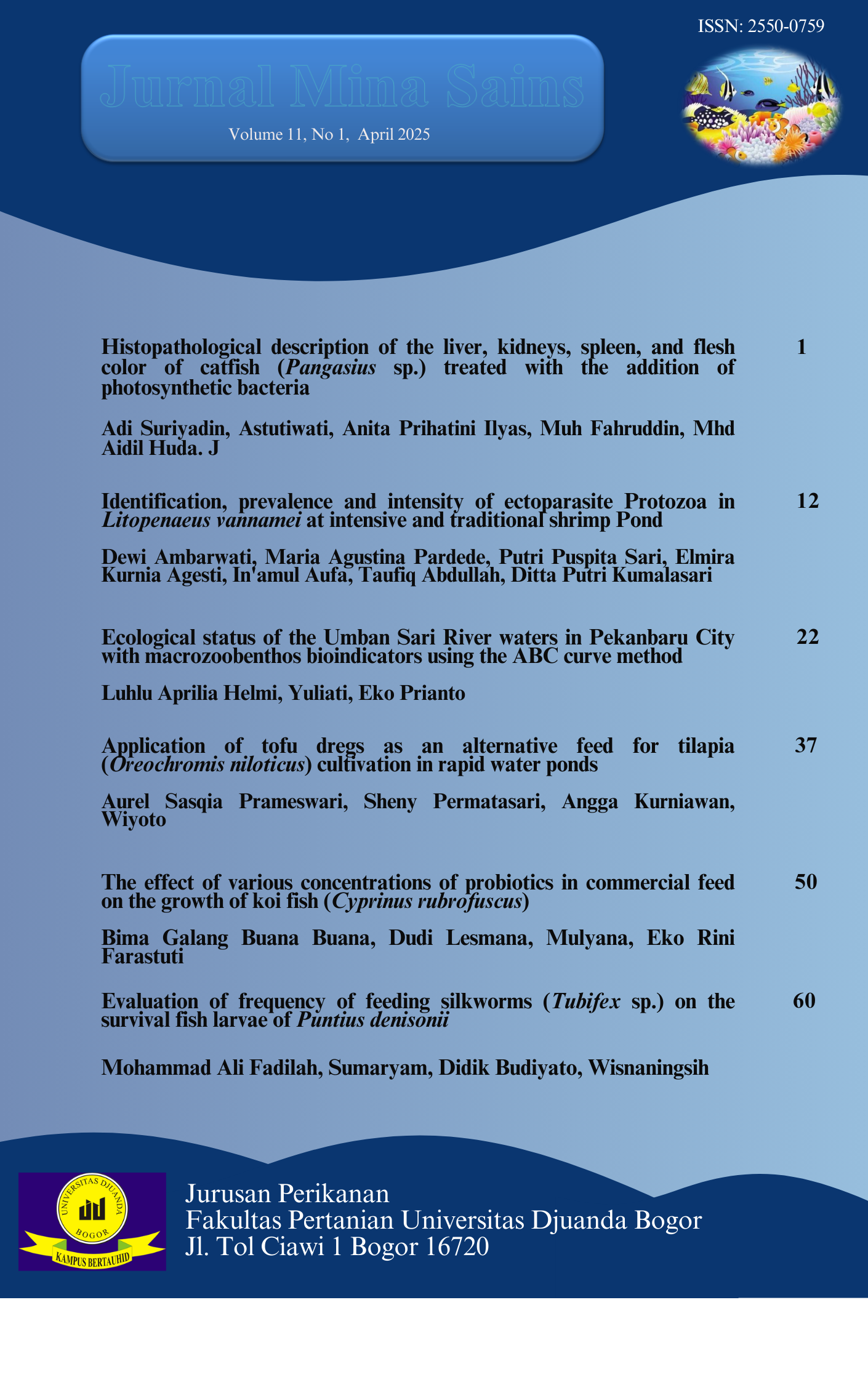
Evaluation of Frequency of Feeding Silkworms (Tubifex sp.) on the Survival Fish Larvae of Puntius denisonii
DOI:
https://doi.org/10.30997/jmss.v11i1.18898Keywords:
Feeding frequency, Puntius denisonii, Tubifex sp., survival rate, water qualityAbstract
Puntius denisonii is a highly valuable ornamental fish that is in great demand in the international trade market. However, overexploitation and habitat degradation have led to a decline. Cultivation efforts with an optimal feeding strategy are necessary to enhance the Survival and growth of this species in a controlled environment. This study aims to analyze the effect of different feeding frequencies of Tubifex sp. worms on the growth and survival rate of P. denisonii larvae and determine the optimal feeding frequency and timing. This research was conducted from January 20 to 29, 2025, at Bogorian Aquatics Farm, Bogor City, using a completely randomized design (CRD) with three feeding frequency treatments: three times per day (A), four times per day (B), and five times per day (C), with nine replications for each treatment. The observed parameters included survival rate and water quality. Data were analyzed using ANOVA at a 95% confidence level, followed by the Least Significant Difference test. The results showed that feeding frequency significantly affected the growth and survival rate of P. denisonii larvae but did not significantly affect water quality. Parameters of dissolved oxygen (5.35-5.37 mgL⁻¹), temperature (27.30-27.41°C), and pH (7.97-8.00) remained stable across all treatments. The treatment with a feeding frequency of five times per day yielded the best results in enhancing larval growth and Survival compared to other treatments. Increasing feeding frequency in P. denisonii aquaculture can improve survival rates without adversely affecting water quality if the aeration system is properly managed.
References
Alfonso, S., Mente, E., Fiocchi, E., Manfrin, A., Dimitroglou, A., Papaharisis, L., Barkas, D., Toomey, L., Boscarato, M., Losasso, C., Peruzzo, A., Stefani, A., Zupa, W., Spedicato, M. T., Nengas, I., Lembo, G., & Carbonara, P. (2023). Growth performance, gut microbiota composition, health and welfare of European sea bass (Dicentrarchus labrax) fed an environmentally and economically sustainable low marine protein diet in sea cages. Scientific Reports, 13(1), 21269. https://doi.org/10.1038/s41598-023-48533-3
Arifin, O. Z. (Otong), Subagja, J. (Jojo), & Hadie, W. (Wartono). (2015). Karakterisasi biometrik tiga populasi ikan semah tor Douronensis Valenciennes, 1842) dalam mendukung konservasi sumber daya genetik. Jurnal Iktiologi Indonesia, 15(2), 143–154. https://doi.org/10.32491/JII.V15I2.68
Asuwaju, F. P., Onyeche, V. O., Ogbuebunu, K. E., Moradun, H. F., & Robert, E. A. (2014). Effect of feeding frequency on growth and survival rate of Clarias gariepinus fingerlings reared in plastic bowls. Journal of Fisheries and Aquatic Science, 9(5), 425–429. https://doi.org/10.3923/jfas.2014.425.429
Azzaydi, M., Rubio, V. C., López, F. J. M., Sánchez-Vázquez, F. J., Zamora, S., & Madrid, J. A. (2007). Effect of restricted feeding schedule on seasonal shifting of daily demand-feeding pattern and food anticipatory activity in European sea bass (Dicentrarchus labrax L.). Chronobiology International, 24(5), 859–874. https://doi.org/10.1080/07420520701658399
Carraro, L., Toffolon, M., Rinaldo, A., & Bertuzzo, E. (2020). SESTET: A spatially explicit stream temperature model based on equilibrium temperature. Hydrological Processes, 34(2), 355–369. https://doi.org/10.1002/hyp.13591
Chatziantoniou, A., Charalampis Spondylidis, S., Stavrakidis-Zachou, O., Papandroulakis, N., & Topouzelis, K. (2022). Dissolved oxygen estimation in aquaculture sites using remote sensing and machine learning. Remote Sensing Applications: Society and Environment, 28, 100865. https://doi.org/10.1016/j.rsase.2022.100865
Conceição, L. E. C., Yúfera, M., Makridis, P., Morais, S., & Dinis, M. T. (2010). Live feeds for early stages of fish rearing. Aquaculture Research, 41(5), 613–640. https://doi.org/10.1111/j.1365-2109.2009.02242.x
Daudpota, A. M., Abbas, G., Kalhoro, I. B., Shah, S. S. A., Kalhoro, H., Hafeez-Ur-Rehman, M., & Ghaffar, A. (2016). Performance, feed utilization and body composition of juvenile Nile tilapia, Oreochromis niloticus (L.) reared in low salinity water. Pakistan Journal of Zoology, 48(1), 171–177.
de Sousa, O. M., de Oliveira, N. Y., Kuhnen, V. V., & Sanches, E. G. (2019). Feeding frequency for dusky grouper Epinephelus marginatus juveniles with automatic feeding system. Aquaculture Research, 50(10), 3009–3016. https://doi.org/10.1111/are.14259
Fatchurochman, V., Rachmawati, D., & Hutabarat, J. (2017). Pengaruh kombinasi pemberian enzim papain pada pakan buatan dan probiotik pada media pemeliharaan terhadap efisiensi pemanfaatan pakan, pertumbuhan dan kelulushidupan ikan bawal air tawar (Colossoma Macropomum). Journal of Aquaculture Management and Technology, 6(3), 30-39.
Febrianti, L., Sulmartiwi, L., & Dewi, N. N. (2023). Application of combination feed of fish viscera silage and fermented rice bran on biomass and population of silk worms (Tubifex tubifex). IOP Conference Series: Earth and Environmental Science, 1273(1), 012042. https://doi.org/10.a/1755-1315/1273/1/012042
Heriyati, E., Rustadi, R., Isnansetyo, A., Triyatmo, B., Istiqomah, I., Deendarlianto, D., & Budhijanto, W. (2022). Microbubble aeration in A Recirculating Aquaculture System (RAS) increased dissolved oxygen, fish culture performance, and stress resistance of red tilapia (Oreochromis sp.). Trends in Sciences, 19(20), 6251. https://doi.org/10.48048/tis.2022.6251
Jain, A. K., Mercy, T. V. A., & Jain, A. (2022). Issues on the inclusion of Puntius denisonii (Day), a freshwater ornamental fish of global value, as Schedule-I species under the Wild Life (Protection) Amendment Act, 2021 of India. Frontiers in Marine Science, 9, 944680. https://doi.org/10.3389/fmars.2022.944680
Jeong, J., Awosile, B., Thakur, K. K., Stryhn, H., Boyce, B., & Vanderstichel, R. (2023). Longitudinal dissolved oxygen patterns in Atlantic salmon aquaculture sites in British Columbia, Canada. Frontiers in Marine Science, 10, 1289375. https://doi.org/10.3389/fmars.2023.1289375
Jung, Y. G., Kang, M. S., & Lee, K. H. (2015). Impact analysis of radioactive contamination in aquaculture. Information (Japan), 18(4), 1391–1396.
Kotani, T., Yokota, M., Fushimi, H., & Watanabe, S. (2011). How to determine the appropriate mortality in experimental larval rearing? Fisheries Science, 77(2), 255–261. https://doi.org/10.1007/s12562-011-0329-8
Kuroski, F., Maltez, L. C., Menossi, O., Oliveira, T. P. A. P., Gamboa, B. J. Q., Okamoto, M. H., Rodrigues, R. V., & Sampaio, L. A. (2025). Influence of temperature on growth and oxidative status of juvenile Southern black drum (Pogonias courbina). Aquaculture Reports, 40, 102560. https://doi.org/10.1016/j.aqrep.2024.102560
Langlois, J., Guilhaumon, F., Baletaud, F., Casajus, N., De Almeida Braga, C., Fleuré, V., Kulbicki, M., Loiseau, N., Mouillot, D., Renoult, J. P., Stahl, A., Stuart Smith, R. D., Tribot, A. S., & Mouquet, N. (2022). The aesthetic value of reef fishes is globally mismatched to their conservation priorities. PLOS Biology, 20(6), e3001640. https://doi.org/10.1371/JOURNAL.PBIO.3001640
Malik, S. (2021). Effect of time-restricted feeding on 24-h rhythm in phototactic behavior of zebrafish. Biological Rhythm Research, 52(10), 1576–1588. https://doi.org/10.1080/09291016.2019.1669941
Syahputra, M. E., Rahmatia, F., & Gultom, V. D. N. (2019). Uji pemberian pakan alami berbeda (Tubifex sp., Artemia sp., Daphnia sp.) terhadap pertumbuhan dan kelangsungan hidup benih ikan mas koki mutiara (Carassius auratus). Jurnal Ilmiah Satya Minabahari, 5(1), 28-39.
Maulini, R., Sahlinal, D., & Arifin, O. (2021). Monitoring of pH, Ammonia (NH3) and temperature parameters aquaponic water in the 4.0 Revolution Era. IOP Conference Series: Earth and Environmental Science, 1012(1), 012087. https://doi.org/10.1088/1755-1315/1012/1/012087
Meyliana, & Widjaja, H. A. E. (2015). E-commerce implementation to support ornamental fish breeders in Indonesia. International Conference on Information Technology Systems and Innovation, ICITSI 2015 - Proceedings, 2015. https://doi.org/10.1109/ICITSI.2015.7437707
Munguti, J., Obiero, K., Odame, H., Kirimi, J., Kyule, D., Ani, J., & Liti, D. (2021). Key limitations of fish feeds, feed management practices, and opportunities in Kenya's Aquaculture Enterprise. African Journal of Food, Agriculture, Nutrition and Development, 21(2), 17415–17434. https://doi.org/10.18697/ajfand.97.20455
Nugroho, R. A., & Nur, F. M. (2018). Insect-based protein: Future promising protein source for fish cultured. IOP Conference Series: Earth and Environmental Science, 144(1), 012002. https://doi.org/10.1088/1755-1315/144/1/012002
Nurlaili, Hikmah, Wijaya, R. A., & Huda, H. M. (2021). Potential and problems of ornamental fish farming development in Depok City (case study: Neon tetra, cardinal and red nose ornamental fish farmer in Bojongsari District). IOP Conference Series: Earth and Environmental Science, 718(1), 012072. https://doi.org/10.1088/1755-1315/718/1/012072
Palupi, I. S., Syawal, & H., Aidil Huda, (2024). Pengaruh salinitas yang berbeda terhadap pertumbuhan benih ikan nila (Oreochromis niloticus). Jurnal Perikanan Terapan, 1(2), 27-38. http://jurnal.uts.ac.id/index.php/jupiter/article/view/4862
Raghavan, R., Prasad, G., Pereira, B., Ali, P. H. A., & Sujarittanonta, L. (2009). Damsel in distress- The tale of Miss Kerala, Puntius denisonii (Day), an endemic and endangered cyprinid of the Western Ghats biodiversity hotspot (South India). Aquatic Conservation: Marine and Freshwater Ecosystems, 19(1), 67-74. https://doi.org/10.1002/aqc.963
RRI. (2024). Ekspor Ikan Hias Indonesia. https://www.rri.co.id/nasional/1194988/ekspor-ikan-hias-indonesia-capai-rp624-miliar
Volkoff, H., & London, S. (2018). Nutrition and reproduction in fish. In Encyclopedia of Reproduction (pp. 743-748). Elsevier. https://doi.org/10.1016/B978-0-12-809633-8.20624-9
Xu, J., Du, Y., Su, G., Wang, H., Zhang, J., Tian, H., Zhou, L., Qiu, T., & Sun, J. (2023). Application of a U-Tube oxygenator in a Litopenaeus vannamei recirculating aquaculture system: efficiency and management models. Water (Switzerland), 15(22), 4019. https://doi.org/10.3390/w15224019
rp624-miliar
Volkoff, H., & London, S. (2018). Nutrition and reproduction in fish. In Encyclopedia of Reproduction (pp. 743-748). Elsevier. https://doi.org/10.1016/B978-0-12-809633-8.20624-9
Xu, J., Du, Y., Su, G., Wang, H., Zhang, J., Tian, H., Zhou, L., Qiu, T., & Sun, J. (2023). Application of a U-Tube oxygenator in a Litopenaeus vannamei recirculating aquaculture system: efficiency and management models. Water (Switzerland), 15(22), 4019. https://doi.org/10.3390/w15224019
Yeruva, T., Jayaram, H., Aurade, R., Shunmugam, M. M., Shinde, V. S., Baragi Venkatesharao, S. R., & Azhiyakathu, M. J. (2023). Profiling of nutrients and bioactive compounds in the pupae of silkworm, Bombyx mori. Food Chemistry Advances, 3, 100382. https://doi.org/10.1016/j.focha.2023.100382
Zakęś, Z., Demska-Zakęś, K., Jarocki, P., & Stawecki, K. (2006). The effect of feeding on oxygen consumption and ammonia excretion of juvenile tench Tinca tinca (L.) reared in a water recirculating system. Aquaculture International, 14(1), 127–140. https://doi.org/10.1007/s10499-005-9019-9
Downloads
Published
How to Cite
Issue
Section
License
Copyright (c) 2025 JURNAL MINA SAINS

This work is licensed under a Creative Commons Attribution-ShareAlike 4.0 International License.
With the receipt of the article by the Jurnal Mina Sains Universitas Djuanda Editorial Board and the decision to be published, then the copyright regarding the article will be diverted to Jurnal Mina Sains Universitas Djuanda.
Department of Fisheries Djuanda University holds the copyright regarding all the published articles in this journal.
Department of Fisheries Faculty of Agriculture, Universitas Djuanda has the right to multiply and distribute the article. Thanks to the Fisheries Department and Agriculture Faculty Universitas Djuanda that funded this journal sustainability.
The manuscript's authentic and copyright statement submission can be downloaded on this form.