
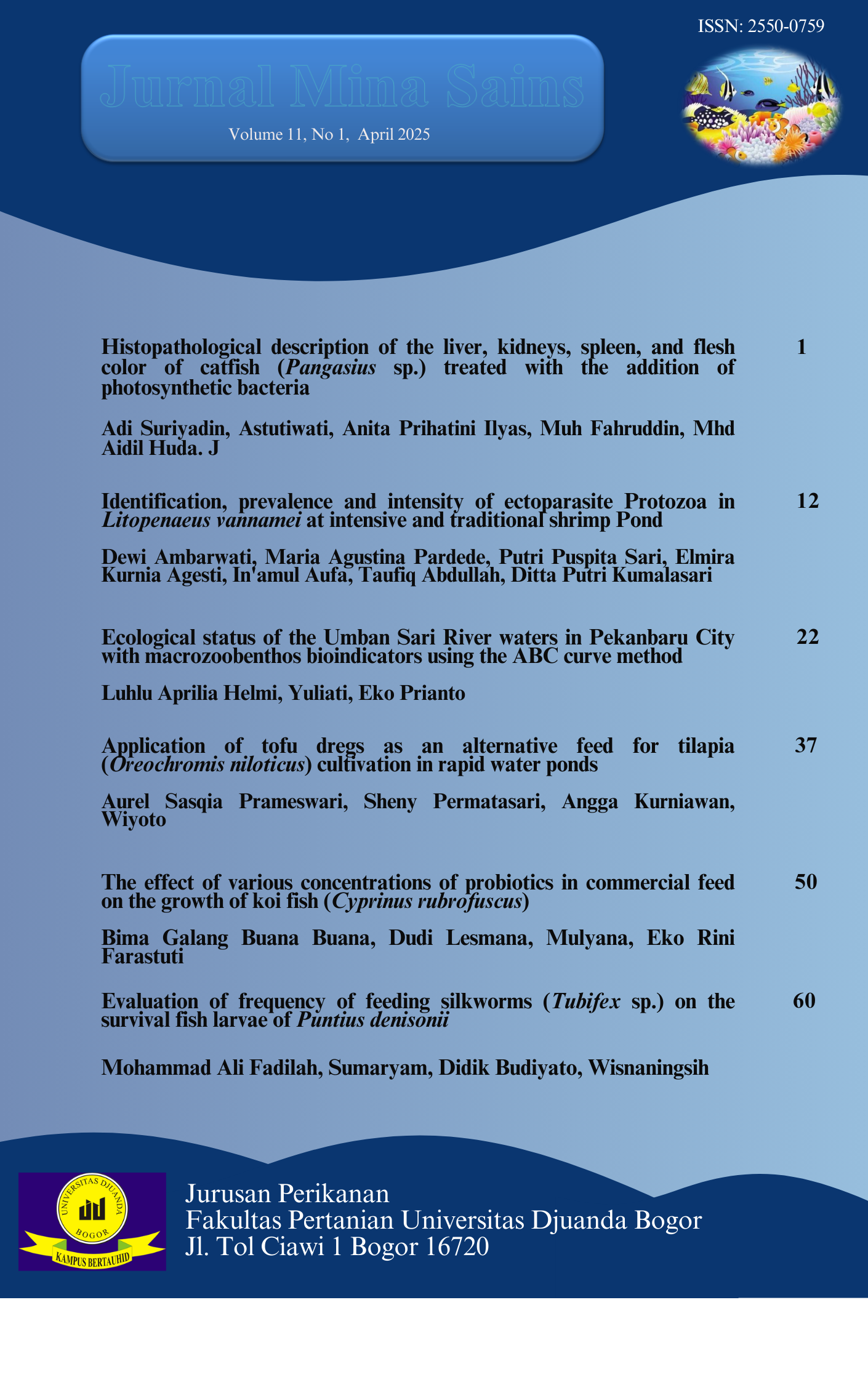
Identification, Prevalence and Intensity of Ectoparasite Protozoa in Litopenaeus vannamei at Intensive and Traditional Shrimp Pond
DOI:
https://doi.org/10.30997/jmss.v11i1.17413Keywords:
ectoparasite, Litopenaeus vannamei, protozoa, prevalence, Vorticella sp.Abstract
This study investigated the prevalence, diversity, and intensity of ectoparasitic protozoa infecting Litopenaeus vannamei in traditional and intensive shrimp ponds. A total of 25 shrimp from each pond type were examined for the presence of ectoparasitic protozoa. Four parasite species were identified in traditional ponds: Zoothamnium sp., Epistylis sp., Vorticella sp., and Trichodina sp. In contrast, three species (Zoothamnium sp., Epistylis sp., and Vorticella sp.) were found in intensive ponds, with Trichodina sp. absent in the latter. The prevalence of ectoparasitic protozoa was higher in intensive ponds, with 44% of shrimp infected, compared to 8% in traditional ponds. The intensity of infection was also higher in intensive ponds, with an average intensity of 10.27, categorized as medium, compared to an intensity of 5.2 in traditional ponds, categorized as low. These findings suggest that intensive farming conditions may contribute to increased susceptibility to ectoparasitic infections in shrimp. The study emphasizes the importance of monitoring and managing parasite infestations to reduce health risks in shrimp aquaculture systems.
References
Abd El-Lateif, R. S., Torra, D. E., & El Sherry, Y. M. (2023). Infestation of external ciliated protozoan in red swamp crayfish (Procambarus clarkii). Journal of Advanced Veterinary Research, 13(2): 197-206.
Abibulaeva, A. S., & Dovgal, I. V. (2021). The First Finding of Sessile Ciliates Vorticella pyriforme Stiller, 1939 and Zoothamnium sinense Song, 1991 (Ciliophora, Peritrichia) in the Black Sea. Ecologica Montenegrina, 43: 69-75. DOI: https://doi.org/10.37828/em.2021.43.10
Al Musaedi, A. I., & Alsaady, H. A. M. (2022). Parasitic intensity, multiplication, movement, and size play role in pathogenesis. Journal of Global Scientific Research, 7(10): 2696-2700. DOI: 10.5281/zenodo.7142909
Apriyadi, A. F., Mahasri, G., & Sulmartiwi, L. (2023, December). Stress level of vaname shrimp (Litopenaeus Vannamei) with infested ciliata pathogens after open wet transportation. In IOP Conference. Series: Earth and Environmental Science 1273 (1): 012003. IOP Publishing.
Bintang, A., Muhar, N., Amri, M., & Eriza, M. (2022). Prevalence and intensity of vaname shrimp (Litopenaeus Vannamei) ectoparasites in shrimp ponds in Nagari Tiku, Tanjung Mutiara District, Agam Regency.
Decamp, O., Conquest, L., Cody, J., Forster, I., & Tacon, A. G. (2007). Effect of shrimp stocking density on size‐fractionated phytoplankton and ecological groups of ciliated protozoa within zero‐water exchange shrimp culture systems. Journal of the World Aquaculture Society, 38(3): 395-406. DOI: 10.1111/j.1749-7345.2007.00111.x
Frischer, M. E., Lee, R. F., Price, A. R., Walters, T. L., Bassette, M. A., Verdiyev, R., & Landers, S. C. (2017). Causes, diagnostics, and distribution of an ongoing penaeid shrimp black gill epidemic in the US South Atlantic Bight. Journal of Shellfish Research, 36(2): 487-500. https://doi.org/10.2983/035.036.0220
Gibson, D.I and A. Jones, A. and Bray, R.A., 2002. Keys to the Trematoda. Volume 1 – CABI, 382.
Giorgetti, G., 1989, February. Disease problems in farmed penaeids in Italy. in Advances in Tropical Aquaculture, Workshop at Tahiti, French Polynesia, 20 Feb-4 Mar 1989.
Grabda, J. 1991. Marine Fish Parasitology. New York: An outline. Polish Scientific Publisher, 306.
Hamdillah, A., Yunus, M., Harlina, H., Ilmiah, I., & Irawan, T. (2023). Prevalence and intensity of ectoparasites in vaname shrimp (Litopenaeus vannamei) from Pond, Bulukumba Regency. International Journal of Multidisciplinary Research and Growth Evaluation, 4 (1): 535-538.
Hafidloh, U., & Sari, P. D. W. (2019, February). Protozoan parasites of Vannamei Shrimp (Litopenaeus vannamei) in farmed fish from Pasuruan, Indonesia. IOP Conference Series: Earth and Environmental Science. 236 (1). 012091. IOP Publishing. https://doi.org/10.1088/1755-1315/236/1/012091
Hendri, S., Santoso, B., & Wulandari, A. (2021). Fungal diseases in Koi: Prevention and Control. Journal of Fish Health, 19(1): 23-30
Kakoolaki, S., & Afsharnasab, M. (2016). Prevalence and intensity of protozoan ectoparasite of the white-leg shrimp (Penaeus indicus) in Helleh site, South of Iran. Sustainable Aquaculture and Health Management Journal, 2(1): 17-23. Doi: 10.18869/acadpub.ijaah.2.1.17
Kakoolaki, S. A, Sepahdari, & M, Mehrabi. (2017). Feasibility study providing a software model to predict incidence of white spot syndrome virus in shrimp ponds contributed with physical and chemical factors in Iran. Iranian Journal of Aquatic Animal Health, 3(2): 110–17. DOI: 10.29252/ijaah.3.2.110
Liang, Z., Shen, Z., Zhang, Y., Ji, D., Li, J., Warren, A., & Lin, X. (2019). Morphology and phylogeny of four new Vorticella species (Ciliophora: Peritrichia) from coastal waters of Southern China. Journal of Eukaryotic Microbiology, 66(2): 267-280.https://doi.org/10.1111/jeu.12668
Li, Y., Cao, S., Jiang, S., Huang, J., Yang, Q., Jiang, S., and Zhou, F. (2024). Comparative study of nutritional composition, physiological indicators, and genetic diversity in Litopenaeus vannamei from different aquaculture populations. Biology, 13(9): 722. https://doi.org/10.3390/biology13090722
Li, X., Chen, J., Wang, H., & Zhang, Y. (2019). Ecological characteristics and impacts of vorticella species in aquaculture systems. Journal of Aquatic Animal Health, 31(3): 245–254.doi: 10.1016/j.ijppaw.2018.10.002
Mahasri, G., & Heryamin, A. (2016). Prevalensi ektoparasit pada udang vaname (Litopenaeus vannamei) dengan padat tebar yang berbeda di tempat penggelondongan di Kabupaten Gresik. Journal of Aquaculture and Fish Health, 5(2), 7-13. https://doi.org/10.20473/jafh.v5i2.11322
Mahasri, G., Kusdarwati, R. & Gustrifandi, H. (2018). Effectivity of immunostimulant from Zoothamnium penaei protein membrane for decreasing the mortality rate of white shrimp (Litopenaeus vannamei) in traditional plus pond. Earth and Environmental Science, 137(1): 1-11. doi :10.1088/1755-1315/137/1/012020
Margolis, L., and Kabata, Z., 1989. Guide to the parasites of fishes of Canada Part III. Can. Spec. Publ. Fish. Aquat. Sci, 95
Marista, M. and Mahasri, G. (2023). Stress response and oxygen consumption level of vaname shrimp (Litopenaeus vannamei) infested by Ciliata pathogens on a culture system with high stocking densities. In IOP Conference Series: Earth and Environmental Science 012012. DOI 10.1088/1755-1315/1273/1/012012
Maimunah, Y., & Kilawati, Y. (2015). Kualitas lingkungan tambak insentif Litapenaeus Vannamei dalam kaitannya dengan prevalensi penyakit white spot syndrome virus. Research Journal of Life Science, 2(1), 50-59. DOI: 10.21776/ub.rjls.2015.002.01.7
Mishra, S. S., Das, R., Choudhary, P., Debburma, J., Sahoo, S.N., Giri, B.S., Rathod, R., Kumar, A., Mishra, C.K., & Swain P. (2017). Present status of fisheries and impact of emerging disease of fish and shellfish in indian aquaculture. Journal of Aquatic Research and Marine Science, 1 (1): 5-26. DOI:10.29199/arms.101011
Mukti, A. T. (2020). Ectoparasite infestation and survival rate of pacific white shrimp (litopenaeus vannamei) that are immunized with crude protein Zoothamnium penaei in intensive ponds. The 1st International Conference on Biotechnology and Food Sciences, 679: 1-6. doi:10.1088/1755-1315/679/1/012019
Muttaqin, I., Julyantoro, P. G. S., & Sari, A. H. W. (2018). Identification and prediction of ectoparasites mangrove crab (Scylla spp.) from the ecosystem mangrove of the Great Forest Park (Tahura) Ngurah Rai, Bali. Current Trends in Aquatic Science, 1(1): 24-31.
Nur, B.A. and Munir, M., 2022. Identifikasi dan tingkat serangan ektoparasit pada budidaya udang vannamei (Litopenaeus vannamei) Secara intensif di tambak unit III UPT BAPL Bangil Pasuruan. Sains dan Matematika, 7(2), pp.58-62.
Nurlatiffah, N., & Ulkhaq, M. F. (2019, February). The prevalence and intensity of ectoparasites infecting vanname shrimp (Litopenaeus vannamei) reared in different ponds. IOP Conference Series: Earth and Environmental Science, 236(1). DOI 10.1088/1755-1315/236/1/012090
Pamenang, G. D., Sulmartiwi, L., Mahasri, G., Rahayu, N. D., & Angwarmas, B. (2020). Inventory of ectoparasites in Pacific white shrimp (Litopenaeus vannamei) that are cultivated with high density. IOP Conference Series: Earth and Environmental Science, 441(1) 012077. doi:10.1088/1755-1315/441/1/012077
Puspitasari, S. D., & Sari, P. D. (2020). Ectoparasites of mangrove crabs (Scylla serrata) and white shrimps (Litopenaeus vannamei) from Gresik, Indonesia. Journal of Veterinary Parasitology, 34(1): 32-36. https://doi.org/10.5958/0974-0813.2020.00006.6
Rahayuni, S., Al Fajar, B. and Wibowo, S.G., 2022. Identifikasi dan Prevalensi Ektoparasit Protozoa Pada Udang vannamei (Litopenaeus vanamei) di Tambak Intensif Kuala Langsa. Jurnal Kelautan dan Perikanan Indonesia, 2(2):, pp.80-85. http://dx.doi.org/10.24815/jkpi.v2i2.26449
Rahman, M. M., Hossain, M. I., & Khan, S. M. (2021). The Role of Trichodina species in Aquaculture: Morphology, Pathogenicity, and Control Strategies. Aquaculture Research, 52(4): 1884–1892.
Rosnizar, R., Fitria, F., Devira, C.N. & Nasir, M., 2018. Identifikasi dan prevalensi jenis-jenis ektoparasit pada udang windu (Penaeus monodon) berdasarkan tempat pemeliharaan. Jurnal Bioleuser, 2(1).
Sarjito, S., Haditomo, A. H. C., Desrina, D., Ferinandika, F. B., Setyaningsih, L., and Prayitno, S. B. (2016). Ectoparasites and vibrios associated with fattening cultured mud crabs (Scylla serrata) (Forsskal, 1775) from Pemalang Coast, Indonesia. Jurnal Teknologi, 78: 4-2. https://doi.org/10.11113/jt.v78.8209
Ummah, Y. L., Mahasri, G., & Sulmartiwi, L. (2024). Intensity and Ectoparasites in Vaname Shrimp (Litopenaeus vannamei) Cultivated in Intensive Ponds. Journal of Aquaculture Science, 9(1): 7-13
Valladao, G. M. R., Alves, L. D. O., and Pilarski, F. (2016). Trichodiniasis in Nile tilapia Hatcheries: Diagnosis, Parasite: Host-Stage Relationship and Treatment. Aquaculture, 451, 444-450. https://doi.org/10.1016/j.aquaculture.2015.09.030
Wahyudi, A. F., Haryadi, J., & Rosdiana, A. (2019, April). Analisis daya saing udang indonesia di pasar ekspor. Agribusiness Forum, 9(1):1-16
Xinlu, S., Xinlu, S., Qingjuan, M., Qingjuan, M., Guijie, L., Guilan, Q., Chuanqi, J., Xiangwei, M., Alan, W. (2014). Morphology and morphogenesis of Epistylis plicatilis Ehrenberg, 1831 (Ciliophora, Peritrichia) from Wuhan, China. Journal of Morphology, doi: 10.1002/JMOR.20265.
Downloads
Published
How to Cite
Issue
Section
License
Copyright (c) 2025 JURNAL MINA SAINS

This work is licensed under a Creative Commons Attribution-ShareAlike 4.0 International License.
With the receipt of the article by the Jurnal Mina Sains Universitas Djuanda Editorial Board and the decision to be published, then the copyright regarding the article will be diverted to Jurnal Mina Sains Universitas Djuanda.
Department of Fisheries Djuanda University holds the copyright regarding all the published articles in this journal.
Department of Fisheries Faculty of Agriculture, Universitas Djuanda has the right to multiply and distribute the article. Thanks to the Fisheries Department and Agriculture Faculty Universitas Djuanda that funded this journal sustainability.
The manuscript's authentic and copyright statement submission can be downloaded on this form.