
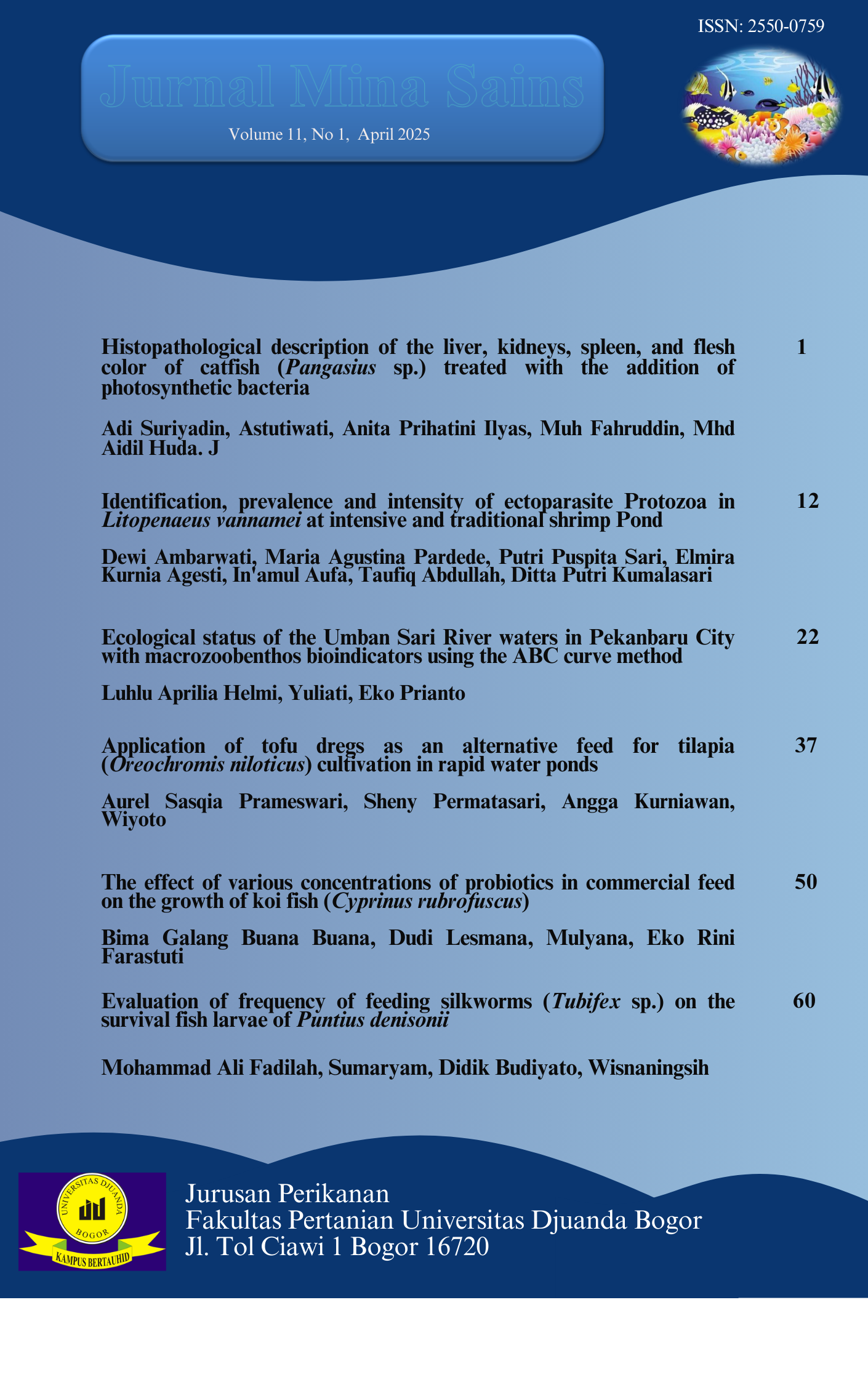
Ecological status of the Umban Sari River waters in Pekanbaru City with macrozoobenthos bioindicators using the ABC curve method
DOI:
https://doi.org/10.30997/jmss.v11i1.15846Keywords:
ABC curve, abundance, biomass, macrozoobenthos, SchistosomaAbstract
Rivers are surface water flows from upstream to downstream estuaries. The Umban Sari River is a tributary that flows into the Siak River. The activities along the river provide ecological pressure that continues to accumulate downstream. This study was conducted in March-May 2024 using macrobenthos as bioindicators of pollution. The purpose of this study was to determine the abundance, diversity, uniformity, dominance, biomass and ecological status of the Umban Sari River waters based on the ABC (Abundance and Biomass Comparison) macrobenthos curve method. This research uses a survey method by determining sampling stations using purposive sampling consisting of three stations. Macrozoobenthos sampling was carried out 3 times with an interval of once a month (30 Day interval). The results showed that the found 8 macrozoobenthic species consisting of Pila ampullacea, Pomacea canaliculate, Lymnaea rubiginosa, Bellamya sumatrensis, Gyraulus convexiusculus, Indoplanorbis exestus, Melanoides pantherine and Schistosoma sp. The highest abundance of macrozoobenthos was found at station I upstream of the river with an average of 3,685 ind/m2 and the lowest was found at station III downstream of the river with an average of 2,148 ind/m2. The diversity and uniformity of the macrozoobenthos is in the medium category, there are no species that dominate. The highest macrozoobenthic biomass was found at station I upstream of the river with an average of 2,643 gr/m2 and the lowest was found at station III downstream with an average of 2,199 gr/m2. The K-Dominant Hypothesis of the ABC curve in the Umban Sari River is included in the category and condition of an undisturbed and unpolluted ecosystem. However, the dominance of the relative biomass (BR) line was found to be only slightly above the relative abundance (KR) line and was close to overlapping, this indicates that the ecosystem condition is starting to become polluted.
References
Alhadad, I., Tanjung A., & Zulkifli, (2024). Macrozoobenthos Community Structure in the Intertidal Zone of Muara Air Haji Village, Pesisir Selatan Regency, West Sumatera Province. Asian Journal of Aquatic Sciences, 7(1): 124-132.
Aritonang, C. E., Budijono, & Fauzi M. (2024). Kandungan Mikroplastik pada Air dan Sedimen di Anak-anak Sungai Siak Kota Pekanbaru, Provinsi Riau. Jurnal Fisika Unand (JFU), 13(3): 329-335. http://dx.doi.org/10.25077/jfu.13.3.329-335.2024
Efendi, M., Nedi S., & Siiregar Y. I. (2020). Kandungan Bahan Organik di Dalam Air dan Sedimen di Kabupaten Pulau Halang Muka Rokan Hilir Provinsi Riau. Asian Journal of Aquatic Sciences, 3(3): 202-208.
Muharisa, Adriman, & El Fajri N. (2015). Water Quality of the Sail River, Pekanbaru Based on Type and Population of Macrozoobenthos. Jurnal Online Mahasiswa (JOM) Bidang Perikanan dan Ilmu Kelautan, 2(2): 1-12.
Oriza, S., Tanjung A., & Elizal. (2023). Struktur Komunitas Gastropod di Zona Intertidal Pulau Pasumpahan Kota Padang Provinsi Sumatera Barat. Asian Journal of Aquatic Sciences, 6(1): 41-49.
Pasaribu, R. H., Eddiwan, & Putra R. M. (2020). Identifikasi Jenis Ikan di Perairan Sungai Umban Sari Kecamatan Rumbai Provinsi Riau. Jurnal Sumberdaya dan Lingkungan Akuatik, 1(2): 131-132.
Pranata, E., Rifardi, & Galib M. (2019). Distribusi Bahan Organik pada Sedimen di Kawasan Perairan Muara Sungai Masjid Stasiun Kelautan Purnama Kota Dumai Provinsi Riau. Jurnal Online Mahasiswa (JOM) Bidang Perikanan dan Ilmu Kelautan, 6(2): 1-9.
Putri, V. T., Yudha I. G., Kartini N., & Damai A. A. (2021). Keragaan Makrozoobentos Sebagai Bioindikator Kualitas Air di Bagian Hilir Sungai Hurun Lampung. Journal of Aquatropica Asia, 6(2): 72-82.
Putro, S. P. (2016). Konsep Aplikasi Budidaya Sistem Polikultur Terintegrasi Biomonitoring Menuju Akuakultur Produktif Berkelanjutan. Yogyakarta. Plantaxia.
Sosiawan, T. G., Setia T. M., & Sakdullah. (2022). Ekosistem Lamun dan Makrozoobenthos di Taman Nasional Kepulauan Seribu. Jurnal TECHNO-FISH, 6(2): 109-132. https://doi.org/10.25139/tf.v6i2.5039
Sumiarsih, E., El Fajri N., Adriman, Teda S., & Rahmi M. R. (2018). Komunitas Makrozoobenthos Sebagai Bioindikator Pencemaran di Perairan Sungai Siak, Pekanbaru. Asian Journal of Environment, History and Heritage, 2(1): 19-28.
Warwick, R. (1986). A new method for detecting pollution effects on marine macrobenthic communities. Marine biology, 92(4), 557-562.
Yasir, M., Haerudduin, & Suryanto A. (2015). Status Pencemaran Sungai Wakak Kendal Ditinjau Dari Aspek Total Padatan Tersuspensi dan Struktur Komunitas Makrozoobentos. Diponegoro Journal of Maquares, 4(2): 112-122. https://doi.org/10.14710/marj.v4i2.8535
Yusnita, Efizon D., & Windarti. (2017). Identifikasi Ikan di Hilir Sungai Umban Sari Pekanbaru. Jurnal Online Mahasiswa (JOM) Bidang Perikanan dan Ilmu Kelautan, 4(2): 1-13.
Zakiawati, D., Norma A., & Pujiono W. P. (2021). Makrozoobentos Sebagai Indikator Status Pencemaran Antar Musim di Anak Sungai Bogowonto, Yogyakarta. Jurnal Pasir Laut, 5(1): 17-25
Downloads
Published
How to Cite
Issue
Section
License
Copyright (c) 2025 JURNAL MINA SAINS

This work is licensed under a Creative Commons Attribution-ShareAlike 4.0 International License.
With the receipt of the article by the Jurnal Mina Sains Universitas Djuanda Editorial Board and the decision to be published, then the copyright regarding the article will be diverted to Jurnal Mina Sains Universitas Djuanda.
Department of Fisheries Djuanda University holds the copyright regarding all the published articles in this journal.
Department of Fisheries Faculty of Agriculture, Universitas Djuanda has the right to multiply and distribute the article. Thanks to the Fisheries Department and Agriculture Faculty Universitas Djuanda that funded this journal sustainability.
The manuscript's authentic and copyright statement submission can be downloaded on this form.