
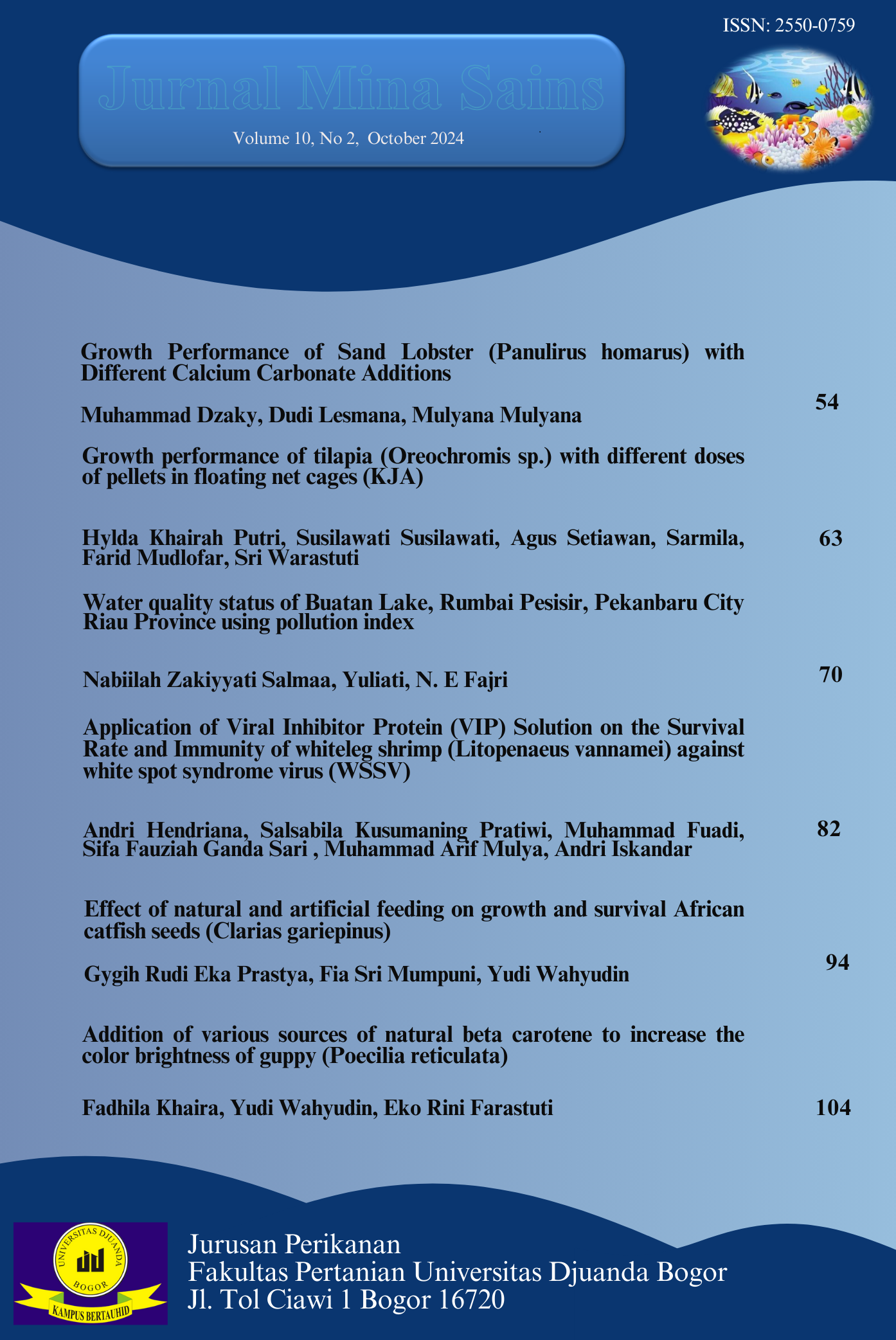
Application of Viral Inhibitor Protein (VIP) Solution on the Survival Rate and Immunity of whiteleg shrimp (Litopenaeus vannamei) against white spot syndrome virus (WSSV)
DOI:
https://doi.org/10.30997/jmss.v10i2.15142Keywords:
Survival rate, Litopenaeus vannamei, Viral Inhibitor Protein, production, White Spot Syndrome VirusAbstract
Farmers frequently face a collapse in white-leg shrimp (Litopenaeus vannamei) production due to disease infection. White spot disease, which was spread by the white spot syndrome virus (WSSV) in Indonesia, is one of the disease outbreaks. Extensive research has been done, including providing immunostimulants to prevent the WSSV outbreak. The application of recombinant viral inhibitor protein (VIP solution) developed by Aquaculture Technology and Development PT Suri Tani Pemuka, Purwakarta, is an innovation to prevent the WSSV outbreak. This study aims to evaluate the administration of VIP solutions to avoid the WSSV outbreak. The treatment consists of control feed (PBS without VIP solution supplementation) and feeds supplemented by VIP solution at 2 mL kg-1 and 5 mL kg-1. The feeding trial used post-larvae shrimp stage 25 (PL25). All the treated shrimp were challenged with WSSV, while positive control shrimp were not given VIP solution feed and were challenged with WSSV. The parameters observed included survival rate (SR), phenoloxidase activity (PO), lysozyme activity, and water quality (temperature, pH, and DO). The results showed that the shrimp-fed VIP solution experienced a significant increase in SR and immune response in the challenge test with WSSV (p <0.05). Supplementing 2 mL kg-1 VIP solution showed higher phenoloxidase activity (p <0.05) and increased SR by 82.50 ± 2.29%. The administration of 2 mL kg-1 VIP Solution for whiteleg shrimp can improve the survival rate and immunity after being challenged with WSSV.
References
Abdurrahman, A. (2022). Produksi dan evaluasi pemberian rekombinan Viral Inhibitor Protein terhadap resistansi udang vaname pascainfeksi virus WSSV. [Tesis]. Seklah Pascasarjana IPB University. Bogor. https://repository.ipb.ac.id/handle/123456789/115172.
Amparyup, P., Charoensapsri, W., Tassanakajon, A. (2013). Prophenoloxidase system and its role in shrimp immune responses against major pathogens. Fish & Shellfish Immunology. 34(4): 990–1001. DOI: 10.1016/j.fsi.2012.08.019
Arafani, L., Ghazali, M., Ali, M. (2016). Pelacakan virus bercak putih pada udang vaname (Litopenaeus vannamei) di Lombok dengan real-time Polymerase Chain Reaction. Jurnal Veteriner. 17(1): 88–95. Cerenius L, Söderhäll K. 2021. Immune properties of invertebrate phenoloxidases. Developmental & Comparative Immunology. 122(2021): 104098. DOI: 10.19087/jveteriner.2016.17.1.88
Cerenius, L, & Söderhäll, K. (2004). The prophenoloxidase-activating system in invertebrates. Immunological reviews. 198: 116–126. DOI: 10.1111/j.0105-2896.2004.00116.x
Chen, I. T., Aoki, T., Huang, Y. T., Hirono, I., Chen, T. C., Huang, J.Y., Chang, G.D., Lo, C. F, & Wang, H. C. (2011). White spot syndrome virus induces metabolic changes resembling the Warburg effect in shrimp hemocytes in the early stage of infection. Journal Virology. 85(24):12919–12928. DOI: 10.1128/JVI.05385-11
Creighton TE. 1993. Proteins: Structures and Molecular Properties. New York: W.H. Freeman and Company.
Ellis, A.E. (1990) Lysozyme Assays. In: Stolen, J.S., Fletcher, T.C., Anderson, D.P., Roberson, B.S. and Van Muiswinkel, W.B., Eds., Techniques in Fish Immunology, SOS Publications, Fair Haven, 101-103.
Fauziah, S. R. (2022). Aplikasi rekombinan viral inhibitor protein melalui pakan buatan pada udang vaname dengan waktu berbeda setelah infeksi WSSV. [Skripsi]. IPB University. Bogor. Dikutip dari https://repository.ipb.ac.id/handle/123456789/114569
Febrianti, D., Sukenda, & Nuryati, S. ()2013. Kappa-Karagenan sebagai imunostimulan untuk pengendalan penyakit infectious myonecrosis (IMNV) pada udang vaname Litopenaeus vannamei. Jurnal Akuakultur Indonesia. 12(1): 70–78.
Feriza, D. (2010). Prospek pemberian imunoglobulin Y (IgY) secara peroral pada udang putih (Litopenaeus vannamei) sebagai imunisasi pasif penyakit white spot syndrome virus (WSSV). [Tesis]. IPB University. Bogor. Dikutip dari https://repository.ipb.ac.id/handle/123456789/56447
Gajula, M. P, Soni, G., Babu, G., Rai, A., & (2013). Molecular interaction studies of shrimp antiviral protein, PmAV with WSSV ring finger domain in silico. Journal of Applied Bioinformatics & Computational Biology. 2(1): 1–5. DOI: 10.4172/2329-9533.1000103
Hirai, M., Ajito, S., Sugiyama, M., Iwase, H., Takata, S., Shimizu, N., Igarashi N, Martel, A., & Porcar, L. (2018). Direct evidence for the effect of glycerol on protein hydration and thermal structural transition. Biophysical Journal. 115(2): 313–327. DOI: 10.1016/j.bpj.2018.06.005
Huang, H., Pan, L., Pan, S. et al. (2018). The feasibility of using primary shrimp hemocyte culture to screen herbal immunostimulants. Aquacult Int 26, 799–811 https://doi.org/10.1007/s10499-018-0238-2
Huang, J., Yang, Y., & Wang, A. (2009). Reconsideration of phenoloxidase activity determination in white shrimp Litopenaeus vannamei. Fish & Shellfish Immunology, 28(1), 240-244. https://doi.org/10.1016/j.fsi.2009.10.010
Jeswin, J., Anju, A., Thomas, P., Paulton, M., & Vijayan, K. (2013). Survivability of Penaeus monodon during white spot syndrome virus infection and its correlation with immune related genes. Aquaculture, 380-383, 84-90. https://doi.org/10.1016/j.aquaculture.2012.12.004
Johnny, F., Zafran, & Rosa, D. (2008). Pemisahan bahan aktif imunostimulan dari dinding sel bakteri Vibrio harveyi dan uji efektivitasnya pada benih ikan kerapu bebek, Cromileptes altivelis. Jurnal Riset Akuakultur. 3(1): 19–26.
Kopec, A. M., Rivera, P. D., Lacagnina, M. J., Hanamsagar, R., & Bilbo, S. D. (2017). Optimized solubilization of TRIzol-precipitated protein permits Western blotting analysis to maximize data available from brain tissue. Journal of Neuroscience Methods, 280, 64-76. https://doi.org/10.1016/j.jneumeth.2017.02.002
Lachman, L., Lieberman, H. A, Kanig, J. L. (). Teori dan Praktek Farmasi Industri (Edisi 3). Universitas Indonesia Press. Jakarta.
Laemmli, U. (1970). Cleavage of structural proteins during the assembly of the head of bacteriophage T4. Nature. 227(5259): 680–685.
Lightner, D. V. (2011). Virus diseases of farmed shrimp in the Western Hemisphere (the America): a review. Journal of Invertebrate Pathology. 106(1): 110–130.
Liu, C., & Chen, J. (2004). Effect of ammonia on the immune response of white shrimpLitopenaeus vannamei and its susceptibility to Vibrio alginolyticus. Fish & Shellfish Immunology, 16(3), 321-334. https://doi.org/10.1016/S1050-4648(03)00113-X
Lu-Qing, Fang-bo P, Ling-Xu J, Jing L. (2007). The effect of temperature on selected immune parameters of white shrimp, Litopenaeus vannamei. Journal of the World Aquaculture Society. 38(2): 326–332.
Mahardika, K., Zafran, & Koesharyani, I. (2004). Deteksi White Spot Syndrome Virus (WSSV) pada udang windu (Penaeus monodon) menggunakan metode Polymerase Chain Reaction (PCR). Jurnal Penelitian Perikanan Indonesia. 10(1): 55–60.
Muliani, Tampangallo, B. R, & Atmomarsono M. (2013). Penggunaan kombinasi suhu, ph, dan salinitas sebagai stressor terhadap perkembangan white spot syndrome virus (wssv) pada benur udang windu (Penaeus monodon) dalam Taufiqurrahman M, Winarno A, Hardianto D, editor. Prosiding Forum Inovasi Teknologi Akuakultur; 2011; Sulawesi Selatan, Indonesia. Sulawesi Selatan; FITA. 1(1): 853-861.
Nakano, H., Hiraoka, M., Sameshima, M (1998). Inactivation of penaeid rod-shaped DNA virus (PRDV), the causative agent of penaeid acute viraemia (PAV), by chemical and physical treatments. Fish Pathology. 33(2):65–71. https://doi.org/10.3147/jsfp.33.65
Nurbariah, K. (2015). Virulensi white spot syndrome virus (WSSV) pada udang pisang Penaeus sp..Prosiding Seminar Nasional Biotik. 3(1).
Permen KKP. Peraturan Menteri Kelautan dan Perikanan Republik Indonesia. 2016. Pedoman umun pembesaran udang windu (Penaeus monodon) dan udang vaname (Litopenaeus vannamei). 75.
Saputra, A., Budiardi, T., & Supriyono, E. (2016). Kinerja produksi ikan sidat Anguilla bicolor bicolor dengan pemberian kalsium karbonat. Jurnal Akuakultur. 15(1): 56-62.
Satheesh Kumar, S., Ananda Bharathi, R., Rajan, J., Alavandi, S., Poornima, M., Balasubramanian, C., & Ponniah, A. (2013). Viability of white spot syndrome virus (WSSV) in sediment during sun-drying (drainable pond) and under non-drainable pond conditions indicated by infectivity to shrimp. Aquaculture, 402-403, 119-126. https://doi.org/10.1016/j.aquaculture.2013.04.001
Saulnier, D., Haffiner, P., Goarant, C., Levy P, & Ansquer, D. (2000). Experimental infection models of Penaeus monodon. Diseases Aquatic Organisms. 79(3): 191–198.
Selvam, D. G, Mujeeb, R. K. M, & Mohamed A.A.H. (2012). An Investigation into occasional white spot syndrome virus outbreak in traditional paddy cum prawn fields in India. The Scientific World Journal. 2012: 1–11. DOI: 10.1100/2012/340830
Sinthujaroen, P., Tonganunt-Srithaworn, M., Eurwilaichitr, L., & Phongdara, A. (2015). Protection of Litopenaeus vannamei against the white spot syndrome virus using recombinant Pm-fortilin expressed in Pichia pastoris. Aquaculture. 435: 450–457.
Suherman, B., Latif, M., & Dewi, S. (2018). Potensi antimikroba kitosan kulit udang vaname (Litopenaeus vannamei) sebagai antibakteri terhadap Staphylococcus epidermidis, Pseudomonas aeruginosa, Propionibacterium agnes, dan Escherichia coli dengan metode difusi cakram kertas. Media Farmasi. 14(1): 116–127.
Trakhanov, S, & Quiocho, A. (1995). Influence of divalent cations in protein crystallization. Protein Science. 4(9):1914.
Tendencia, E. A., Bosma, R. H., & Verreth, J. A. (2010). WSSV risk factors related to water physico-chemical properties and microflora in semi-intensive Penaeus monodon culture ponds in the Philippines. Aquaculture, 302(3-4), 164-168. https://doi.org/10.1016/j.aquaculture.2010.03.008
Wade. (1994). Hand book of Pharmaceutical Excipients (Second Edition). Pharma Ceutical Press. London. 83: 243–375.
Wang, C.H., Yang, H. N., Tang, C. Y., Lu, CH., Kou, G. H., & Lo, C.F. (2000). Ultrastructure of white spot syndrome virus development in primary lymphoid organ cell cultures. Diseases of Aquatic Organisms. 41(2):91–104.
Widanarni, Gustilatov, M., Sukenda, Utami , D. A. S. (2019). Pemanfaatan madu untuk meningkatkan respons imun dan resistansi udang vaname (Litopenaeus vannamei) terhadap infeksi White Spot Syndrome Virus. Jurnal Riset Akuakultur. 14(1): 59–69. DOI: 10.15578/jra.14.1.2019.59-69
Williams, A., & Barry, B. (2004). Penetration enhancers. Advanced Drug Delivery Reviews. 56(5):603-618.
WOAH, World Organisation for Animal Health. 2023. Infection with White Spot Syndrome Virus. [diunduh 2024 Mei 05]. https://www.woah.org/en/what-we-do/standards/codes-and-manuals/aquatic-manual-online-access/.
Yolanda, Y. (2023). Analisa pengaruh suhu, salinitas, dan pH, terhadap kualitas air di Muara Perairan Belawan. Jurnal Teknologi Lingkungan Lahan Basah. 11(2):329– 337.
You, X., Su, Y., Mao, Y., Liu, M., Wang, J., Zhang, M., & Wu, C. (2010). Effect of highwater temperature on mortality, immune response and viral replication of WSSV-infected Marsupenaeus japonicus juveniles and adults. Aquaculture, 305(1-4), 133-137. https://doi.org/10.1016/j.aquaculture.2010.04.024
Yusnaini, Ramli, M., Nur, I., Idris, M., Kurnia, A., Riani, I. (2021). Penerapan kantong jaring ukuran mini untuk produksi lobster ukuran super di Desa Tapulaga Kecamatan Soropia Kabupaten Konawe Provinsi Sulawesi Tenggara. Panrita Abdi: Jurnal Pengabdian kepada Masyarakat, 5(3): 412-419.
Zonneveld, N., Huisman, E. A., & Boon, J. H. (1991). Prinsip-Prinsip Budidaya Ikan. Jakarta: PT. Gramedia Pustaka Utama.
Downloads
Published
How to Cite
Issue
Section
License
Copyright (c) 2024 JURNAL MINA SAINS

This work is licensed under a Creative Commons Attribution-ShareAlike 4.0 International License.
With the receipt of the article by the Jurnal Mina Sains Universitas Djuanda Editorial Board and the decision to be published, then the copyright regarding the article will be diverted to Jurnal Mina Sains Universitas Djuanda.
Department of Fisheries Djuanda University holds the copyright regarding all the published articles in this journal.
Department of Fisheries Faculty of Agriculture, Universitas Djuanda has the right to multiply and distribute the article. Thanks to the Fisheries Department and Agriculture Faculty Universitas Djuanda that funded this journal sustainability.
The manuscript's authentic and copyright statement submission can be downloaded on this form.