
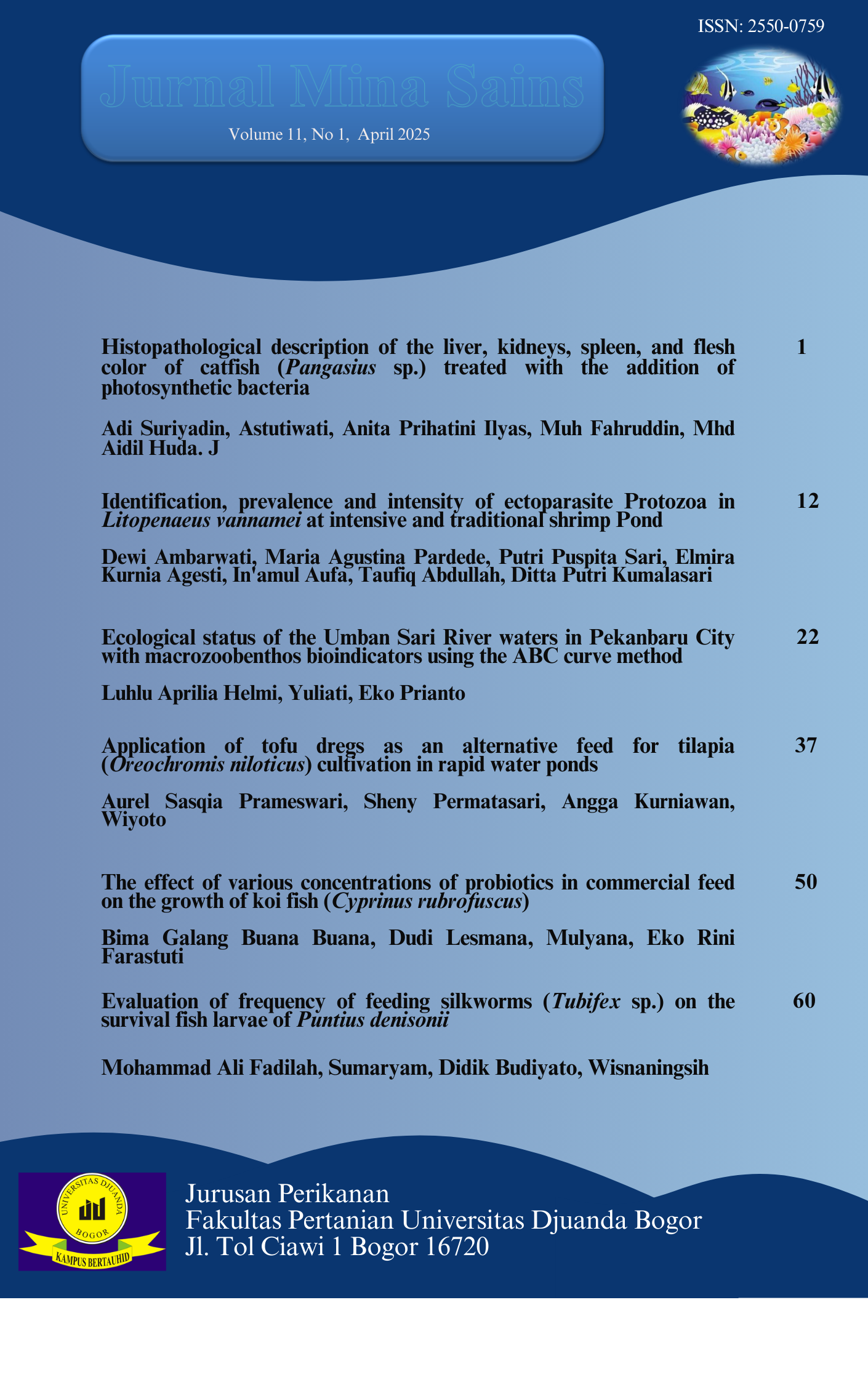
Histopathological description of the liver, kidneys, spleen, and flesh color of catfish (Pangasius sp.) treated with the addition of photosynthetic bacteria
DOI:
https://doi.org/10.30997/jmss.v11i1.11076Keywords:
Hydropic degeneration, hemorrhage, histopathology, Pangasius sp. , Rhodococcus sp.Abstract
Pangasius sp. is a freshwater fish that is a favorite for the community to consume. This study aims to analyze the histopathology of catfish-given bacteria (Rhodobacter sp. and Rhodococcus sp. in aquaculture ponds against the histopathology and occurrence of yellowing in the flesh of catfish (Pangasius sp.). A randomized block design (RAK) was used for the study, with three groups: A (0.2 mL / L), treatment B (0.5 mL / L), and C (control). The procedure for using photosynthetic bacteria is to mix each treatment dose with 1,000 mL of water and then spread it evenly in the cultivation pond. The study's results showed tissue damage to the liver, kidneys, and spleen organs, which was characterized by hemorrhage, inflammatory cell proliferation, fatty and hydropic degeneration, and Melano Macrophages Aggregate (MMA). Organ tissue damage indicates that environmental conditions or water quality are unsuitable. Unsuitable environmental conditions cause stress, dysfunction, and damage to organs. The use of photosynthetic bacteria has a better effect than without the use of photosynthetic bacteria.
References
Anderson, S., 2001. Salmon Color and the Consumer. Microbehavior and Macroresults: Proceedings of the Tenth Biennial Conference of the International Institute of Fisheries Economics and Trade. https://ir.library.oregonstate.edu/concern/conference_proceedings_or_journals/9s1616848
Andrika, E., 2013. Perubahan Histopatologi Limpa Ikan Nila (Oreochromis niloticus) yang Terinfeksi Bakteri Edwardsiella tarda. Universitas Airlangga. http://repository.unair.ac.id/id/eprint/26222.
Cheville, NF., 1999. Introduction to Veterinary Pathology. Edisi II. Lowa: Low State University Press. The Bovine Practitione, 34 (1). hal 214.
Ghufron, HMK., 2010. A to Z Budidaya Biota Akuatik Untuk Pangan Kosmetik dan Obat–obatan. Yogyakarta: Lily Publisher, hal 218.
Hadi, AA., dan Alwan, SF., 2012. Histopathological Changes in Gills, Liver and Kidney of Freshwater Fish, Tilapia Zillii, Exposed to Aluminium. Int. J. Of Pharm & Life Sci, 3(11), hal 2071-2081.
Kobayashi, M., 1995. Waste Remediation and Treatment Using Anoxygenic Phototrophic Bacteria. In Anoxygenic Photosynthetic Bacteria. (pp. 1269-1282). 10.1007/0-306-47954-0_62
Li, M., Robinson, M., dan Oberle, D., 2009. Yellow Pigments in Catfish Evaluated. The Catfish Journal, 23 (6), hal 11 and 14. https://www.researchgate.net/publication/326812435_Yellow_pigments_in_catfish_evaluated
Mansyur, A., dan Tangko, AM., 2008. Probiotik : Pemanfaatannya untuk Pakan Ikan Berkualitas Rendah. Media Akuakultur. 3 (2), hal 145-149. http://dx.doi.org/10.15578/ma.3.2.2008.145-149
Mc Gavin, MD., dan Zachary JF., 2007. Pathologic Basic of Veterinary Disease. Mosby Incorporation. The Canadian Veterinary Journal, 48 (7), hal 724. https://www.ncbi.nlm.nih.gov/pmc/articles/PMC1899845/
Munro, ALS., 1978. The Aquatic Environtment. In Fish Pathology. Roberts, R.J. (ed). Bailliere Tindall, London.
Priosoeriyanto, BP., Ersa, IM., Tiuria, R., dan Handayani, SU., 2010. Gambaran Histopatologis Insang, Usus dan Otot pada Ikan Mujair (Oreochromis mossambicus) di Daerah Cimpea. Hemera Zoa, 2 (1), hal 9. http://repository.ipb.ac.id/handle/123456789/59409
Puspasari, N., 2010. Efektivitas Ekstrak Rumput Laut Gracillaria verrucosa sebagai Imunostimulan untuk Pencegahan Infeksi Bakteri Aeromonas hydrophila pada Ikan Lele Dumbo Clarias sp. Fakultas Perikanan dan Ilmu Kelautan. Institut Pertanian Bogor. http://repository.ipb.ac.id/handle/123456789/59490
Rahmawati, Z., Yanuar, U., dan Arfiati, D., 2016. Analisis Histopatologi Otot Ikan Mas (Cyprinus carpio) yang Terinfeksi Koi Herpes Virus (KHV) pada Kolam Pemeliharaan Ikan Mas. Prosiding Seminar Nasional Kelautan Universitas Trunojoyo. Madura. hal 290-294.
Roberts, RT., 2001. Fish Pathology. Edisi III. W.B. Saunders. London Edinburg. Philadelphia, St. Louis, Sydney, Toronto. https://doi.org/10.1046/j.1365-2761.2002.00335.x
Safratilofa., 2017. Histopatologi Hati dan Ginjal Ikan patin (Pangasionodon hypopthalmus) yang diinjeksi Bakteri Aeromonas hydrophila. Jurnal Akuakultur Sungai dan Danau, 2 (2), hal 83-88. http://dx.doi.org/10.33087/akuakultur.v2i2.21
Smith, HA., dan Jones, TC., 1961. Veterinary Pathology. Lea and Febiger, Philadelpia.
Trisna, DE., Sasanti, AD., dan Muslim., 2013. Populasi Bakteri, Kualitas Air Media Pemeliharaan dan Histologi Benih Ikan Gabus (Channa striata) yang Diberi Pakan Berprobiotik. Jurnal Akuakultur Rawa Indonesia. 1 (1), hal 90-102. https://doi.org/10.36706/jari.v1i1.1782
Underwood, J.C.E., 1992. General and Systematic Pathology. New York: Churchill Livingstone. pp. 133-136.
Verschuere, L., Rombaut, G., Sorgeloos, P., dan Verstraete, W., 2000. Probiotic Bacteria as Biological Control Agents in Aquaculture. Microbiologi and Molecular Biology Reviews. 64 (4), hal 655-671. https://doi.org/10.1128/MMBR.64.4.655-671.2000
Watson, AK., Kaspar, H., Lategan, MJ., dan Gibson, L., 2008. Probiotics in Aquaculture : The Need, Principles and Mechanisms of Action and Screening Processes. Aquaculture 274 (1), hal 1–14. https://doi.org/10.1016/j.aquaculture.2007.11.019
Widiyanto, T., 2001. Pendekatan Biokondisioner dengan Bakteri Fotosintetik Anoksigenik (BFA) untuk Pengendalian Senyawa Metabolik Toksik di Tambak Udang. Program Pascasarjana. Institur Pertanian Bogor.
Yuniarti, T., Eliyani, Y., dan Yudistirta, AN., 2014. Karakteristik Organoleptik Filet Ikan Patin (Pangasionodon hypophthalmus) dari Tiga Lokasi Budidaya Di Kabupaten Bogor. Jurnal Penyuluhan Perikanan dan Kelautan (JPPIK). 8 (1). https://doi.org/10.33378/jppik.v8i1.46.
Downloads
Published
How to Cite
Issue
Section
License
Copyright (c) 2025 JURNAL MINA SAINS

This work is licensed under a Creative Commons Attribution-ShareAlike 4.0 International License.
With the receipt of the article by the Jurnal Mina Sains Universitas Djuanda Editorial Board and the decision to be published, then the copyright regarding the article will be diverted to Jurnal Mina Sains Universitas Djuanda.
Department of Fisheries Djuanda University holds the copyright regarding all the published articles in this journal.
Department of Fisheries Faculty of Agriculture, Universitas Djuanda has the right to multiply and distribute the article. Thanks to the Fisheries Department and Agriculture Faculty Universitas Djuanda that funded this journal sustainability.
The manuscript's authentic and copyright statement submission can be downloaded on this form.