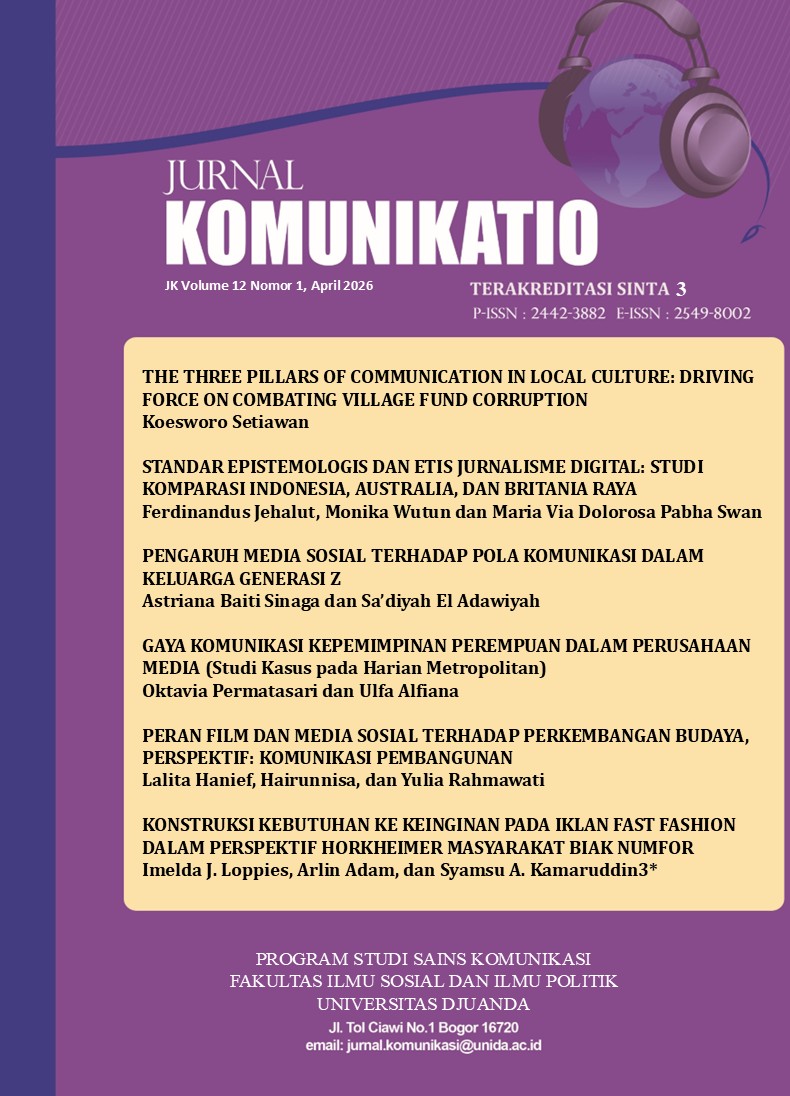
Pengaruh Media Sosial Terhadap Pola Komunikasi dalam Keluarga Generasi Z
DOI:
https://doi.org/10.30997/jk.v12i1.23616Keywords:
Communication patterns, Family, Generation Z, Social mediaAbstract
Digital communication is now embedded in everyday family life, especially for Generation Z adolescents who rely heavily on smartphones and social media. This shift raises a central concern: when messaging becomes the default, does the quality of family communication change? This study examines the influence of social media use on family communication patterns among mid-adolescent Gen Z. A quantitative survey was administered to 237 senior high school students in Jakarta (ages 15–18). The data were analyzed descriptively to map device ownership, platform preferences, and the ways social media is used in daily interaction with parents and siblings. Results show near-universal smartphone ownership and frequent social media use in everyday routines, including learning and communication at home. WhatsApp emerged as the dominant platform for family interaction, and many respondents reported choosing chat-based communication even while they were physically at home. Social media produced a double-edged effect. On the positive side, it supports fast, low-cost, distance-independent communication, helps coordinate family activities, and enables quick sharing of updates. On the negative side, heavier use was associated with reduced openness, weaker togetherness, and fewer meaningful face-to-face conversations, alongside concerns about the fading of traditional family values. Overall, the findings suggest that social media can strengthen connectivity, but direct interaction remains essential for sustaining warm and healthy family communication.
References
Abdul Rashid Mohamed, & Mohamad Daud Hamzah. (2005). Kajian Korelasi Emosi Malu Dengan Pencapaian Akademik Di Kalangan Mahasiswa Melayu. Jurnal Pendidik Dan Pendidikan.
Adiningrum SZ, Tutiasri RP, Saifudin W. 2024. Pola Komunikasi Pada Orang Tua Gen X yang Bekerja dengan Remaja Gen Z yang Melakukan Kenakalan Remaja. JIIP (Jurnal Ilm. Ilmu Pendidikan) (eISSN. 7(1):222–229.
Ahmad, K. R., Sibuan Amir, L., & Hapipi, M. (2024). Pengaruh Media Sosial terhadap Pola Komunikasi dan Hubungan Sosial dalam Kalangan Generasi Z. Sanskara Ilmu Sosial Dan Humaniora, 1(02), 85–94. https://doi.org/10.58812/sish.v1.i02
Aritonang, A. M., Pasaribu, E. S., Purba, H., Siburian, P. R., & Yunita, S. (2024). Pengaruh Media Sosial terhadap Pola Interaksi Kelompok Masyarakat. Indo-MathEdu Intellectuals Journal, 5(3), 2869–2875. https://doi.org/10.54373/imeij.v5i3.1189
Claudia, S. I., Sa’diyah, ) ;, & Adawiyah, E. (2024). Strategi Komunikasi Direktorat Pendidikan Profesi Guru Dalam Mengembangkan Minat Generasi Z Menjadi Guru. In Jurnal Professional (Vol. 11, Number 1).
DeVito, J. A. (1997). Komunikasi Antar Manusia. Professional Books.
El Qudsi, M. I., & Syamtar, I. A. (2020). Instagram Dan Komunikasi Politik Generasi Z Dalam Pemilihan Presiden 2019 (Studi Pada Mahasiswa Universitas Pertamina). Perspektif Komunikasi: Jurnal Ilmu Komunikasi Politik Dan Komunikasi Bisnis, 4(2), 167. https://doi.org/10.24853/pk.4.2.167-185
Firamadhina, F. I. R., & Krisnani, H. (2021). PERILAKU GENERASI Z TERHADAP PENGGUNAAN MEDIA SOSIAL TIKTOK: TikTok Sebagai Media Edukasi dan Aktivisme. Share: Social Work Journal, 10(2), 199. https://doi.org/10.24198/share.v10i2.31443
Hargie, O. (n.d.). Skilled interpersonal communication: Research, theory and practice, Fifth edition.
Hayat, M. A., Jayadiningrat, S., Wibisono, G., & Iyansyah, M. I. (2021). Peran Media Sosial Dalam Komunikasi Politik. Jurnal Indonesia Sosial Teknologi, 2(1), 104–114.
Indriyani, M. (2020). Efektivitas Penggunaan Media Online Tirto.Id terhadap Pemenuhan Kebutuhan Informasi Berita Livi Zheng. Jurnal Studi Jurnalistik, 2(2), 157–167. https://doi.org/10.15408/jsj.v2i2.15065
Keifer. (2014). penggunaan Media sosial. In Angewandte Chemie International Edition (Vol. 6, Number 11, pp. 951–952).
Luthfiyyah, N., Saripa, M., & Azis, F. (2025). PENGARUH MEDIA SOSIAL TERHADAP POLA KOMUNIKASI DALAM KELUARGA MILENIAL. In Jurnal Studi Multidisipliner (Vol. 9, Number 5).
Muhammadiyah Mataram, U., Sastika Wiramaya, D., Ni, N., Rohmah, matul, Saudi, Y., Penyiaran Islam, K., Agama Islam, F., & Kunci, K. (n.d.). Seminar Nasional Paedagoria Pengaruh Media Sosial terhadap Akidah Generasi Z Muslim di Perkotaan.
Nadeak, T. B., & Rustandi, D. (2024). Pola Komunikasi Keluarga Dalam Membentuk Kesehatan Mental Gen Z Di Era Digital (Vol. 11, Number 6).
Permatasari, A. A. (2022). Cyberbullying sebagai Kekerasan Berbasis Gender Online: Dampak terhadap Remaja serta Peran Keluarga. Jurnal Wanita Dan Keluarga, 3(1), 1–15. https://doi.org/10.22146/jwk.5201
Rahmat, A. (2017). Interaksi Sosial dalam Dunia Maya ( Fenomenologi Cyber Tumming dan Abu Youtubers Makassar). Jurnal Ilmu Komunikasi, 18.
Rahmawati, R., Indi Rahayu, P., Syihabuddin Taufiq, M., Matematika dan Ilmu Pengetahuan Alam, F., & Sulawesi Barat, U. (n.d.). MASSIVE: Jurnal Ilmu Komunikasi Analisis dampak penggunaan media sosial terhadap kesehatan mental gen-z (studi kasus pada mahasiswa universitas sulawesi barat). Retrieved https://massive.respati.ac.id
Romadlon, F. (2020). Mendefinisikan Ulang Pola Pembelajaran Daring: Antara Sharing Knowledge dan Transfer Etika. In COVID-19 Dalam Ragam Tinjauan Perspektif.
Solomon, D., & Theiss, J. (n.d.). Interpersonal Communication Putting Theory into Practice.
Sulfikar, A. A. D. (2012). (Analisis Framing Blog Kompasiana Wisnu Nugroho tentang Komunikasi Politik Presiden SBY).
Suryani, I., Amana Fatiha, P., Husna Salsa, N., Rizqiah, N., Rahmadani, S., Sari, V., Hakiki, M., & Tinggi Ilmu Tarbiyah Batu Bara Sumatera Utara, S. (2025). Dampak Teknologi Komunikasi Terhadap Komunikasi Keluarga. 5. https://doi.org/10.37680/almikraj.v5i2.6852
Susanto, E. H. (2016). Media Sosial Sebagai Pendukung Jaringan. Aspikom, (1), 379–398.
Yoanita, D. (2022). Pola komunikasi keluarga di mata generasi z. Jurnal SCRIPTURA, 12(1), 33–42. https://doi.org/10.9744/scriptura.12.1.33-42
Downloads
Published
How to Cite
Issue
Section
License
Copyright (c) 2026 JURNAL KOMUNIKATIO

This work is licensed under a Creative Commons Attribution-ShareAlike 4.0 International License.
Authors who publish with Jurnal Komunikatio agree to the following terms:
- Authors retain copyright and grant the journal right of first publication with the work simultaneously licensed under a Creative Commons Attribution 4.0 International License that allows others to share the work with an acknowledgement of the work's authorship and initial publication in Jurnal Komunikatio.
- Authors are able to enter into separate, additional contractual arrangements for the non-exclusive distribution of the journal's published version of the work (e.g., post it to an institutional repository or publish it in a book), with an acknowledgement of its initial publication in Jurnal Komunikatio.
- Authors are permitted and encouraged to post their work online (e.g., in institutional repositories or on their website) prior to and during the submission process, as it can lead to productive exchanges, as well as earlier and greater citation of published work